

You almost snapped that he did not own that phrase today. But you were too tired already.
“It was a coincidence,” you said. “A monstrous, disgusting coincidence. He recognized your father in a photo this morning.”
Michael swore under his breath.
“What exactly did you think would happen?” you asked. “That you could live two full lives forever and the universe would never get bored enough to make them collide?”
“Mom, I didn’t know. I swear I didn’t know.”
“Congratulations,” you said coldly. “For once, neither did I.”
The shame between you was now so large it had ceased to be personal. It had become architectural, a structure the two of you were standing inside without doors.
He said, “Does Laura know?”
“No. But tell me why on earth I should be the one carrying that secret for you.”
“Because if you tell her like this, it’ll destroy everything.”
You almost admired the audacity. Even now, with every wall splitting open, his first instinct was management. Containment. Optics.
“It already destroyed everything,” you said.
“Mom, please. Let me handle it.”
“You’ve had a year to handle it.”
“I was trying.”
“No. You were delaying. There’s a difference.”
On the other end of the line, he sounded younger than he had in years. Not innocent, but frightened in that deeply childlike way people revert when consequences finally outrun their self-justifications.
“I do love Laura,” he said.
You looked out the bedroom window at your overgrown side yard, at the lilac bush Martin once planted because he knew you loved the smell. The absurdity of the sentence felt almost elegant in its stupidity.
“Apparently,” you said, “you also love making a wreckage of everyone else.”
He breathed hard into the phone. “Can I come over?”
Everything in you wanted to say no. To hang up. To let him sit in his own panic for a few more hours. But another part of you, the older part, the one that knew families survive or fail not on the basis of virtue but on the basis of who is still willing to sit in the room with the truth, said yes.
“Two o’clock,” you said. “And come alone.”
He arrived at 2:07.
He looked terrible. Pale, sleepless, unshaven. His polo shirt was wrinkled as if he had put it on and taken it off and put it on again several times before leaving the house. For one disorienting second, he was just your son again. The boy who once came home from seventh grade after getting suspended for punching a kid who mocked his stutter, trying and failing not to cry while he insisted he was fine.
Then the present reassembled itself.
You let him in.
Neither of you hugged.
He stood in the living room staring around as though the house had changed overnight. Maybe it had. Maybe truth alters architecture. Maybe once betrayal enters a room, the furniture never sits the same again.
He looked at the family photographs on the mantel. You saw him notice that one frame was out of place. The one Daniel had picked up that morning.
“Sit,” you said.
He sat on the couch. You took the armchair opposite him. The same chair where you had spent years pretending your quiet life was enough.
For a long moment, neither of you spoke.
Then he said, “I’m sorry.”
The words floated there, small and insufficient.
“Are you?” you asked.
“Yes.”
“For which part?”
He swallowed hard. “All of it.”
“That’s not an answer.”
He nodded once, like a man bracing for impact. “I’m sorry I lied. I’m sorry I cheated. I’m sorry I let it go this far. I’m sorry you had to find out like this. And I’m…” His voice broke. “I’m sorry for what happened with Daniel.”
You looked at him steadily. “Don’t say his name like we’re all in the same social circle.”
Michael shut his eyes briefly.
Then, in pieces, he told you the story.
It had started at work. That part was as old as human weakness. Long hours, pressure, travel, the intimacy of repeated conversations in hotel bars and empty conference rooms. Daniel had been brought in as a design consultant on a restoration project for a historic downtown building Michael’s company was funding. He was older than some of the others, sharper, more self-contained. They worked late. They began talking. One night became several. Several became a secret arrangement balanced on excuses and hunger and whatever ache in your son had been waiting for years for a name.
“I didn’t plan it,” Michael said.
“No one plans rot,” you answered. “They just keep ignoring damp spots.”
He almost smiled at that. Almost. But shame pressed it flat.
He had known he was attracted to men, he said, since college. Had convinced himself it was a phase. Then a compartment. Then something he could manage privately while still living the life everyone expected. Marriage, children, holidays, practical love. Laura had not been fake, exactly. He loved her. But some part of him had always been walled off, and Daniel had made the wall feel suddenly impossible to keep maintaining.
“He wanted me to leave,” Michael said quietly. “Not right away. But eventually. He said he wasn’t going to be someone I visited between parent-teacher conferences and soccer games. He was right.”
You looked at him and felt your heart do something terrible and human. It broke in more than one direction at once. For Laura, for the children, for yourself, for the son in front of you who had grown into a man capable of both profound confusion and profound harm.
“And what were you planning?” you asked. “Really.”
He stared at his hands. “I don’t know.”
That was probably the truest thing he had said all day.
“I thought if I waited long enough, something would make the decision for me.”
You laughed once, bitter and stunned. “Well. It did.”
His face crumpled then. Not theatrically. Not manipulatively. Just the plain ugly collapse of a man who had finally run out of lies sturdy enough to stand on.
“I never wanted to hurt you.”
“Stop saying that as if intent is magic,” you said. “Everyone who detonates a family says they never wanted anyone to get hit by the debris.”
He covered his face with both hands.
For several minutes, the only sound in the room was his breathing and the ticking of the old wall clock in the hallway. Martin’s clock. The one that ran a minute fast because he claimed it kept the house alert.
At last you asked the question you had been circling since morning.
“Does Laura know anything?”
“No.”
“Nothing?”
“She knows I’ve been distant. We’ve been fighting more. She asked if there was someone else once, a few months ago. I said no.”
Of course he had.
You looked toward the kitchen. The kettle sat on the stove where you had left it, untouched. How many mornings had Laura lived beside this man and felt some shape in the air without having proof? How many times had she looked at his back and mistaken secrecy for stress?
“What are you going to do?” you asked.
Michael lowered his hands.
This time, when he answered, the voice that came out did not belong to a panicked child. It belonged to a grown man standing at the edge of the crater he had made.
“I’m going to tell her.”
You held his gaze. “Today.”
“Yes.”
“Everything?”
He hesitated.
Your expression must have changed because he immediately added, “Yes. Everything.”
Including the part about Daniel? Including the part about you?
His face went blank with horror.
“No,” he said. “Mom, please.”
There it was. The final impossible thing. The fact that your own accidental collision with his double life had become one more secret inside the secret, radioactive and unshareable.
You wanted to say that Laura deserved the full truth. That secrets breed mold and half-truths are just lies with better marketing. But when you pictured that conversation, when you pictured your daughter-in-law learning not only that her husband had carried on a year-long affair but that his affair partner had, through the black-comedy sadism of fate, spent a birthday night in your bed before anyone recognized the connection, your stomach folded in on itself.
Some truths illuminate. Others simply burn.
“She does not need that detail today,” you said finally.
Michael stared at you, stunned.
“Do not mistake this for protection of you,” you added. “It is mercy for her. There’s enough poison in the first truth.”
His eyes filled again. “Why are you being kinder to me than I deserve?”
You sat back in your chair and looked at him for a long time. At the lines around his mouth. At the man he had become. At the boy he had once been. At the ruin of both.
“Because,” you said quietly, “I am still your mother. Unfortunately for both of us.”
He let out a broken sound that was half laugh, half sob.
You stood. “Call her. Tell her you’re coming home early. Tell her the truth. Tell her all of it except the part that belongs to my humiliation more than her healing.”
He rose too, shaky and pale.
At the front door he turned. “Will you ever forgive me?”
The question hung there, far too soon and yet inevitable.
“I don’t know,” you said.
It was the only honest answer.
After he left, you sat at the kitchen table until dusk.
You did not cry at first. Shock is dry. It preserves you through the first hours the way ice preserves a body after impact. But around six-thirty, when the sunlight thinned and the house became shadowed and ordinary again, grief came for you in full.
Not one grief. Many.
Grief for Martin, because some wounded part of you still wanted him to be here to tell you what to do, even though this mess belonged to a generation beyond him. Grief for Laura and the children. Grief for your own birthday, cracked open into something grotesque. Grief for your son’s hidden life and the damage it had done. Grief for the impossible absurdity that you, after eighteen years of widowhood and caution, had chosen one impulsive night to feel alive only to wake inside a story too twisted to confess without sounding insane.
You cried until your head hurt.
Then you washed your face, made toast, and sat in the quiet house because survival is often humiliatingly practical.
At eight-fifteen, your phone rang.
It was Laura.
The sound of her voice almost undid you before she said a word.
“Eleanor,” she said. Not Mom. Not tonight. Her voice was stripped down to something raw and formal. “Did you know?”
You closed your eyes.
“Not until this morning.”
On the other end came a small, ruined silence. You could hear, somewhere behind her, a door closing. The muffled chaos of children in another room. A television left on because ordinary domestic noise is sometimes the only thing keeping a person from screaming.
“He told me,” she said. “About the affair.”
You said nothing.
“He said it was with a man.”
Still you said nothing.
And then, very quietly, “He said you found out accidentally.”
There it was. Close enough to the truth to slice. Mercifully, he had kept the worst of it.
“Yes,” you said.
She inhaled shakily. “I keep trying to understand whether this is one betrayal or several.”
“All I can tell you,” you said, “is that none of it is your fault.”
Laura laughed then, bitter and exhausted. “Women always say that to each other in disasters, don’t we?”
“Because sometimes we need the reminder.”
She was quiet for a long time.
“I asked him if he loved me,” she said at last. “He said yes. I asked him if he loved him. He said he didn’t know.”
The sentence hung there, unbearably human in its ugliness.
“What am I supposed to do with that?” she whispered.
You looked at the darkening kitchen window and saw your own reflection, older and tired and somehow more awake than you had been in years.
“You do not have to decide tonight,” you said. “You only have to get through tonight.”
A small sob escaped her then, quickly smothered.
“I’m sorry,” you said. “I am so, so sorry.”
“I know,” she whispered.
She came over the next morning with the children.
Not because things were normal. Not because she had forgiven anyone. But because she needed somewhere to sit that was not the house where every wall suddenly felt like a witness. She arrived with puffy eyes, unwashed hair, and the grim, practical energy of a woman who has been up all night arranging emergency childcare, emotional containment, and the remains of her own dignity.
You opened the door and pulled her into your arms.
She held on longer than she ever had before.
The children, thankfully, were too young to understand much. They sensed tension the way children always do, but not its shape. They played on the rug with toy trucks while Laura sat at your kitchen table drinking coffee that went cold untouched.
“I feel stupid,” she said eventually.
“You are not stupid.”
“I asked him so many times if something was wrong.”
“That does not make you stupid. That makes you married.”
She laughed once, miserably.
By noon, your daughter called, having finally noticed through the family group text that something was badly wrong. Then your son-in-law. Then, inevitably, Michael again, twice, but you did not answer. The day became a parade of practical sorrows. Lawyers’ names scribbled on notepads. Questions about finances. School pickup schedules. Whether the children should sleep at your place one night this week if things at home became too tense.
In the middle of all that, your own private humiliation sat silent and glowing like a coal you could not touch.
Daniel texted you once around three o’clock.
I’m sorry. Again.
You stared at it for a long time.
Then, because perhaps you were tired of silence doing all the work in your life, you replied:
Don’t contact me anymore.
He did not answer.
Days passed.
Then weeks.
Life, rude and relentless, resumed its motion. Laura moved with the children into a short-term rental for a while. Michael began therapy, which struck you as both necessary and offensively late. Your daughter visited more often, suddenly overcorrecting for years of distracted absence in a way you found both touching and faintly ridiculous. People brought casseroles because casseroles are what Americans do when words aren’t big enough and appetite is too broken for ceremony.
Through it all, you carried two parallel truths.
One: your family had cracked open.
Two: something in you had, too.
Not only the shame. Also the awakening.
That was the part you hated admitting, even to yourself. Because buried under the wreckage of coincidence and betrayal was one clean fact: before morning had poisoned it, the night had been real. The feeling of being alive again had been real. The warmth, the laughter, the startling return of your own body to you had not been illusions simply because their aftermath was monstrous.
This complicated your grief in ways you could not confess to anyone.
So you confessed it to your journal instead.
At sixty-five, you wrote in a spiral notebook at your kitchen table, I discovered that loneliness can drive a woman toward danger, yes. But it can also drive her toward life. The danger is not only in wanting too much. It is in wanting nothing at all.
You filled pages.
About Martin. About the long widow years. About becoming peripheral in your children’s lives. About the humiliating invisibility of aging. About the way one reckless night had shattered your family and, somehow, also shattered your numbness. Writing became less like documentation and more like excavation. You were not trying to explain away what happened. You were trying to find yourself underneath it.
A month later, Laura handed Michael separation papers.
It was not dramatic. No screaming in driveways. No thrown dishes. Just signatures, exhausted tears, and the slow administrative sound of a marriage being converted into legal language. Michael cried when he told you. You listened. You did not comfort him more than he had earned.
When he came by one Sunday to help fix your porch step, the two of you worked in near silence for an hour before he said, “I don’t think I knew how miserable I’d become.”
You kept hammering.
“That doesn’t excuse anything,” he added quickly.
“No,” you said. “It doesn’t.”
He nodded. “But it’s true.”
You looked at him then. At this strange familiar man. Your son. The child you made from love. The adult who had injured so many people with fear and indecision. The person who was now, perhaps for the first time in his life, stripped of the ability to hide from himself.
“It may be true,” you said, “but you do not get to use your misery as a halo. People can suffer and still be cruel.”
He absorbed that in silence.
Then he said, “I know.”
Months later, on an afternoon bright with early spring, you received a letter in the mail.
Not a bill. Not junk. A real letter, handwritten on thick cream paper.
It was from Daniel.
You nearly threw it away unopened. Instead, curiosity, that old reckless cousin of disaster, made you sit down and read.
He wrote that he had moved to Chicago for a project. That he was sorry for the pain his relationship with Michael had caused, though he knew apology was useless against certain kinds of aftermath. He wrote that he had kept thinking about your birthday night, not sentimentally, not as some tragic romance, but as the strangest intersection of honesty and ruin he had ever experienced. He wrote that meeting you had forced him to reconsider the hidden architecture of other people’s lives, including his own.
Then, near the end, he wrote:
Before everything turned, you seemed more alive in that bar than anyone else in the room. I hope you didn’t lose that again because of what came next.
You folded the letter slowly and placed it in the drawer beside your cookbooks.
You did not respond.
But you did think about that sentence for days.
Because beneath all the shame and grief, it pointed toward something you had been circling without naming. The story was no longer only about scandal. About betrayal. About a night gone catastrophically wrong. It was also about the fact that you had gone out into the city on your sixty-fifth birthday expecting maybe a drink and a little rebellion, and instead discovered an inconvenient truth: your life was not over.
Damaged, yes. Complicated beyond belief, certainly. But not over.
That realization began changing you in quiet ways.
You cut your hair shorter.
Not because of heartbreak, though movies love that symbolism. Because one morning you looked in the mirror and realized the long careful style you had worn for years belonged to a version of yourself organized around shrinking. The new cut made your cheekbones look sharper. Your daughter said it made you look “French and a little dangerous,” which pleased you more than it should have.
You joined a writing group at the library.
At first, you told yourself it was only for structure, just a reason to get out of the house on Tuesdays. But soon you found yourself reading aloud essays about widowhood, aging, suburban loneliness, motherhood, and the absurd black comedy of late-life reinvention. People listened. Not politely. Hungrily. As if your honesty had given them permission to stop performing, too.
One evening after the group, a retired nurse named Gloria took you out for pie and said, “You’ve got a voice. Not just a style. A voice.”
No one had said that to you in years either.
Around the same time, your daughter began visiting every Sunday with her kids. Not always for long. But enough. Michael, after several painful months, came too sometimes, usually quieter than before, carrying guilt the way some men carry old back injuries. Laura did not come, though she and you spoke on the phone occasionally. Her anger had settled into something firmer and cleaner. Self-respect, perhaps. The children adapted the way children do, heartbreakingly and well.
As for you, you kept writing.
What started as private notes became essays. Essays became a manuscript. Not a tell-all. Not the sort of lurid confession publishers market with women’s shoes and wine glasses on the cover. Something truer. A book about loneliness, family secrets, aging female desire, and what it means to become visible to yourself after decades of being useful to everyone else.
You called it After Silence.
When the small university press in your state agreed to publish it, you sat at your kitchen table and laughed until you cried.
At the launch event, nearly two years after your sixty-fifth birthday, the room was full.
Not packed, not glamorous, but full enough to make your chest ache. Library people. Local readers. Women from the writing group. Your daughter in the second row. Laura, unexpectedly, near the back. Even Michael, sitting stiffly beside a bookshelf, looking both proud and as if he would happily crawl inside a wall if given the chance.
You stood at the podium with your reading glasses low on your nose and looked out at all of them.
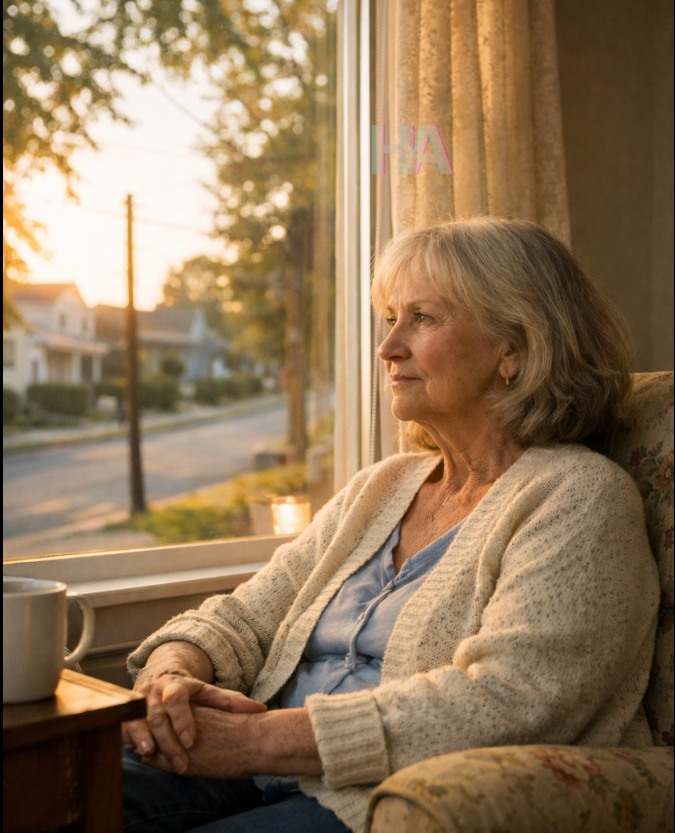
For a fleeting second, you thought about the version of yourself who sat alone by the window every afternoon believing the story was over. If someone had told her where one reckless bus ride would lead, she would have called them insane.
Then you began to read.
Not the scandalous parts. Not the parts that belonged to other people’s wreckage. You read a passage about turning sixty-five and realizing that invisibility can become addictive because it protects you from disappointment. You read about grief hardening into habit. About the risk of wanting again.
When you finished, the applause came warm and sustained. Not because your life had been dramatic. Because your truth had become useful. That is one of the few noble alchemies still available to us.
Afterward, while people stood in line for signed copies, a woman in her seventies with silver braids leaned close and whispered, “Thank you for writing that older women still have bodies. People act like ours are museum exhibits.”
You laughed so hard you nearly smeared your signature.
Later that evening, after the last chair had been folded and the last copy signed, you stepped outside the bookstore into the soft blue dusk. Spring air moved gently through the trees. Cars slid by with their headlights on. The city looked almost tender.
Michael came out a minute later.
He stood beside you, hands in his coat pockets, and looked up at the sky before speaking.
“You turned it into something beautiful,” he said.
You did not answer right away.
“It wasn’t beautiful at the time,” you said.
“No,” he admitted. “But you still did.”
You looked at him. At the man he was still becoming. At the scars he had made and the ones he carried. Forgiveness, you had learned, was not a lightning strike. It was weather. It moved in patterns, retreated, returned, changed shape.
“I’m still angry,” you said.
“I know.”
“I may always be angry.”
He nodded. “I know that too.”
A long silence settled between you, but it was no longer the dead kind. It had room in it. Air.
Then he said, “I’m glad you weren’t alone that night.”
You turned toward him sharply.
He stared ahead, not meeting your eyes. “Not because of who it was. God, obviously not that. But because… before all this, I hadn’t really seen how small your life had gotten. That’s on me. On all of us.”
The honesty of that hit you harder than apology.
You looked down at your hands. Older hands. Stronger than they looked.
“I hadn’t seen it either,” you admitted.
He gave a tiny, sad smile. “You see it now.”
“Yes,” you said. “I do.”
On the way home, you drove with the windows cracked and the radio low. Your book sat on the passenger seat. At a stoplight, you caught sight of yourself in the rearview mirror. The shorter hair. The lines around your eyes. The face of a woman who had been lonely, reckless, humiliated, furious, awakened, and changed. Not polished by suffering. Sharpened by it.
Back at the house, you stood for a long moment in the front hallway before turning on the lamp.
It cast that familiar amber pool across the rug. The same rug. The same walls. The same house where one impossible morning had almost convinced you that your life had become a dark joke told by fate at your expense.
But houses can survive terrible nights.
So can women.
You moved to the front window and looked out at the quiet street. The birds were gone now, replaced by the hush of evening. Somewhere nearby, a television flickered behind curtains. Someone laughed in the distance. The world, still imperfect and rude and unexpectedly generous, kept moving.
At sixty-five, you had gone looking for one small rebellion before it was too late.
Instead, you found the buried ruins of your family, the secret shape of your son’s unhappiness, the limits of your own numbness, and a brutal reminder that desire and disaster sometimes arrive wearing the same coat.
But you also found yourself.
Not the younger self. Not the woman before grief. Not the dutiful mother or the widow frozen inside loyalty to the dead. Someone newer. Stranger. Truer. A woman old enough to know that survival is not the same as living, and brave enough, finally, to choose the second one even after the first has nearly flattened her.
That night, before bed, you opened your journal and wrote one last sentence beneath everything else:
The truth took my breath away that morning, yes. But it also gave it back.
THE END
See more on the next page
Advertisement