
So sad when jealousy tears families apart.
Some people can’t stand to see their siblings happy.
Praying for Whitney and Drew.
My hands went cold. Not the charmeuse cold. A different cold, the kind that starts at the fingertips and crawls inward like frost on a windshield. I could feel my pulse in my teeth. My vision narrowed to the size of the phone screen.
And inside that screen, I was the villain. The jealous sister. The failed designer shaking down her own family for money.
Diane had been right about one thing.
She did make sure everyone knew what kind of daughter I was.
She just got to write the description first.
I sat in the studio for a long time after that. The fluorescent light finally gave up and went dark, and I didn’t replace it. I sat in the glow of my phone screen reading comments from people who didn’t know me, who had never seen the inside of my studio or the thread count on that lace or the way silk charmeuse moves when the bias cut is right.
And I thought maybe she wins.
Maybe the story is already written and I’m just the footnote, the jealous hands, the ungrateful body part.
Lorraine found me like that the next morning.
She replaced the fluorescent tube, she kept spares in the shop because she said fluorescent lights were like men, unreliable but occasionally necessary. And when the new one hummed to life and the room turned white again, she looked at my face and then at my phone, still open to Diane’s post.
She read it. All of it. The post, the comments, the emoji reactions from strangers who had decided I was the villain based on three paragraphs written by a woman who had never once visited my studio.
Then she set the phone down screen-first on the cutting table.
“You know what I’ve learned in forty years of selling fabric?” she said.
I shook my head.
“People will believe whatever story gets told first. But the truth doesn’t need to be first. It just needs to be louder.”
She tapped the edge of my laptop.
“An invoice with your name, your logo, and your work itemized line by line? That’s pretty loud, baby.”
I looked at the mannequin. Bare, headless, tilted slightly to the left, the way it always tilted, the way I always adjusted for. And I thought about the signature, silver thread T.R. inside the corset along the left boning channel, pressed against my sister’s ribs for her entire wedding day.
The dress knew who made it, even if nobody else did.
In the stories they told about me, I was the villain, the jealous sister, the failed designer trying to profit off family.
But I had something they didn’t count on.
I had the dress.
And the dress had my name inside it.
The voicemails started on Tuesday.
Diane left fourteen in one hour.
I didn’t listen to them in real time. I played them back later, sitting cross-legged on the studio floor with a cup of Lorraine’s too-sweet coffee, and it was like listening to a woman audition for five different roles in the same play.
Voicemail one: tears.
“Tessa, please. I’m your mother. Don’t do this.”
Voicemail four: legal threats.
“I’ve spoken to a lawyer. You can’t bill family for a gift. This is harassment.”
Voicemail seven: bargaining.
“What if Whitney pays you something? A smaller amount? Can we work this out privately?”
Voicemail eleven: back to threats.
“You have no idea what I’m capable of. I will make sure you never work in this town again.”
Voicemail fourteen: just a long exhale. Ten seconds of breath, then a click.
It was like emotional roulette. I half expected voicemail fifteen to be in a completely different language. Or maybe just static. Maybe by voicemail twenty she’d circle all the way back to tears and we’d start the whole carousel over again.
I set the phone down and looked at the ceiling. A water stain near the corner had been spreading slowly for months. It looked like a map of a country that didn’t exist yet.
I thought about how many things in my life looked like that. Shapes without names. Outlines of places I hadn’t been allowed to visit.
Then my phone rang.
Not Diane’s number. Not Whitney’s. A 912 area code. Savannah, but not one I recognized.
“Miss Ror?” a woman’s voice. Clear. Unhurried. The kind of voice that had never needed to raise itself because it had always been listened to.
“This is Tessa.”
“My name is Ruth Hargrove. I believe you made my daughter-in-law’s wedding dress.”
My hand tightened around the phone. Not fear. Something closer to the feeling you get when a teacher calls your name and you don’t know if you’re in trouble or about to be praised.
“I did,” I said.
“Funny,” Ruth said. “Because the receipt my family paid for says a woman named Elise Laurent made it out of a studio on Spring Street in SoHo.”
A pause.
Not an empty one. A loaded one. The kind of pause that has already drawn its conclusions and is waiting for you to catch up.
“Elise Laurent doesn’t seem to exist, Miss Ror.”
I sat down on the stool.
“No,” I said. “She doesn’t.”
“I thought not. My son happened to mention at brunch last weekend that you’d sent Whitney an invoice. Whitney told him it was a joke, a misunderstanding between sisters. Drew believed her because Drew believes most things Whitney says, which is a separate conversation I intend to have with my son in due time.”
It sounded like a price, and prices interest me.
Ruth Hargrove, I would later learn, had been the chief financial officer of her husband’s logistics company for twenty-two years before retiring. She did not use words like misunderstanding without auditing them first.
“So I did what I do when a number doesn’t add up,” she continued. “I looked at the dress.”
My breath caught. Not dramatically. Just a small hitch, like a needle snagging on a thread.
“I had Whitney’s dress brought to my house. Told her I wanted to photograph the details for a family album. She was delighted. She loves being photographed.”
A note of dryness there. Just a trace.
“I took the dress to my tailor, a woman I’ve used for thirty years, and I asked her to examine the construction, the lining, the beading, the seams. And she found something interesting.”
I closed my eyes.
“Inside the corset,” Ruth said, “along the left boning channel, a monogram in silver thread. T.R.”
Check off, you beautiful old playwright.
“My tailor said it’s a designer’s signature. A mark of authorship. She said only a trained couturier would know to place it there.”
Ruth paused.
“She also said whoever made that dress was extremely talented. She used the word extraordinary. And Patricia does not use that word for anything, including her grandchildren.”
I opened my eyes. The mannequin was still bare. The fluorescent was still humming. But the room felt different. The way a room feels different when someone opens a window you didn’t know was there.
“I searched your name,” Ruth said. “Tessa Ror Atelier. You have a website. It’s modest, but your portfolio is not. You’ve been featured in Savannah Magazine. You won an emerging designer award from the Bridal Association of the Southeast two years ago.”
Another pause.
“You are not a poor designer, Miss Ror. You are an excellent one.”
I couldn’t speak for a moment. Not because I was emotional, or not only because I was emotional, but because no one in my family had ever said the word excellent in the same sentence as my name. Diane had said talented once at a Thanksgiving, and it had sounded like a diagnosis.
“Mrs. Hargrove—”
“Ruth.”
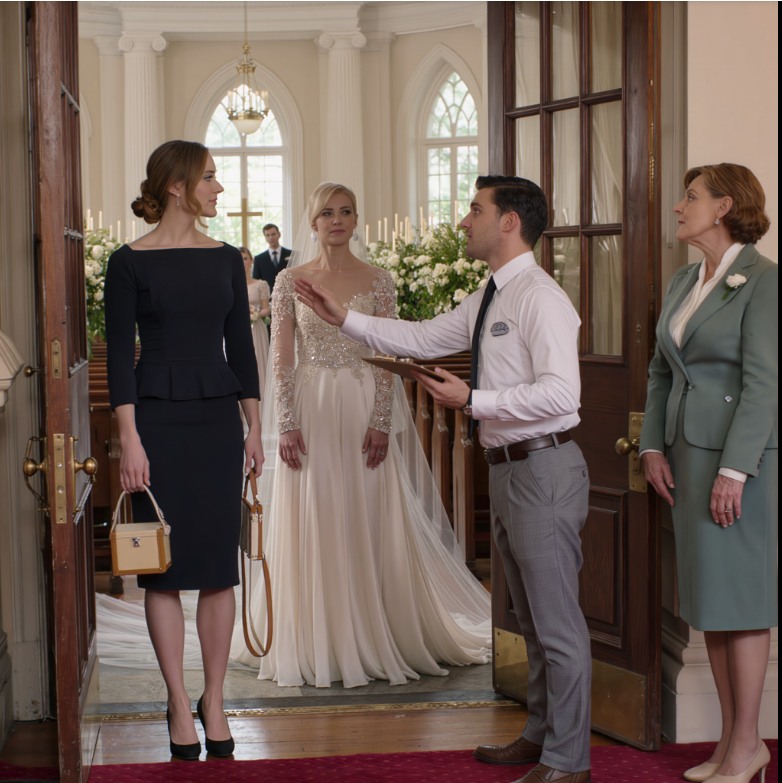
“Ruth. I didn’t send the invoice to cause problems for your family. I sent it because my sister wore a dress I made for free while she told your family it cost forty thousand dollars from a designer who doesn’t exist. And my mother stood at the door of the wedding and told a man with a clipboard that I wasn’t good enough to come inside.”
A silence, but not the cold kind. Not the Whitney silence or the Diane silence. A listening silence. The silence of a person who is taking inventory.
“I paid forty thousand dollars,” Ruth said slowly, “for a dress made by a woman my daughter-in-law uninvited from the wedding. And the woman who actually made it is charging eighteen, which means my family has been defrauded of forty thousand dollars by the bride.”
She said it without heat. That was the most devastating part, the absence of drama.
Ruth Hargrove didn’t need to yell. She had arithmetic.
“How much is the dress actually worth?” she asked.
“Eighteen thousand four hundred. That’s the fair market price for ninety-two days of custom work.”
“Then that is what I will pay you directly. The forty thousand is between my son and his wife, but the woman who made the dress should be paid by the people who wore it.”
I opened my mouth, closed it, opened it again.
“Thank you,” I said.
It came out smaller than I expected.
“Don’t thank me,” Ruth said. “Thank your own hands. They’re the only honest ones in this entire arrangement.”
After we hung up, I sat in the studio and the silence was different. Not the fluorescent silence of loneliness. Not the phone-screen silence of being the villain.
A different kind.
The silence after a storm breaks and you realize the roof held.
The dominoes started tipping that same evening.
Drew called Whitney. I wasn’t on the call. I didn’t need to be. Whitney told me later, in one of the ninety-eight calls I would eventually not answer, that Drew came back from a walk on the beach and asked her quietly, with the voice of a man holding something fragile, “Who is Elise Laurent?”
Whitney tried. She cried. She said it was complicated, that her sister was jealous, that the invoice was revenge.
Drew listened.
Then he said, “My mother found the designer’s signature inside the corset. The dress was made by your sister. The receipt was fake. Where is the forty thousand, Whitney?”
She didn’t have an answer that didn’t involve the truth.
And the truth was a forty-thousand-dollar hole in the foundation of a marriage that was six days old.
Diane tried to intervene. She called Ruth Hargrove directly, mother to mother, she said, to clear the air.
Ruth listened for approximately ninety seconds, then said, “Mrs. Ror, a misunderstanding is forgetting a name on a guest list. This is fraud.”
And hung up.
If someone called you a poor designer while wearing your work, what would you do?
Because here’s what I learned. You don’t have to do anything. You just have to have done good work.
The work speaks. The thread holds. And the signature eventually is found.
The forty thousand unraveled faster than cheap thread, and with it every lie Whitney had stitched into her new life.
Drew Hargrove called me on a Thursday afternoon. I was pinning muslin to a dress form for a commission I’d taken from a woman in Bluffton, a mother-of-the-bride dress, which felt like the universe’s idea of a joke, and I almost didn’t pick up because I’d stopped answering numbers I didn’t recognize.
But this one had a Beaufort prefix, and something about the way it rang twice, then stopped, then rang again suggested a person who wasn’t sure they should be calling.
“Is this Tessa, the, uh, the designer?”
“It is.”
“This is Drew. Whitney’s— I’m Whitney’s husband.”
He said it the way you say a word you’ve just learned and aren’t sure you’re pronouncing correctly.
“I wanted to ask you something, and I’m going to sound like an idiot, but how much does a wedding dress actually cost? Like a real one. From a real person.”
I pulled a pin from the muslin and held it between my teeth. A habit. Lorraine says it’ll kill me someday. I say there are faster ways to go.
“It depends on the dress,” I said around the pin. “Off the rack, you’re looking at two to five thousand. Semi-custom, five to ten. Fully custom, hand-beaded, French lace, cathedral train, you’re in the fifteen to twenty-five range. Higher if the designer’s name is famous. And yours, for Whitney’s, eighteen-four. That’s what I invoiced.”
A long exhale. Not a Diane exhale. There was no theater in it. Just a man sitting with a number that was twenty-two thousand dollars smaller than the one he’d been told.
“More than a lie,” I said. “Less than a marriage, apparently.”
Drew laughed. Not a happy laugh. The kind that leaks out when the alternative is worse.
“Yeah,” he said. “That checks out.”
He asked me a few more questions, practical ones, about the materials, the timeline, whether eighteen thousand was a normal price or whether I’d inflated it. I answered each one honestly. He thanked me the way you thank a doctor who’s just read you a scan you didn’t want to hear and hung up.
I took the pin out of my teeth and stuck it into the muslin.
My hands were steady.
Whitney called that evening. Not the honeymoon Whitney. Not the crying Whitney. Not the Whitney who deploys tears like ordnance.
A different Whitney.
Quieter.
The voice under all the other voices. The one that exists when no one’s watching and there’s no script and the performance has ended and you’re just a person sitting in the wreckage of a thing you built out of lies because you didn’t think the truth was enough.
“Tess.”
I waited.
Outside the studio window, Broughton Street was doing its evening thing, couples walking toward restaurants, a busker with a banjo on the corner, the smell of fried shrimp from the place two doors down.
The world continuing.
“I didn’t plan it,” she said. “The forty thousand. It wasn’t— I didn’t wake up one day and decide to steal. It started small. Drew’s mom asked where I was getting the dress and I panicked. I didn’t want to say my sister was making it in a studio above a fabric shop. I wanted them to think I belonged in their world. So I made up a name, and then they offered to pay, and the number kept getting bigger, and I just— I let it happen.”
“You fabricated a receipt, Whitney. You created a fake designer with a fake address. That’s not letting something happen. That’s building something.”
“I know.”
Her voice cracked. Not the practiced crack. A real one. The sound of dry wood splitting.
“I didn’t think it would go this far. I just wanted one perfect day. I wanted them to think I was someone.”
And there it was. The thing under the thing.
Whitney Ror Hargrove, golden child, the face, the one who danced in the center of the room, had looked at the Hargroves’ world and felt exactly what I had felt looking at ours.
Not enough.
She had stood in front of a mirror in a forty-thousand-dollar fiction and thought, If the dress is expensive enough, maybe I’ll finally belong.
She was wrong, of course.
But I understood the math.
I’d been running a version of it myself, not with money but with labor. If I make something beautiful enough for them, maybe they’ll see me.
We were both wrong.
The difference was I’d paid in time, and she’d paid in someone else’s money.
“You could have just told them the truth,” I said. “That your sister made it. That would have been enough.”
A pause.
Then, very quietly, “It wouldn’t have been enough for Mom.”
I closed my eyes.
Because she was right.
Diane had built us both, Whitney into a face that needed to perform, me into hands that needed to produce. Whitney lied because Diane taught her that image was more valuable than truth. I sewed for free because Diane taught me that love had to be earned with labor.
We were both her architecture.
We just lived on different floors.
But understanding is not the same as forgiving. I want to be clear about that.
Understanding is an intellectual exercise. Forgiveness is a door.
And I wasn’t ready to open it.
Maybe someday, but not because she’d asked. Because I’d decided.
“I’m not withdrawing the invoice,” I said.
“I know.”
“And I’m not going to pretend Elise Laurent is real.”
“I know.”
“But I’m not trying to destroy your marriage, Whitney. I’m trying to get paid for my work. Those are different things.”
She was quiet for a while. The banjo outside had switched to something slow and minor key.
Then she said, “The dress really was beautiful, Tess.”
“I know,” I said. “I made it.”
We hung up.
I don’t know if it was a goodbye or a pause. I don’t know if we’ll speak again in a week or a year or ever, but it was the first honest conversation we’d had since I was ten years old, sitting behind a curtain sewing sachets for a sister who never asked where they came from.
The money arrived the next morning.
A wire transfer.
$18,400.00 from Ruth Hargrove, with a memo line that read:
Invoice #027 — Tessa Ror Atelier — custom bridal gown.
Below that, a separate email from Ruth:
For the most beautiful dress at the wedding, made by the only honest person in the room who wasn’t even allowed in.
I sat in my studio and stared at the number on the screen.
$18,400.
It was the first time someone had paid me what my work was worth. Not a family rate. Not a favor. Not a gift wrapped in guilt and called love.
A price.
My price.
I looked at the wall where Lorraine’s words lived, written on a scrap of muslin I’d pinned there months ago in handwriting that wasn’t mine.
A seamstress takes orders. A designer names her price.
I finally understood what she meant.
It was never about the money.
It was about the naming.
It was about standing in front of your own work and saying, This is what it costs. Not because you’re greedy. Because you’re real. Because your hands made something, and your hands have a name, and your name has a number, and the number is not zero.
The number is not zero.
It was the last time I would ever sew for free.
Here is what happened to the people who told me I wasn’t good enough to enter a building that wore my work on its body.
Whitney did not get divorced. Not immediately. But Drew found other inconsistencies. The timeline of stories Whitney had told his family about her career, her savings, her background. Some of them held up. Most of them didn’t.
I don’t know what their marriage looks like now. And I’ve decided that’s not my story to tell.
I know that trust, once cracked, doesn’t heal the way bones do. Bones grow back stronger. Trust just grows back thinner.
Diane’s Facebook post stayed up for eleven days before she deleted it.
By then, someone in the comments, I never found out who, had replied with a link to my website. My portfolio. The Savannah Magazine feature. The bridal association award.
The comment said, Wait, so the daughter you called a poor designer actually made the dress and she won awards for her work? Ma’am.
It had 237 likes.
Diane’s original post had 214.
The math was not in her favor.
She called me once more after that. I let it go to voicemail.
She said, “I think we should talk.”
She did not say she was sorry. She did not say she was wrong. She said I think we should talk the way a general says we should negotiate from a position she still believed was strength but was in fact the last chair in an empty room.
I did not call her back.
Not because I was punishing her. Because I had nothing left to say that an invoice hadn’t already said better.
Ruth Hargrove, true to her word, did something I hadn’t expected.
She gave my name to six women in her circle. Mothers of brides. Grandmothers of debutantes. One woman who wanted a custom christening gown for her first grandchild.
She didn’t do it as charity.
She did it as recommendation.
“I know a designer in Savannah,” she told them. “She’s the real thing.”
The first call came on a Wednesday.
A woman named Caroline from Hilton Head whose daughter was getting married the following spring.
“Mrs. Hargrove gave me your name,” Caroline said. “She told me you made the most extraordinary dress she’d ever seen.”
“I did,” I said.
I was standing at my cutting table, one hand on the bolt of charmeuse Lorraine had left for me. Cool under my palm. Steady.
“What’s your rate?”
I smiled.
Not the smile from the parking lot, the one I’d used to keep from breaking in front of a man with a clipboard.
This one was different.
This one came from somewhere lower, somewhere warmer, the place where work and worth meet and finally agree on a number.
“Let me send you my pricing sheet,” I said.
After I hung up, I stood in the studio for a minute. The fluorescent hummed, the new one Lorraine had installed, steady and white. The mannequin stood in the corner, still bare, still tilted slightly to the left.
On the passenger-side hook by the door, where I’d hung it the night I drove back from the wedding, was the garment bag.
I walked over and unzipped it, and the miniature sewing kit I’d packed at five in the morning on the day my sister got married, just in case something went wrong with the dress.
I’d driven forty minutes to protect a dress for a woman who didn’t want me in the room. I’d packed an emergency kit for a person who considered my presence the emergency.
I took out the small pair of scissors, German steel, sharp enough to cut charmeuse without dragging, and carried them to the cutting table.
I smoothed the ivory charmeuse flat.
Lorraine had left a note with it, written on a receipt in her terrible handwriting.
For your next client, not your next apology.
I placed the scissors on the fabric, aligned the grain, and made the first cut.
The phone buzzed on the table. I glanced at it.
Ninety-eight missed calls.
I hadn’t counted them. Megan had, because Megan counted everything, but I’d seen the number climb over the past week like a thermometer. Nobody wanted to read ninety-eight calls from Diane and Whitney and one from a Beaufort number that was probably Aunt Patty recruited for the cause.
I didn’t listen to them. I didn’t delete them.
Maybe someday I’d pick up.
Maybe someday there would be a voicemail that started with the right words, not how dare you or after everything I’ve done or you’re destroying this family, but something smaller and harder and truer, something that sounded less like a strategy and more like a person.
But not today.
Today I had charmeuse on the table and scissors in my hand and a client who had asked for my pricing sheet and said thank you before we’d even started.
The morning light came through the studio window and caught the fabric and turned it to water.
I cut along the bias the way I always do, slow, steady, letting the blade follow the grain instead of fighting it.
The charmeuse fell open like a breath.
Like a door.
Like the first page of something that hadn’t been written yet.
What are you still making for free for people who don’t value your hands?
Whatever it is, stop.
Name your price. Send the invoice. The dress will remember who made it, even if they don’t.
Here’s what Tessa’s story taught me, and I think it might matter to you too.
Somewhere along the way, most of us learned that love means giving without counting, that if you’re good enough, generous enough, quiet enough, the people closest to you will eventually see your value.
So you keep sewing.
You keep showing up at five in the morning with an emergency kit for people who never once asked how you were doing.
You call it loyalty.
You call it family.
You call it love.
But what you’re really doing is setting your own price at zero and then wondering why no one offers more.
Tessa didn’t get her $18,400 because she screamed or begged or burned anything down.
She got it because she did something that sounds simple but feels almost impossible when you’ve spent your whole life being the hands.
She named her price.
She put her work on paper, attached a number, and sent it to the people who had been wearing her labor like it cost nothing.
That invoice wasn’t revenge.
It was an introduction.
It said, This is who I am. This is what I do. And this is what it’s worth.
So let me ask you something.
What are you still doing for free? What skill, what time, what emotional labor are you handing over to someone who has never once said thank you?
And would you even know how to stop?
Think about it.
Really think.
And if a name comes to mind, if a face flashes behind your eyes right now, maybe that’s your invoice waiting to be written.
See more on the next page
Advertisement