
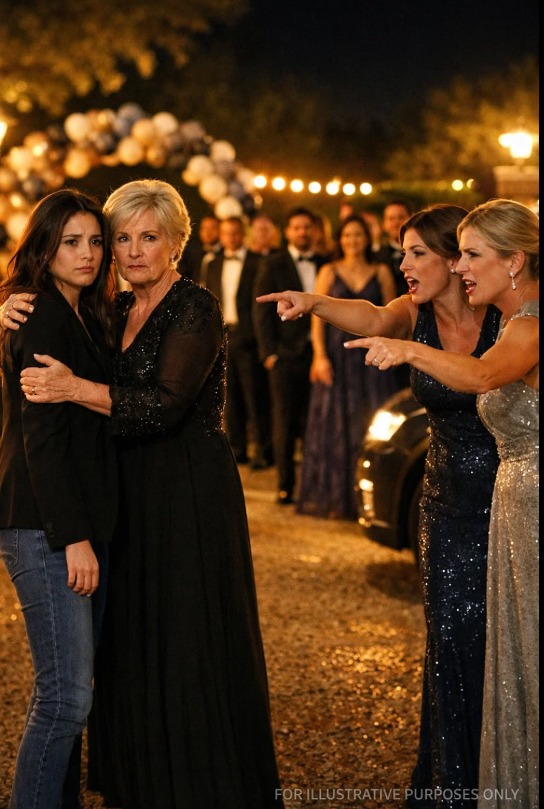
And in that moment, I understood that what frightened my mother wasn’t the attorney, or the money, or even the witnesses on the terrace.
It was that someone older than her had finally said, out loud, what she had been doing to me for years.
The next morning, my phone lit up before seven.
My mother called three times. Madison texted twice. Then came the family group chat, suddenly alive with cousins pretending neutrality and aunts saying things like Let’s all cool down—the standard language of people who hate conflict more than injustice.
I didn’t answer any of them.
At eight-thirty, I drove my CR-V—my actual CR-V, now parked safely outside my apartment—back to Grandma Eleanor’s house. Michael had already arranged for the insurance account password to be changed, and a locksmith was scheduled to reprogram the keys that afternoon. For the first time in two weeks, driving didn’t feel like borrowing my own life.
Grandma was in the breakfast room with coffee and toast, dressed in cream slacks and a pale blue sweater as if the night before had been merely unpleasant weather. She motioned for me to sit.
“You slept?” she asked.
“A little.”
She nodded, then pushed a folder across the table. Inside were copies of the vehicle title, insurance forms, and a short typed statement Michael had drafted for my mother and Madison to sign, acknowledging that the car belonged solely to me and that they had no right to use it without written permission.
“You don’t have to press charges,” Grandma said. “But you also do not have to protect people from the consequences of what they chose.”
I looked down at the papers. “I don’t want police at the center of this.”
“That is your choice,” she said. “Just make sure mercy is not another word for surrender.”
An hour later, my mother arrived uninvited.
She walked into the breakfast room with that brittle dignity she wore when she was trying to look wronged instead of exposed. Madison followed behind her, holding a diaper bag and a wounded expression that might have worked on almost anyone else.
“You’ve made your point,” my mother said to me, not Grandma. “This has gone far enough.”
I folded my hands on the table. “It went far enough when you took my car.”
Madison stepped in quickly. “I said I was giving it back.”
“You drove it to the party,” I said. “In front of me. With my things still in the center console.”
That shut her up.
Grandma gestured to the papers. “Sit down. Sign.”
My mother didn’t move. “You are humiliating your own daughter.”
Grandma met her eyes. “No. I’m refusing to help her humiliate hers.”
There was a long, raw silence.
Then my mother did something I had been waiting my whole life to see: she stopped performing. The sweetness dropped. The wounded parent act vanished. What remained underneath was not grief, but irritation.
“Arya has always been easier,” she said flatly. “Madison needs more. Madison struggles more. Arya lands on her feet. She always has.”
I looked at her and realized that was the closest thing to honesty I would ever get.
“You keep saying that,” I replied, “like it means I owe everybody access to my life.”
Her expression hardened. “Families make sacrifices.”
“Families ask,” I said. “Thieves decide.”
Madison inhaled sharply. My mother looked as if I’d slapped her.
But Grandma leaned back in her chair, and I saw a grim flicker of pride in her eyes.
Michael arrived ten minutes later to witness the signatures. My mother signed first, furious enough to dent the paper. Madison signed second. Then Grandma gave them both one final piece of news.
“I met with Michael after you left,” she said. “I am updating my estate documents. Karen, you are no longer my medical proxy or executor. I won’t place authority in the hands of someone who confuses control with love.”
My mother went absolutely still.
“Mom—”
“No.” Grandma’s voice never rose. “You will not inherit responsibility just because you are the oldest. Responsibility is earned.”
Madison whispered, “This is because of a car?”
Grandma turned to her with a look sharp enough to cut marble. “No. It is because of a pattern. The car simply made it visible.”
They left without another word.
Three weeks later, Madison had a rental. My mother had stopped texting after I sent one final message: Do not come to my apartment unannounced. Do not ask for my keys. Do not speak for me. I blocked her after that.
Grandma and I started having Sunday breakfast together.
Sometimes we talked about ordinary things—her hydrangeas, my clients, whether the local bakery had ruined its blueberry muffins. Sometimes we didn’t talk much at all. But the silence between us no longer felt like the silence I grew up with—the kind that demanded I swallow every injury to keep the peace.
This silence was clean.
On the first Sunday of autumn, Grandma handed me a small wrapped box. Inside was a silver keychain engraved with one sentence:
Never be flexible about your dignity.
I laughed, then cried, then laughed again.
And when I walked out to my CR-V, sunlight across the windshield and my own keys in my own hand, I finally understood something simple and permanent:
The car had never just been a car.
It was the first thing anyone in my family had ever given me without expecting me to hand it over