
“Yes.”
He lowered his voice. “You could stop this before it starts.”
I almost smiled.
“No,” I said. “He already started it. I’m just deciding where it ends.”
Up on the forty-first floor, Ethan was stepping into the kind of room he had spent months chasing.
Cole Urban Holdings had been stretched thin for almost a year, though the financial press had not yet fully grasped how serious the damage was. His firm had expanded too fast on vanity projects and short-term debt. One hotel conversion stalled. A mixed-use development bled cash. Two anchor tenants elsewhere delayed renewal. He needed a flagship lease in a trophy tower to restore market confidence, reassure lenders, and signal stability to Vanessa’s family, who were wealthy enough to treat marriage like a merger.
Sapphire Tower was not just another building.
It was the building.
Five floors there would place his company where investors, journalists, and rivals could see it. It would make him look solid precisely when he needed steel and glass to stand behind him. That was why Vanessa was with him. She did not merely want a fiancé. She wanted a trajectory.
And trajectories are very sensitive to humiliation.
At nine thirty-two, while I guided a final line of dust toward the curb, my second phone buzzed.
Mariana.
I answered without fully lifting it to my ear. “He’s already presenting,” she said. “He doesn’t know yet.”
“How does he look?”
“Confident. A little smug. Vanessa is doing that thing where she smiles before anyone says anything.”
I pictured it perfectly.
“And the broker?”
“Terrified.”
“Good.”
Mariana laughed softly. “He asked whether ownership would join by video or send counsel only. I told him the owner prefers to evaluate major tenants personally.”
I looked up at the tower then. Sunlight had reached the higher glass by that point, turning the upper floors into hard, pale gold. At street level, delivery trucks argued with curbs and a woman in a green blazer crossed toward the lobby talking into a headset. The city kept moving because cities always do, even when private histories are about to detonate thirty floors above the pavement.
“Give him five more minutes,” I said.
Then I ended the call.
The memory of Ethan’s face when he recognized me on the sidewalk kept replaying under my calm. Not pity. Not love. Recognition sharpened by embarrassment. That had always been one of his weakest points. He could tolerate causing pain more easily than being publicly associated with it. He did not like looking cruel. He liked looking correct. Reasonable. Elevated. The kind of man who leaves a marriage because his wife cannot keep up with his becoming. Vanessa gave him cover by being louder and crueler, so he had slipped into condescension and let her carry the blade.
But he still said it.
You should leave. This place isn’t for you.
That line had done something strange inside me.
It had not wounded me the way it once would have. It illuminated him. The need to define where I belonged. The certainty that he could map my place in the world according to his convenience. The assumption that class was not only money, but visibility — who gets to stand at the entrance and who is expected to disappear into service corridors.
If only he had known.
If only he had looked harder.
Part 4: The Room Upstairs
At nine thirty-six, I handed the broom to a young maintenance worker named Sam, who had been pretending not to listen from near the planters.
“Can you finish this side for me?” I asked.
His eyes widened. “Yes, ma’am.”
He still called me ma’am when no one else was around, though in public he was careful to mimic the hierarchy others saw. Good kid. Quick learner. One day he would probably run operations somewhere if nobody crushed the ambition out of him first.
I removed the cap from my head and slipped it into my tote. Then I walked toward the side entrance.
Not the main lobby where Ethan and Vanessa had entered. The service elevator route. I preferred it when making a point. The hallway smelled faintly of bleach and printer toner. A maintenance cart stood parked by a fire door. Someone on the loading dock was arguing about pallets and delayed manifests.
I rode up alone.
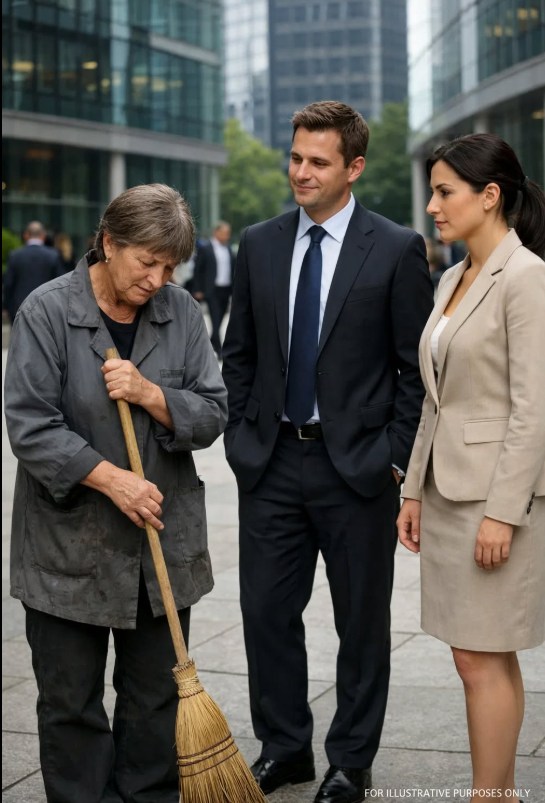
As the elevator climbed, my reflection in the brushed steel door looked exactly as it had outside — gray uniform, pinned hair, practical shoes, no visible jewelry except the thin gold band I wore on my right hand, the one that had belonged to my mother. A stranger to the world Ethan had chosen. A service worker in the imagination of anyone who confused labor with hierarchy.
Perfect.
The doors opened onto a private corridor one floor below the meeting suite. Mariana was waiting there in a cream blazer, holding a garment bag and a tablet.
“You’re enjoying this,” she said.
“A little.”
“You deserve more than a little.”
Mariana had been one of my father’s strongest executives before she became mine. Efficient without being brittle. Loyal only after evidence, never blindly. The first time she saw me in a janitorial uniform walking the basement levels at six in the morning, she didn’t react with shock. She asked whether I wanted a separate report template for things people only say around invisible staff.
That was when I knew she would stay.
“What’s the room like?” I asked.
“Ethan is pitching expansion, stability, long-term prestige, and institutional credibility,” she said. “Which would be more convincing if his company weren’t two quarters away from a liquidity emergency.”
“And Vanessa?”
“Acting like she’s already chosen the art for the reception area.”
I nodded.
Mariana handed me the garment bag.
Inside was the suit I kept upstairs for moments like this. Deep charcoal. Clean lines. No theatrics. The kind of suit that does not announce money because it assumes it. I changed in the executive washroom, washed the dust from my hands, unpinned my hair, and slipped on low black heels.
When I stepped out ten minutes later, the woman in the mirror no longer looked invisible.
She looked like consequence.
Mariana gave me the latest file summary as we walked.
“His projections are inflated. He’s relying on financing he hasn’t secured. We also got overnight confirmation that Vanessa’s father is waiting on this lease before approving merger discussions with their family office.”
So that was the true pressure point.
Not romance.
Not redemption.
Capital.
Conference Room 41B had floor-to-ceiling windows facing the spine of the city. The morning light there was unforgiving, the kind that makes polished shoes look sharper and tired eyes look exposed. Through the frosted glass beside the door, I could already hear Ethan’s voice — smooth, paced, practiced. The same voice that once whispered apologies into my hair after small cruelties, before deciding he preferred the cruelties to the apologies.
Mariana opened the door.
Conversation stopped.
Not gradually.
All at once.
Eight people sat around the table. Ethan at the head near the presentation screen. Vanessa to his right, one manicured hand near a leather portfolio. Two associates from his firm. One outside broker. Two members of my leasing team. At the far end, legal counsel with a stack of unsigned documents.
Ethan looked up first.
At the sight of me, all the color left his face.
Vanessa followed his gaze and blinked once, twice, as if her mind could not reconcile the woman from the sidewalk with the one now walking in wearing tailored wool under the tower’s light. The broker’s pen stopped in midair. One of Ethan’s associates actually glanced toward the door as though expecting the real owner to walk in behind me.
I did not rush the moment.
I crossed to the seat reserved for ownership and rested one hand lightly on the leather chairback before sitting. Only then did I look directly at Ethan.
“Please,” I said. “Continue. I wouldn’t want to interrupt your pitch.”
The silence became physical.
Vanessa recovered first, though badly.
“I’m sorry,” she said, forcing a smile so hard it almost cracked. “There seems to be some confusion.”
Mariana took her seat beside me and opened the folder in front of her. “There isn’t,” she said.
The broker cleared his throat.
“Mr. Cole, perhaps we should—”
“No,” Ethan said too quickly.
His voice betrayed him.
Not because it was loud. Because it had gone thin. Men like Ethan never expect the room to change species around them. A room they entered to dominate had become a room in which they were being assessed.
He looked at me and tried on dignity.
“You own Sapphire Tower?”
I held his gaze. “Yes.”
Vanessa laughed once, but it came out wrong. “That’s absurd.”
“Not particularly,” I said. “It’s been true for years.”
Her mouth opened, then closed.
I let the words settle just long enough to sting. Not too long. A humiliated person will often salvage themselves by deciding the reveal is theatrical. I wanted this to feel administrative. Final. The humiliating part had happened outside, at street level, when they thought the hierarchy was safe.
Now this was simply business catching up.
Part 5: The Lease That Died
Ethan set both hands on the table.
“Why wasn’t this disclosed during negotiations?”
Mariana answered before I did. “Ownership is disclosed on all appropriate legal instruments. Personal visibility is not a tenant entitlement.”
A small silence followed that.
The broker looked like he wished the floor would open and solve his career for him.
Vanessa’s composure began to split at the edges. “You let us walk in there like fools,” she said. “You stood outside in that uniform and—”
“And worked?” I asked. “Yes.”
She turned red.
“That wasn’t normal.”
I almost smiled. “No. Neither was stopping to mock a woman with a broom on your way to request five floors in her building.”
Even my own legal counsel looked impressed.
Ethan tried another route. He straightened his tie and reclaimed tone where he had lost control of fact. “Whatever happened outside was unfortunate,” he said. “But I’m sure we can all act professionally and focus on the opportunity in front of us.”
Professionally.
The word landed in the room like a dare.
I folded my hands. “Professionally,” I repeated. “All right.”
Then I nodded to Mariana.
She turned a page in her folder. “Cole Urban Holdings has requested a ten-year lease spanning floors thirty-two through thirty-six. The application emphasizes long-term stability, executive visibility, and strategic prestige. However, our internal review raised concerns regarding debt exposure, financing dependency, and concentration risk.”
Ethan’s jaw tightened. “That was not the impression conveyed in previous meetings.”
“No,” I said softly. “I imagine you’re used to controlling the impression.”
Vanessa leaned forward. “This is retaliation.”
I looked at her. “No. Retaliation is emotional. This is diligence.”
That was the moment she lost whatever remained of elegance.
“You were sweeping trash ten minutes ago.”
“Yes,” I said. “And now I’m deciding whether your fiancé’s company is the kind of tenant we want in this tower. Life is strange.”
Across from me, one of Ethan’s associates dropped his eyes so abruptly I knew he was hiding a reaction. Not amusement. Recognition. The kind men get when the boss’s myth starts cracking in front of witnesses.
Ethan tried to laugh.
“Come on, Isabel. Let’s not pretend this is about finance.”
I didn’t look away. “You’re right,” I said. “It’s also about judgment.”
The room went still again.
Then I leaned back in my chair. “Five years ago, you chose the moment when I was weakest to strip me out of a marriage, a home, and a life. This morning you looked at me doing honest work and decided it was safe to humiliate me publicly because you thought status only ran one way. Now you’re asking me to attach one of my flagship buildings to a company led by a man whose first instinct is contempt toward people he thinks are beneath him. That is not just a moral issue. It is a business risk.”
No one interrupted.
Vanessa’s face went from flushed to pale.
Ethan’s eyes hardened because shame, in men like him, often changes costume and comes back as anger.
“This is personal.”
“Yes,” I said. “Which is why I let the financial review happen first.”
I turned one page in my folder and slid it gently across the table. Mariano from legal pushed a second document after it. Ethan glanced down. His expression changed again.
Not because he understood everything at once.
Because he understood enough.
The first page was a formal notice declining the lease on underwriting grounds. The second was worse: a legal memorandum regarding reputational conduct on private property, including statements witnessed by staff and visitors that morning. Not a lawsuit. Not yet. But a record. A wall where he expected a door.
“You can’t be serious,” he said.
“I’m completely serious,” I replied.
Vanessa looked from him to me and back again. “What does that mean?”
Mariana answered. “It means Sapphire Tower will not be entering into a lease with Cole Urban Holdings. Effective immediately, all negotiations are terminated.”
The broker made a helpless sound.
One of Ethan’s associates closed his laptop without being asked, which told me everything about where his instincts for self-preservation lived.
Ethan stared at the page, then at me. “You’re going to blow up a deal this size because of one conversation on a sidewalk?”
“No,” I said. “I’m declining a tenant because your balance sheet is fragile, your leverage is worse than represented, and your conduct confirms what your numbers already suggested. The conversation on the sidewalk only saved us time.”
That landed.
Because it was true.
And because he knew it.
Part 6: What the Room Finally Saw
Vanessa stood abruptly.
“This is insane. Do you have any idea who my father is?”
Mariana didn’t blink. “Yes,” she said. “We reviewed that too.”
The silence afterward was almost cruel.
Vanessa looked at Ethan, expecting rescue, but he was still staring at the decline notice as if it might rearrange itself if he glared hard enough. That was the first moment she truly understood what this meant. Not just embarrassment. Not just a ruined morning. A fracture in the version of Ethan she had bet on.
I could see the calculation happening behind her eyes. How much of his confidence had been projection? How close was the company to the edge? Had her father known? Would he still take meetings after a flagship rejection by a tower his ex-wife secretly owned? How many people in their world would hear about a public lease collapse inside a building he had walked into like a conqueror?
Power is often visible in the exact second other people start recalculating around you.
Ethan rose slowly.
My body recognized that movement before my mind did. For years, when he stood that way — shoulders back, jaw set, chest full of controlled aggression — it meant a conversation was about to become a correction. The kind delivered softly enough to avoid witnesses but hard enough to shape your week around preventing the next one.
I no longer feared that version of him.
That realization was almost holy.
He placed both palms on the table and leaned toward me. “You planned this.”
I met his eyes. “No. You did. You just didn’t know it.”
He laughed then, but there was nothing smooth in it. “Unbelievable. After all these years, you’re still punishing me.”
“Punishing you would be public,” I said. “I’m simply declining to trust you with my property.”
Vanessa made a sound of disbelief. “Your property,” she repeated.
“Yes,” I said.
Outside the windows, the city blazed in full morning. Park Avenue flashed below like a steel river. Somewhere far beneath the glass, a maintenance worker was still sweeping the entrance, finishing the line I had started. The image pleased me more than it should have.
Because that too was my building.
All of it.
The shine. The dust. The tenants. The service halls. The skyline. The workers who made importance possible without applause. Ethan had always understood only the part that glittered. That had always been his weakness.
He collected surfaces and mistook them for structure.
I stood.
The movement ended the meeting more clearly than any formal word could have. Legal counsel gathered documents. Mariana rose beside me. The leasing team shut their folders and waited. Even the broker seemed to understand that trying to mediate this now would be like asking a severed cable to carry current again.
“Mr. Cole,” I said, “security will escort your team to the lobby. Any future communication can go through counsel.”
His face darkened.
“You think this makes you powerful?”
I looked at him for a long second. “No,” I said. “This reminds me I always was.”
That was the line that broke him.
Not dramatically.
Not with shouting.
With stillness.
Something in his expression emptied, as if the internal structure of him had finally met a weight it could not bear. He understood then — maybe not the full inheritance, not the years of hidden ownership, not the discipline it took to survive what he had done and come back stronger — but enough. Enough to see that the story he had told himself about me had been the scaffolding of his own arrogance.
And now it was gone.
Valentina recovered first, because humiliation in public often makes the ambitious crueler before it makes them honest.
She turned on him.
“You told me she was finished,” she said.
The room sharpened.
Ethan swung toward her. “Now is not the time.”
“No,” she snapped. “Actually, it is exactly the time.”
Her voice had lost all glamour. It was raw with anger and panic. She looked around the table, saw the witnesses, and either forgot or no longer cared how she sounded. “You said the divorce cleaned everything up. You said there was no real money left on her side. You said she was unstable.”
There it was.
The old script.
Not only that I had been left. That I had been rewritten. Minimized. Diagnosed into irrelevance. Women are so often buried socially before they are buried legally. Easier that way. Makes the taking look like management instead of theft.
Ethan hissed her name.
But the damage was done.
My counsel made a small note in the margin of his folder. Mariana’s expression did not change, but I knew that look. She had already filed the sentence away under useful.
Valentina laughed bitterly. “My father is going to love this.”
And with that, she grabbed her bag and walked out ahead of everyone, leaving the room with the hard clipped steps of a woman who had just realized she had linked herself to a man whose future was not rising, but cracking.
Part 7: What Honest Work Protects
Ethan watched her go.
For one brief, strange second, I saw the old version of him — not kind, exactly, but younger, hungry, needing to be seen. The man who once cried in my kitchen over his first signed contract. The one I had loved before success taught him how much he enjoyed looking down.
Then he looked at me again, and the moment vanished.
“I could’ve helped you,” he said.
I almost laughed.
“From what?” I asked. “Work? Dignity? Ownership?”
His mouth tightened. “You didn’t have to make me look like this.”
The truth of that sentence was almost unbearable in its smallness. After everything — the hospital papers, the apartment, the years of silence, the sidewalk mockery, the condescension, the rewrites — his clearest grief was still the damage to his appearance.
Something in me went completely still.
“No,” I said softly. “You did that yourself.”
He left without another word.
The room remained quiet for several seconds after the door shut behind him. Then the broker exhaled into both hands as if surfacing from underwater. One of my leasing managers muttered, “Well,” in the tone of someone who knew they had just watched a story people would whisper about for years.
Mariana looked at me. “You all right?”
I nodded.
Not because I felt triumphant.
Because I felt accurate.
And there is a kind of peace in that which triumph never quite reaches.
The rest of the morning moved like business. That was the beauty of real power. There is paperwork after the scene ends. Calls to return. Tenant shortlists to revise. Notes to circulate. Instructions for security and reception in case Ethan tried to re-enter with a sadder face and a better performance. By noon, a revised deck was already being prepared for another prospective tenant with cleaner books and less theatrical leadership.
Life in office towers does not pause for private justice.
It simply absorbs it and keeps climbing.
I changed back into my gray work uniform before leaving the floor.
Mariana raised an eyebrow. “You’re going back downstairs?”
“Yes.”
She smiled slightly. “You’re terrifying.”
“No,” I said. “I’m sweeping.”
When I reached the lobby, Ernie was waiting beside the turnstiles, trying very hard not to grin while on the clock.
“Well?” he asked.
I adjusted my gloves. “They understand now.”
He nodded toward the front drive. “The blonde one left first. Angry. He stood outside almost five minutes before getting in his car.”
I did not ask whether he looked shaken.
I already knew.
Outside, the air had warmed. The city was fully awake now, bright and impatient. Street vendors had set up near the corner. A woman in a green blazer shouted into a headset while crossing against the light. Sam had finished the sweep line but left the broom leaned discreetly beside the planter, exactly where I would want it.
I picked it up and resumed where I had left off.
A few passersby glanced at me, then away.
Invisible again.
It almost made me smile.
Not because invisibility had won.
Because now it was a choice.
That afternoon, when I picked up Thomas and Lucy from school, neither of them knew their mother had refused a major lease, dismantled her ex-husband’s confidence in a forty-first-floor boardroom, and watched his fiancée recalculate her future in real time. They climbed into the back seat smelling like crayons, paper, and playground dust. Lucy needed to tell me about a classroom argument over whether dragons counted as animals. Thomas had lost the loose arm of his teddy bear and was trying not to cry because he had decided, at seven, that boys should be brave in exactly the saddest ways.
I drove them home through the slow crawl of late-day traffic.
At a red light, Lucy asked whether I was tired.
“A little,” I said.
“From cleaning?”
I looked at her in the rearview mirror. “From work.”
That was enough for now.
At home in Brooklyn, the evening smelled like soup and detergent and the small warm chaos of ordinary life. Thomas spread crayons across the kitchen table while Lucy read upside down on the couch because children are mysterious little creatures with no respect for spines. I stitched the teddy bear’s arm back on after dinner while answering two emails and ignoring three calls from numbers I did not recognize.
One voicemail was from Ethan.
I did not listen to it immediately.
Instead, I tucked the children into bed. I kissed Thomas’s forehead and reminded Lucy to put the comic on her nightstand instead of under her cheek. I stood in the doorway afterward and watched them sleep, their breathing soft and even in the dark. That old instinct rose in me then — the one that measures every decision against the peace of children.
This was why I had stayed invisible.
Not from fear.
From protection.
Later, in the kitchen with only the under-cabinet lights on, I finally played the voicemail.
My name in his voice again. Controlled. Tired. Almost sober in a way I had never heard before. He said the meeting had been unnecessary theater. He said Vanessa had overstepped. He said he wanted to talk privately, adult to adult, to separate the past from today’s business outcome. By the end of the message, the old edge was back. He said he hoped I would not let bitterness interfere with rational decisions moving forward.
I deleted it before the final sentence ended.
Then I laughed.
Not loudly.
Just once, under my breath.
Because even then, even after the refusal, even after the reveal, some part of him still believed the greatest danger in the room was my emotion instead of his entitlement. Men like Ethan can lose contracts, fiancées, public standing, even the confidence of their own associates, and still walk away convinced the real issue is a woman’s bitterness. The durability of that lie would be admirable if it weren’t so pathetic.
Three days later, the price became public.
Not through gossip.
Through finance.
Word spread quickly in the circles where prestige leasing and development financing overlap. Cole Urban Holdings had failed to secure Sapphire Tower. A family office tied to Vanessa’s father paused merger exploration pending strategic review. One lender requested updated collateral disclosures. Another wanted revised occupancy assumptions across two troubled properties. By Friday afternoon, a trade publication ran a polite, brutal headline about market questions surrounding Ethan’s expansion narrative.
By Monday, Vanessa’s engagement ring no longer appeared in her photos.
I did not celebrate that either.
A woman like her would survive. Women like that always do. They know how to pivot from one glittering narrative to the next. But she would remember the sidewalk. She would remember the gray uniform and the broom and the tower doors closing behind her while the woman she mocked remained standing on her own property. That memory would itch beneath every polished version of herself for years.
Ethan came apart more slowly.
That felt right.
He had not destroyed me in one dramatic act either. He had done it through timing, omission, coldness, legal efficiency, and the social convenience of letting people imagine the worst about a woman who had stopped performing prettily under pressure. It made sense that his unraveling would follow the same architecture — not spectacular, just cumulative. One lost deal, then another doubt, then a board member asking harder questions, then a bank insisting on a conversation in a room without deference.
The real price of arrogance is not the first fall.
It is the way people stop cushioning you once they finally see what you are.
A month later, I saw him one last time.
Not in a boardroom.
Not at a gala.
On a sidewalk again.
It was early morning, cooler than before. I was standing near the loading entrance of one of my smaller buildings in SoHo, reviewing a maintenance issue with a supervisor, still in work clothes because I prefer inspecting water damage before offices fill up with perfume and excuses. A black sedan stopped at the curb too abruptly.
Ethan stepped out alone.
No Vanessa.
No associates.
No broker.
Just him.
For a second, I thought he might come dressed in condescension again. Men like him often return wearing regret as if it grants them access to the room they burned down. But when he walked toward me, what struck me first was not sadness.
It was reduction.
He looked smaller.
Not poorer. Not ruined. Just scaled down by reality. The kind of man who had once been held up by projection and now had to carry his own weight without it. He stopped a few feet away and looked at the gloves in my hands, the clipboard under my arm, the damp concrete being examined by maintenance, and something like disbelief crossed his face all over again.
“You really do this,” he said.
I nodded once. “Yes.”
He glanced at the building, then back at me. “Why?”
There were many answers.
Because work keeps pride from going soft. Because silence reveals character faster than status does. Because my children deserve a mother who understands labor, not just wealth. Because after being discarded for being too human, I wanted to build a life no one could revoke with paperwork and posture. Because sweeping my own entrances reminds me exactly what kind of empire I refuse to become trapped inside.
But I gave him the simplest one.
“Because I like knowing what belongs to me,” I said.
That hurt him more than any accusation could have.
He looked down for a moment, then back up. “I was cruel.”
“Yes.”
“I thought…” He stopped, swallowed, tried again. “I thought you were done.”
“I know,” I said.
“I didn’t understand who you were.”
This time I nearly smiled. “No,” I said. “You understood enough. You just preferred the version of me that needed your approval.”
He took that in.
Around us, the maintenance supervisor pretended to focus on drain lines while very clearly hearing every word. Across the street, a cyclist shouted at a cab. Somewhere above, a window washer’s equipment tapped softly against glass. Life, as always, refused to become cinematic just because two damaged people were finally standing inside the truth.
Ethan exhaled. “I’m sorry.”
I believed he meant it.
At least partly.
Pain had reached him in a language he respected — loss of leverage, loss of status, loss of the future he had already begun spending in his mind. Whether that pain had made him honest or simply lonely was harder to say. Probably some of both. Human beings are rarely pure even in remorse.
But belief and return are not the same thing.
“I know,” I said.
He waited.
That was the thing he still didn’t understand. The old life had trained him to expect my empathy to open the next door automatically. He could apologize and I would explain him back into my own heart. That mechanism had once existed in me.
Not anymore.
After a long moment, he nodded.
Then he got back into the car and left.
My supervisor cleared his throat awkwardly and asked whether I wanted the drainage report by noon or end of day. I answered without missing a beat. Work resumed because work always resumes. That, too, was part of healing.
The city does not accompany your closure with violins.
It hands you another task.
Years later, people still tell the story wrong.
They say my ex-husband mocked me while I was sweeping outside a building, and thirty minutes later he found out I was rich all along. They say it like a fairy tale about secret wealth and revenge. They say it like the uniform was a costume and the broom a prop and the whole point was humiliation returned with interest.
But that was never the real story.
The real story was that after being shattered, I built a life so grounded that no one could shame me with honest work. The real story was that ownership mattered less than perspective. The real story was that men like Ethan can only humiliate women who still agree, somewhere deep down, that labor lowers them. Once that illusion dies, the insult has nowhere to land.
And the real reason he paid the price thirty minutes later was not because I wanted revenge.
It was because he revealed himself exactly when it mattered most.
That is what silence gives you.
Not mystery.
Evidence.