
Luke glanced at Eli, then at the recovered saddlebag on the table. “Storm brought you. Men like that followed.”
For the first time since the cabin, Clara looked tired enough to fall.
The hotelkeeper offered rooms on the second floor. Clara accepted one for Eli and Luke despite Luke’s protest.
“I can pay for a stable corner,” he said.
“You can,” Clara replied. “But you will not.”
“Mrs. Hayes—”
“Clara,” she said.
The correction was gentle, yet it struck him harder than command.
He looked at the fine staircase, the polished rail, the carpet no muddy boot had any business touching. “Clara, I do not belong upstairs in a place like this.”
She held his gaze. “Neither did I, the first time my husband brought me to a bank meeting. Belonging is often just a door someone was bold enough to open.”
Luke had no answer for that.
The hearing before Judge Albright lasted less than an hour and left Silas Trent with nothing but pressed lips and wasted ink.
Clara spoke clearly. Whitmore produced contracts, correspondence, and the recovered draft. Luke testified only to where and how he found her. He did not embellish. He did not call himself brave. He said the mare had fallen, the woman had a pulse, and his cabin had a fire.
Judge Albright, an old man with spectacles low on his nose, studied Luke for a long moment.
“You risked your boy’s life as well as your own?”
Luke looked at Eli seated in the back, small hands folded hard in his lap.
“I risked what was already in the storm, Your Honor. I did not put us there by helping her. We were there.”
The judge leaned back. “And you expected no payment?”
“No, sir.”
“Why?”
Luke’s eyes moved once to Clara, then away. “Because there are things a man does before he starts counting.”
No one spoke for several seconds.
That sentence traveled through Three Forks by supper.
It reached Helena by the end of the week.
By then, Luke expected never to see Clara again except perhaps in a newspaper column or from the far side of a crowded street. Women like her returned to ranch houses, ledgers, and men with polished boots. Men like him returned to split wood, thin beans, and work paid in coin when luck allowed.
But Clara did not vanish.
On the third evening after the hearing, she came to the livery where Luke was brushing his gelding.
The old horse lifted his head and nickered as if remembering her weight.
Clara carried a small sack of oats.
Luke straightened. “Ma’am.”
“Clara,” she said again.
He gave a reluctant half-smile. “Clara.”
She poured the oats into the feed box and stroked the gelding’s neck. “He saved me too.”
“He likes being paid better than I do.”
“So I have noticed.”
They stood together in the smell of hay, horsehide, lamp oil, and thawing mud. Outside, wagons rattled over the street. Inside, the horse chewed with grave satisfaction.
“I am expanding north of Copper Ridge,” Clara said.
Luke’s shoulders stiffened. “That is good land if you mind the water.”
“I need someone who knows it.”
“You have foremen.”
“I have foremen. I have accountants. I have men who know cattle and men who know markets. What I do not have enough of are men I can trust when no one is watching.”
Luke turned the brush in his hand. “Trust is dear.”
“Yes,” she said. “That is why I do not spend it lightly.”
She explained the offer plainly: manager of the new Copper Ridge operation, $120 a month, a house for him and Eli, schooling arranged, and after two successful years, a share in the ranch. Not charity. Work. Hard work. Honest work. Work that would carry his name if he made it stand.
Luke stared at her as if she had spoken in another language.
“I am not educated for that.”
“I can teach accounts.”
“I have never managed men.”
“You have led your son through grief and winter. Men are not always harder than that.”
“I am poor.”
“That is not a character flaw.”
The words landed in him where old shame lived.
He looked toward the stall where Eli was showing the gelding a scrap of peppermint begged from the hotel kitchen. The boy’s sleeves were too short. His boots pinched. He was trying not to show either because poor children learn early that needing things makes fathers hurt.
Luke swallowed. “Folks will say I took advantage.”
“Folks already speak,” Clara said. “They are rarely improved by facts.”
“And if I fail?”
“Then we will know you tried at something worth failing.”
He looked at her then, really looked. Beneath the fine coat and composed face was the woman who had wept for a mare, defended his boy, and carried loneliness like a second shadow. She was not offering him rescue from work. She was offering him work with a door at the far end of it.
“I need to ask Eli,” he said.
Clara nodded. “Of course.”
Eli answered before Luke had finished explaining.
“Will there be a room?”
“Yes.”
“With a window?”
“Likely two.”
“And school every day?”
“Yes.”
“And maybe a dog that chooses me?”
Luke glanced at Clara. She did not smile, but her eyes did.
“Maybe,” Luke said.
Eli put both hands flat on the table as if voting in Congress. “Then say yes, Pa.”
So Luke Carter said yes.
Spring came slowly, dragging mud behind it. The Copper Ridge ranch house rose from timber and stone on a south-facing slope where morning light struck first. Luke worked beside the carpenters when he could, though Clara had not hired him to swing a hammer. He said a man ought to know the bones of the place he meant to keep.
Clara visited every Thursday.
At first she came with Whitmore or Jenkins, her main foreman, bringing ledgers, supply lists, hiring papers, and instruction. She taught Luke how to read more than numbers: which costs lied quietly, which men padded freight, which buyers smiled when they meant to cut price. Luke learned because learning was work, and work had never frightened him.
He hired carefully. Tom Fletcher, young but steady. Peter Morrison, old enough to know weather by the ache in his knees. Bobby Chen, who had been overlooked by men less wise than Luke and knew horses better than any of them.
When one hand questioned taking orders from a man who had been nearly destitute two months before, Luke did not raise his voice.
He handed the man his pay for the day and said, “A man who cannot respect honest beginnings will not help build an honest end.”
The hand left. The others stayed.
By May, fences held. By June, cattle grazed fat on the north pasture. By July, the books showed profit where Clara had expected loss. She sat in Luke’s study one warm evening, turning the ledger pages with a quietness that made him more nervous than criticism.
“Well?” he asked.
She looked up. “You are under budget.”
“Pete says that is because I am too stingy to buy proper hinges.”
“Pete is correct about the hinges. But you are under budget.”
The smile they shared was small and dangerous.
After that, Thursdays changed.
Clara still came with papers and questions, but sometimes she stayed for supper. Sometimes she walked the pasture with Eli while Luke finished chores. Sometimes Luke found her on the porch at dusk, looking over the land as though trying to believe rest could belong to her too.
One evening, Eli fell asleep with his head on the table while Clara was telling him about a cattle dog named Amos who once chased a judge into a water trough. Luke carried the boy upstairs, and when he returned, Clara stood by the hearth, touching the mantel where he had set a small brass button from Sarah’s old coat.
“Your wife’s?” she asked.
“Yes.”
“She must have been loved.”
“She was.”
Clara drew her hand back. “I never wished to stand in a dead woman’s place.”
Luke understood then that she had been carrying a fear she had not named.
“You do not,” he said. “No one stands there.”
Her eyes lifted to his.
Outside, thunder rolled far off over the ridge. Inside, the lamp flame bent and steadied.
“She made me the kind of man who stopped for you,” Luke said. “If there is any good in that, it belongs partly to her.”
Clara’s mouth trembled once, and she looked away before tears could claim her.
The threat came in August wearing legal paper.
Silas Trent had not forgotten humiliation. He gathered whispers the way dry grass gathers sparks. He told bankers Clara’s judgment was compromised. He told cattlemen Luke Carter had climbed by sentiment, not skill. He told anyone who would listen that Hayes Cattle was governed from a widow’s heart rather than her head.
The letter from Helena arrived on a hot afternoon. Clara read it in Luke’s study, then laid it flat on the desk. Her face had gone bloodless.
“They are refusing the expansion credit,” she said.
Luke knew what that meant. New range delayed. Contracts weakened. Men like Trent waiting to say they had warned her.
“Because of me,” he said.
“Because of them.”
“If stepping away protects you—”
“No.”
The word cracked through the room.
Eli, outside on the porch, stopped whittling.
Clara lowered her voice, but not her force. “Do not offer those men your absence as if it were medicine. They will call it proof.”
Luke stood near the window, one hand braced against the frame. “I will not be the reason they hurt what you built.”
She came to him then. Not quickly. Not dramatically. Step by step, like a woman crossing a bridge she had measured for months.
“You are part of what I am building.”
He looked down at her.
The room held still.
Clara’s gloved hand rose, then stopped before touching his sleeve. That restraint undid him more than boldness would have.
“I have spent five years proving I could survive without needing anyone,” she said. “It turns out survival is a smaller thing than living.”
Luke’s voice was rough. “Clara.”
“I love you,” she said, quiet enough that it belonged to him before it belonged to the room. “Not because you saved me. Because you kept being the same man after you learned my name.”
He closed his eyes once.
When he opened them, there was no storm, no class between them, no parlor full of men measuring his boots. There was only the woman who had trusted him with work, with truth, with loneliness, and now with the one thing power could not protect.
“I love you,” he said. “And it scares me more than that blizzard ever did.”
Her laugh broke into a tear.
He took her hand then. Just her hand. But the gesture crossed every line they had been pretending not to see.
They told Eli before they told the Territory.
The boy listened solemnly, then asked whether Clara would still let a dog choose him if she became family. Clara knelt, gathered him close, and said she would consider it her first duty as a stepmother to be approved by the dog.
Eli hugged her so hard her hat slipped sideways.
The announcement went into the Montana Territory Register the next week. Some congratulated. Some whispered. Silas Trent sent no message at all. That silence suited Luke fine.
They married in September at the Hayes ranch garden under a sky so clear it seemed washed clean for the occasion. Clara wore cream wool and wildflowers. Luke wore a dark suit Clara had ordered, though Eli said he still looked like Pa underneath, which was the finest compliment he could have given.
When Reverend Michaels asked who gave the bride, Jenkins stepped forward, weathered and grave.
“She gives herself,” he said. “But I stand pleased to witness it.”
Clara’s eyes shone.
Luke placed his mother’s plain gold ring on her finger. Clara placed a heavier band on his, inscribed inside with two words he did not read until later.
Kindness returned.
The first year did not make life easy. It made it shared.
There were drought worries, sick calves, broken wagons, late buyers, and letters from men who found Clara more offensive married to Luke than they had found her alone. But Copper Ridge prospered. The refused credit came back on better terms after Clara made the bank regret its caution. Trent’s influence thinned when profit proved louder than gossip.
One cold evening the following spring, Luke came in from the barn to find Clara and Eli by the hearth. A yellow dog slept at the boy’s feet, having chosen him six weeks earlier with no regard for ceremony. Clara held a small knitted garment in her lap.
Luke stopped in the doorway.
Eli looked up, unable to keep the secret. “Pa, I am going to be a brother.”
Clara’s eyes filled before she smiled.
Luke crossed the room slowly, as if sudden movement might wake him from it.
“A baby?”
“Yes,” she whispered.
He knelt before her chair and put his forehead against her hands, the same hands that had once trembled around a tin cup in his poor cabin. Eli leaned into his shoulder. The dog sighed in his sleep. The fire burned steady.
Later, after Eli had gone upstairs and the house settled into that deep quiet earned only by work and love, Clara brought out a folded paper.
“What is that?” Luke asked.
“A new partnership agreement.”
He frowned. “Clara—”
“Half of Copper Ridge,” she said. “Effective now. And when Jenkins retires, full partnership in Hayes Cattle.”
He stared at her. “That is too much.”
“No,” she said. “It is accurate.”
He shook his head, overwhelmed. “I was a man with $18 and a hungry boy.”
“You were a man who stopped in a blizzard.”
“That cannot be the measure of everything.”
“No,” Clara said, touching his face. “But it was the beginning of everything.”
Their daughter was born in May, small and loud and perfect, with Clara’s dark hair and Luke’s solemn gray eyes. They named her Sarah, and when Eli heard it, he cried without shame because children sometimes understand grace before adults do.
Years later, people in Montana would tell the story in polished ways. They would say Luke Carter saved a cattle queen and became a powerful man. They would say Clara Hayes married beneath her and somehow rose higher. They would speak of profit, land, contracts, and legacy.
But in the Carter-Hayes house, the story remained simpler.
A mare carried her far enough.
A boy held on.
A poor man stopped counting the cost long enough to do what was right.
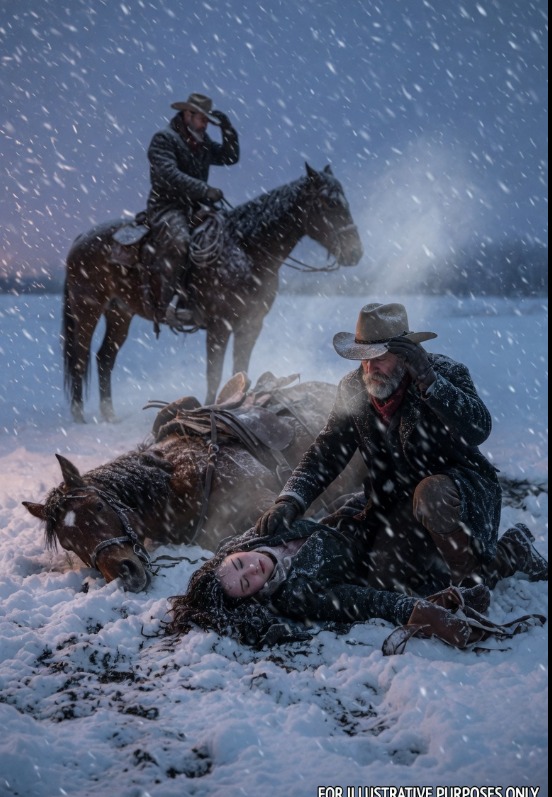
And a woman who had nearly stopped believing in goodness opened her eyes beside a fire and found it watching over her with bandaged hands.
On winter nights, when snow pressed against the windows and the old gelding stood warm in the barn, Luke still made coffee before dawn. Habit, he claimed. Clara never corrected him.
She only set out the second cup.
Two cups. Both empty. The fire held.
See more on the next page
Advertisement