
At about ten feet down, the temperature dropped. Not cold, exactly, but cooler than the sunbaked world above. The stone lining was rough under my hands. Dirt sprinkled into my hair every time my boots shifted. When I reached the bottom, I stood still for a second and let the dark settle.
“Cole?” Maisie’s voice echoed from above.
“I’m good. Come slow.”
She climbed down with more confidence than I liked.
At the bottom, the flashlight beam showed broken planks, an old rusted bucket, and the shallow depression where groundwater had once collected. The walls were ordinary at first glance. Stone, dirt, roots pushing through seams.
Then Maisie pointed.
“There.”
On the north side, about waist height, one section of stonework looked newer. Not new. Just less ancient. The mortar was smoother. One flat stone in the center had a small carved mark: a five-pointed star.
We cleared debris away and ran our fingers around the edges.
“Secret door,” Maisie said, delighted.
“It’s a niche,” I said.
“Niche sounds disappointing.”
We used the pry bar.
The stone resisted, then gave with a cracking sigh that showered us in grit. Behind it was a narrow cavity just big enough to hold a wrapped bundle.
I pulled it free carefully.
Oilcloth again. Grandma liked things to survive.
Inside was a leather journal, a silver dollar from 1889, and a narrow strip of buckskin with a sequence of symbols burned into it—three short lines, a circle, and what looked like a crooked arrow.
The journal’s first page read:
Walter Hart — Notes on My Father’s Foolishness and Other Family Burdens
Maisie actually bounced on her heels. “I love him already.”
Most of the journal was written in a cramped, practical hand. It wasn’t a diary so much as a record of things Walter had been told and things he suspected. The first useful passage came five pages in.
Father said Ezekiel never trusted the sheriff after Red Hollow. Said Amos Colton rode with men who wanted the box before the dead were cold. Ezekiel hid it where water had been but would not be again, and where the earth would keep a second secret beside the first.
Another page:
June thinks the old shaft under Twin Teeth ties into the wash tunnel. I told her she was chasing desert stories. She proved me wrong once already.
And later:
If I die before this is settled, any Hart who reads this should know the treasure is not only the box. There are papers with it. Those matter more than the coin.
I read that line twice.
“Papers?” Maisie asked. “What papers?”
“I don’t know.”
But suddenly the whole thing felt bigger than buried money.
Maybe the Coltons weren’t after gold at all.
Maybe they wanted whatever those papers could prove.
The last useful page included a rough sketch: the well, the ridge, the dry wash, and a line leading from the well to a point marked cold vent near the base of the cliff.
Below it, Walter had written:
Listen for the hollow wind below the split stone. Not the first crack. The second.
We climbed out with the journal and sealed the niche again as best we could.
On the drive back to the house, neither of us talked much. The ranch rolled by in heat and silence, but now I saw it differently—not as land, but as layers. Things hidden inside things. Stories buried under dust and waiting for the right hands.
Back at the house, we spent two hours going through Walter’s journal. Most pages were family accounts, cattle tallies, weather notes, repairs. Then Maisie found a loose sheet tucked into the back cover.
It was a copy of a handwritten statement signed by a man named Thomas Bell, dated 1892.
I state under no force that Amos Colton lied regarding Ezekiel Hart’s possession of the payroll box. I heard Amos say he aimed to retrieve it after Hart led them wrong. I was afraid then and am ashamed now.
There was no official seal, no witness signature, nothing that made it legally solid on its own—but it was something.
And if more papers like that were hidden with the box, then the treasure could expose a very old lie.
“Wade wants this gone,” I said.
Maisie nodded. “Because if the papers prove a Colton framed Ezekiel, then the whole family legend changes.”
“Maybe more than the legend.”
“Like what?”
I thought of land claims. Water rights. Old fraud that might connect to present ownership. Greedy men rarely chased antiques for sentimental reasons.
Before I could answer, we heard tires on gravel.
I looked out the kitchen window.
Not Wade.
Sheriff Bellamy.
She parked near the porch, got out, and looked toward the ridge before she ever looked at the house. That made me wonder how much she already suspected.
We met her outside.
She held up a small evidence bag. Inside was a broken padlock.
“Found this near your west boundary this morning,” she said. “Fresh cut. Doesn’t belong to you, does it?”
“No,” I said.
Nora’s eyes narrowed slightly. “Then somebody was testing access.”
Maisie crossed her arms. “Wade?”
“Can’t prove it.” Nora glanced toward the barn. “You two been exploring up around Twin Teeth?”
My spine stiffened. “Why?”
“Because I saw your boot prints.”
She wasn’t accusing. She was observing.
I made a choice right then.
Not the whole truth. But some.
“We found old family notes,” I said. “About the land. About why my grandma didn’t trust the Coltons.”
Nora watched me a second longer than was comfortable. “And?”
“And I think Wade believes there’s something here.”
“That much I’d already guessed.”
She shifted her weight. “Listen carefully. Two nights ago, somebody ran plates on a truck registered to your estate. Yesterday morning, a survey crew filed a request to inspect adjoining parcels near the ridge. No permit’s been approved. That may be coincidence. I don’t believe in coincidence.”
“Should we leave?” Maisie asked.
Nora’s face softened by half an inch. “Not unless you want to. But you stop doing risky things alone. You understand me?”
I thought about the well and wisely kept my mouth shut.
She looked at both of us and knew anyway.
“You remind me of June,” she said. “That’s not always a compliment.”
After she left, Maisie sat at the table and tapped Walter’s journal.
“Cold vent,” she said. “Split stone. Second crack.”
“Tomorrow.”
“No,” she said. “Tonight we hide this somewhere better.”
She was right.
We wrapped the journal and documents in plastic, sealed them in a coffee can, and hid them beneath loose bricks inside the fireplace hearth.
Then we took turns pretending not to be nervous.
At a little past midnight, Deputy the cattle dog started barking outside.
Which would have been very alarming if Deputy had lived with us.
He didn’t.
I sat straight up on the couch.
Maisie whispered from under her quilt, “Did you hear that?”
I had.
I went to the window without turning on a light.
Moonlight silvered the yard. Ben’s dog stood near the barn, fur raised, barking toward the ridge. A second later headlights flashed beyond the far fence line—just once, then gone.
Not the road.
Inside the property.
My stomach dropped.
I grabbed Nora’s card and my phone.
By the time the sheriff answered, the lights were gone.
But whoever had come onto Hart’s End Ranch that night had not come by accident.
And now they knew we were running out of time.
Chapter 6: The Cold Vent
Sheriff Bellamy arrived in twelve minutes.
I know because I counted every second between the moment I called and the wash of headlights over the yard. In those twelve minutes, the ranch became a different place. Every creak in the walls sounded like a footstep. Every breath of wind through the screen door sounded like somebody trying the latch.
Ben came too, pulling up right behind the sheriff with Deputy in the front seat and a shotgun across the dash that he said later was “for coyotes and bad decisions.”
Nora searched the property with a flashlight and a deputy from the county office. They found tire tracks near the west fence and boot prints by the barn, but nobody on-site. The tracks led back toward the ridge, then disappeared into hard ground.
“Whoever it was,” Nora said, squatting near the prints, “they knew enough not to come straight up the drive.”
Ben stood with his thumbs in his belt loops, staring toward Twin Teeth. “Told you the smiley one wouldn’t quit.”
Nora looked up at me. “Anything missing?”
I checked the barn, the shed, the tack room. Nothing obvious.
“No.”
“Then they were scouting,” she said.
“For what?” Maisie asked.
But none of us answered because we all knew.
The next morning, after almost no sleep, Ben insisted on walking the lower pasture with me while Nora talked quietly with Maisie on the porch.
“You gonna tell me what you found yet?” Ben asked as we followed the fence line.
I hesitated.
He stopped walking and looked straight at me. “Cole. I’m not asking for greed. I’m asking because if you’re standing on something dangerous, I need to know how close you are to getting hurt.”
So I told him most of it. The windmill tin. The line shack packet. Walter’s journal. The singing well. The papers.
Ben listened without interrupting, which is a rare and useful quality.
When I finished, he let out a low whistle. “June really did it.”
“What?”
“She found Ezekiel’s trail and kept it alive.”
“You believe the treasure is real?”
He gave me a look. “Son, at this point I believe your family’s got half the county acting stupid over a box nobody’s seen in a hundred years. That’s real enough.”
I told him about the journal mentioning a cold vent and the split stone.
Ben rubbed his mustache. “There’s a limestone break at the north side of Twin Teeth. Small openings in the cliff face. Kids used to dare each other to stick hands in there looking for scorpions.”
“That sounds promising.”
“It sounds like a good place to get bit. I’m coming.”
I almost argued, but then I remembered the well and the headlights and decided maturity looked good on me.
Sheriff Bellamy wasn’t thrilled either, but after I showed her Walter’s copy statement and told her there might be more historical documents hidden with whatever else was out there, her expression changed.
“This stays off record for now,” she said. “If I make it official before we know what we’ve got, every rumor hound within fifty miles will be climbing your ridge by sunset.”
“So you believe us?” Maisie asked.
Nora looked at the old paper in her hand. “I believe your grandmother expected this. That’s enough.”
By late afternoon it was too hot to breathe right, so we waited until evening.
The four of us—me, Maisie, Ben, and Nora—hiked toward Twin Teeth with water, ropes, flashlights, pry tools, and more determination than caution. The ridge threw long shadows across the wash. Cactus wrens darted through scrub. The rocks glowed red-black as the sun lowered behind them.
The north side of the ridge was cooler, steep and cut with cracks where old water had carved into the stone. We found the split stone almost by accident: a tall slab cleaved in two, leaning against the cliff like a door left ajar.
Wind passed through the crack and came out with a low, hollow moan.
The cold vent.
“There,” Maisie said.
Below the split stone were two narrow openings in the cliff face. The first was visible and shallow. The second, partly concealed by brush and rubble, sat lower and farther back.
“Not the first crack,” I said. “The second.”
Ben set down his pack. “Well, Walter was dramatic, I’ll give him that.”
The hidden opening wasn’t much bigger than a crawlspace. Cool air breathed from inside. When I shined my flashlight in, I saw a narrow tunnel angling downward through stone and packed dirt.
“Looks natural for the first few feet,” Nora said. “Then maybe widened.”
“By who?” Maisie asked.
Ben snorted. “Probably somebody with a real good reason.”
We cleared brush and loose rock, then went in one at a time.
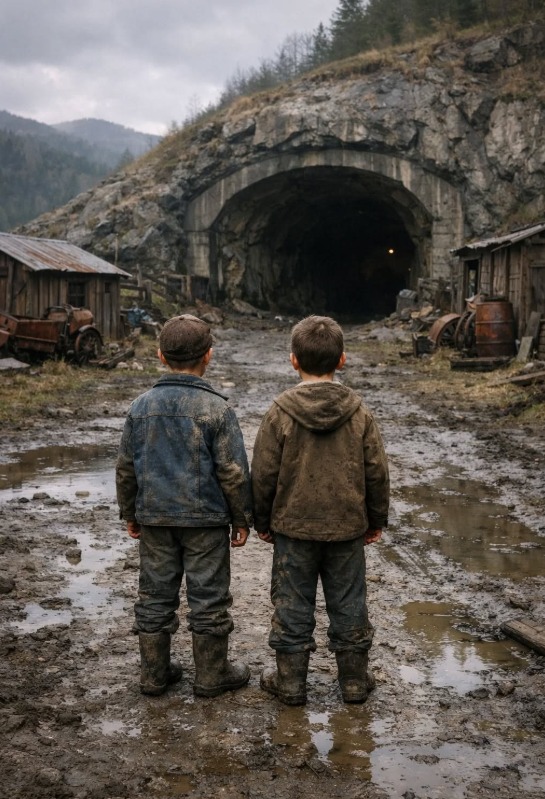
The tunnel was tight enough to force us onto our knees at first. Dust coated everything. The air smelled of minerals and age and something faintly metallic. After about twelve feet it opened into a low chamber tall enough to crouch in.
My flashlight beam found old timber braces blackened with time.
“Mine shaft?” I whispered.
“Maybe an exploratory cut,” Ben said from behind me. “Small one. Folks dug all over these hills back in the day looking for silver, copper, anything that glittered.”
On the far wall, partly hidden by rockfall, was a narrow wooden door reinforced with iron bands.
My skin prickled.
Someone had built that.
Nora stepped beside me and ran her light over the hinges. “That’s old.”
“Can we open it?” Maisie asked.
Ben put a hand on the timber brace overhead. “Slowly. If this chamber shifts, we all have a bad evening.”
The door wasn’t locked, but it had swollen tight over time. It took all four of us working the pry bar and pulling in turns before it groaned inward.
Behind it was another chamber.
Smaller. Drier. Deliberate.
Shelves carved into the wall held rusted lanterns, a broken pickaxe, and two rotted crates collapsed into themselves. In one corner sat a cedar chest banded in black iron.
No movie soundtrack played. No shaft of heavenly light broke through the ceiling.
But every person in that chamber went still.
The chest was real.
After all the clues and stories and warnings, it sat there like history with a pulse.
Maisie whispered, “Oh my God.”
Ben crossed himself without irony.
Nora said nothing at all.
The chest was waist-high, dust-coated, and locked with an iron clasp that had rusted almost through. On the lid, barely visible under grime, was the same five-pointed star we had seen in the well.
My hands shook so hard I had to wipe them on my jeans.
Ben crouched beside it and tested the lid. “No obvious trap.”
“Comforting,” Nora said.
We forced the clasp.
The chest opened with a crack and a smell of cedar, dust, and old paper.
Inside, wrapped in oilcloth and canvas, were bundles.
The first bundle held stacks of gold coins in cloth sleeves, tarnished silver dollars, and velvet bags heavy with uncut turquoise the color of desert sky after rain.
Maisie put both hands over her mouth.
The second bundle held paper packets sealed in waxed cloth. Deeds. Letters. Affidavits. Survey notes. A leather folio tied shut with rawhide.
The third bundle held a revolver, rusted but recognizable, and a small tin box.
My heart beat so hard it hurt.
“Don’t move too much yet,” Nora said sharply. “We document first.”Generated image
She took out her phone and photographed everything from every angle. Ben did the same. I knelt and picked up the leather folio carefully.
Inside were folded documents, one signed by a county clerk in 1893, one by a territorial judge’s office, and several personal statements. The names Amos Colton and Ezekiel Hart appeared over and over.
The clearest document was a notarized confession from Thomas Bell—the same man whose copy Walter had kept.
This version was official.
It stated that Amos Colton had falsely accused Ezekiel Hart of theft to divert suspicion from his own role in the Red Hollow ambush. It also said Ezekiel had hidden the payroll box and certain land records after learning that Colton and two others intended to seize not only the shipment, but also survey papers proving access rights to a spring-fed drainage crossing Hart land.
I looked up at Nora. “What does that mean?”
She took the paper and scanned it, then let out a low breath. “It means the treasure included evidence. Maybe enough to prove your family’s claim against old fraudulent encroachments. Maybe enough to explain why June never sold.”
Ben whistled softly. “Lord above.”
Then Maisie opened the tin box.
Inside was a folded note in Grandma June’s handwriting.
If you found this, you earned it. Don’t let the wrong men turn old blood into new money. The coin can buy freedom. The papers can buy justice. Keep both safe.
My throat tightened so suddenly I had to look away.
Grandma had known.
Maybe not where she’d die or when we’d arrive. But she had known enough to leave a trail only we could follow.
Nora took the note and read it once, then handed it back. “We need to get this out of here now.”
That was when the flashlight beam cut across the chamber from the tunnel entrance.
A voice called, almost cheerful, “I had a feeling I was late to my own party.”
Wade Colton.
He stood in the outer chamber with two men behind him, both carrying flashlights and one carrying a handgun low at his side. Wade himself didn’t look surprised.
He looked pleased.
“Thank you,” he said, smiling into the dark. “I knew June left something, but I never expected her grandchildren to be this efficient.”
Nora moved in front of Maisie at once, one hand going to her holster. “Back out, Wade.”
He raised both palms. “Sheriff, let’s not turn a historical misunderstanding into paperwork.”
“You brought an armed man onto private property.”
“He’s licensed.”
The man with the gun grinned.
Ben stepped forward. “You’re about one breath from getting real stupid.”
Wade’s gaze drifted to the open chest. Gold glinted in the flashlight beams. The papers lay spread across my hands and Nora’s.
There it was.
The look greedy men get when myth becomes inventory.
“I think,” Wade said softly, “those items belong in a more secure arrangement than two children and a county sheriff can provide.”
“They belong to the Harts,” Nora said.
Wade tilted his head. “Does history really belong to whoever happens to trip over it?”
“No,” I said. “It belongs to the people your family lied to.”
That got his full attention.
His smile thinned.
“Careful, son.”
Maisie took one step closer to me. “Or what?”
The man with the gun shifted.
Everything in the chamber seemed to go razor-tight.
Wade sighed like a disappointed teacher. “This could have been simple. A quiet sale. Generous cash. New lives for everyone. Instead you dug up old resentments.”
“Funny,” Nora said. “That’s usually what graves are for.”
Wade’s expression finally hardened. “Give me the folio.”
Nora drew her weapon.
The tunnel exploded into motion.
Ben lunged sideways, slamming his shoulder into the armed man just as he raised the pistol. The shot went wild, deafening in the stone chamber. Maisie screamed. I shoved the folio behind me and tackled the second man into the wall.
Dust poured from the ceiling.
Nora shouted, “Down!”
The chamber shook with another crack overhead.
Timbers groaned.
Wade swore and stumbled backward as loose rock rained down between the chambers.
Ben wrestled the gun from the man’s hand. Nora pinned the second man against the wall with terrifying efficiency. I got up gasping, ears ringing, and grabbed Maisie by the arm.
“Move!”
The ceiling above the outer chamber was collapsing.
Not a full cave-in, but enough. Enough to bury someone slow.
Wade scrambled for the tunnel opening, half-crawling, half-falling. One of his men shoved past him. Dust blotted the flashlight beams into gray cones.
Ben hauled the disarmed gunman by the collar. Nora shouted into her radio. Stone cracked like gunfire overhead.
I looked back once and saw the cedar chest still open, gold gleaming under falling dust.
The earth had hidden it for over a century.
Now the earth seemed ready to swallow it again.
We got out barely ahead of the collapse.
By the time we crawled into open air, coughing and blinking under the darkening sky, the second chamber entrance was blocked by a slab of fallen stone and a spill of rubble.
Wade staggered to his feet twenty yards away, face and shirt gray with dust, all charm gone.
Nora trained her weapon on him. “Do not move.”
This time, he listened.
And standing under the shadow of Twin Teeth ridge, with the desert wind rising and the sheriff’s radio crackling for backup, I realized something important.
Finding the treasure was only half the story.
Keeping it was going to be war.
Chapter 7: What the Papers Proved
Wade Colton spent that night in a holding cell in Red Canyon, furious, filthy, and finally without a smile.
Sheriff Bellamy charged him with criminal trespass, conspiracy, intimidation, and unlawful entry with armed accomplices pending more formal review from the county. It wasn’t everything he deserved, but it was a beginning.
The problem was the treasure.
The chamber entrance was partially collapsed, unstable, and officially now part of an active criminal and historical investigation. By sunrise, the county had tape around the ridge, a deputy parked near the trail, and more local gossip than the town had seen since a pastor ran off with a car dealer’s wife in 2008.
Elena drove in from Tucson before noon.
She walked into the ranch house, listened to the whole story without interrupting once, then set her briefcase down on the table and said, “Well. That escalated.”
Maisie, who had not slept and had apparently decided sarcasm was her life raft, pointed to the coffee pot. “You’re gonna need that.”
Elena did.
By the time she finished her second cup, the kitchen table looked like mission control. Sheriff Bellamy sat with a legal pad. Ben leaned against the counter. I spread out copies of the documents we had managed to photograph before the cave-in. Nora had transferred them from her phone to a printer at the county office that morning.
The gold and most of the original papers were still inside the blocked chamber.
But the photos were enough to start.
Elena scanned the notary statements and the old territorial record, then turned to the survey pages and deed fragments.
“This is bigger than a treasure claim,” she said.
“How much bigger?” I asked.
She tapped a 1893 survey addendum. “If authentic—and they appear authentic—these documents show that Ezekiel Hart held legal access rights to a spring drainage route that was omitted from later revised plats after the Red Hollow incident.”
Ben frowned. “In English?”
“It means part of the water corridor and adjoining use rights may have been stripped from the Hart property under false pretenses and folded into adjacent claims that passed through other hands.”
“Colton hands?” Maisie asked.
Elena looked at her. “Possibly at first. Later transferred, subdivided, disputed, maybe ignored. But if these records survived and were never officially voided, then June Hart may have been sitting on proof that her family was cheated.”
Nora leaned back in her chair. “Which gives motive.”
“Exactly,” Elena said. “Not just for greed. For suppression.”
I sat there trying to take it in.
All my life, adults had treated family history like background noise. Old grudges. Old stories. Old names. Suddenly those old names had teeth.
“What happens now?” I asked.
Elena’s expression sharpened. “Now we move faster than anyone trying to bury this again.”
By afternoon, she had filed emergency motions to freeze any adjacent development petitions affecting Hart land, request state historical oversight for the chamber, and secure temporary protective custody over the discovered materials on behalf of the estate.
For a woman in a navy blazer, Elena could be terrifying.
Meanwhile, Ben and I rode the ranch boundaries to make sure no one else had cut fencing or tampered with the place. Maisie stayed with Nora at the house, copying every line from the photographed papers into a notebook “in case the universe decides to be dramatic again.”
The ranch looked different to me now.
Still dry. Still rough. Still expensive in all the ways that matter.
But under the sun-baked skin of it ran a vein of history nobody had managed to kill.
Toward evening we found another problem.
At the north fence near the county wash, one of the posts had been spray-painted in red:
SELL OR LOSE IT
I stared at the words until my vision blurred.
Ben touched the paint with one thick finger, then looked toward the road. “Cowards always write on wood instead of speaking from their own mouths.”
I took a photo and called Nora.
She arrived forty minutes later, jaw tight, and added vandalism to the growing list.
“Wade still has friends,” she said.
“No kidding,” Maisie muttered.
That night we ate chili from a pot on the stove while the kitchen fan clicked like it might die at any moment.
Maisie set down her spoon and said, “What if this never stops?”
Nobody answered right away.
The truth sat between us.
Treasure stories end with a chest opening. Real life begins there.
Elena finally said, “It may not stop quickly. But that doesn’t mean it wins.”
Maisie looked at her. “You talk like somebody who’s done this before.”
Elena’s mouth curved a little. “I grew up with three brothers and a grandfather who kept land records in shoeboxes. I assure you, property fights are America’s favorite blood sport.”
That got a tired laugh out of me.
Later, after everyone had gone and the house was quiet again, I stepped onto the porch alone.
The desert at night is a different country.
The heat loosened. The stars came hard and bright. Somewhere out in the dark a coyote barked. The wind carried dust and sage and distance.
Maisie came out and sat beside me on the porch swing.
“Can’t sleep?” I asked.
She shook her head. “Every time I close my eyes, I hear that gunshot.”
“Yeah.”
After a minute she said, “Do you ever think Mom knew about any of this?”
I looked out at the ridge line. “Maybe some of it.”
“She should’ve told us.”
Maybe. But parents are just people standing in front of children trying to look like answers. Most of them aren’t.
“Grandma told us,” I said.
Maisie leaned her head on my shoulder. “In the most dramatic possible way.”
“Very on-brand.”
We sat there in silence until she said, “Do you know what I keep thinking?”
“What?”
“That if Aunt Linda hadn’t kicked us out, we might never have come here in time.”
The thought hit me like a blow.
Because she was right.
If we’d stayed in that house—small, humiliated, surviving but not living—Wade might have gotten the ranch cheap. Or the papers might have stayed buried until the wrong people dug first.
Sometimes cruelty shoves you toward the very thing meant to save you.
The next morning, state historians arrived with a geotechnical crew. By afternoon they had stabilized the chamber entrance enough to begin careful recovery. Nora kept the site controlled. Elena hovered with paperwork like an avenging angel. Ben supplied opinions nobody asked for and most people needed.
Maisie and I were allowed to observe from outside the perimeter.
Hours later, a conservator emerged carrying a sealed evidence container with the leather folio inside.
Then another with coin bundles.
Then another with the turquoise.
The cedar chest itself came out near sunset, black iron bands flaking, star carved on the lid, older and smaller than all the trouble it had caused.
I thought seeing it in daylight would make it less magical.
It didn’t.
It made it more real.
And real things are always heavier.
When the final catalog was done, Nora let us review the secured inventory in the county office.
The treasure included:
Two hundred thirty-seven gold coins of mixed mint years.
Assorted silver dollars and trade coins.
Five velvet sacks of rough turquoise.
A rusted revolver likely tied to the period.
Original affidavits naming Amos Colton in the Red Hollow fraud.
Survey documents and access records involving Hart land and spring drainage rights.
Personal letters from Ezekiel’s son describing threats made after the shooting.
Grandma June’s note.
Walter Hart’s cross-reference sheet from 1974.
A hand-drawn map linking the well, ridge chamber, and wash tunnel.
Elena sat back from the table and said, almost reverently, “This will hold.”
“What does that mean?” I asked.
“It means the evidence trail is stronger than rumor. It means Wade’s people can’t laugh this off as fantasy. It means your grandmother preserved history better than half the state archive.”
Nora folded her arms. “It also means the Coltons may finally be publicly tied to a lie they’ve been living off for generations.”
“Will that change anything?” Maisie asked.
Elena looked at her. “Yes.”
And she was right.
Because two days later, the Arizona papers picked up the story.
Not the treasure-hunter nonsense. The real story.
Historic Cache and Fraud Documents Recovered at Red Canyon Ranch
The article named Hart’s End Ranch. It named June Hart. It referenced territorial records, disputed claims, and an ongoing investigation into unlawful interference by private development interests.
Wade wasn’t convicted yet. But he was exposed.
And exposed men make mistakes.
On the third day after the article ran, Elena received a call from a Phoenix attorney representing Desert Crest Development. They wanted to distance themselves from Wade Colton. They claimed he had exceeded his authority. They also quietly withdrew their pending interest in several Red Canyon parcels.
On the fourth day, Aunt Linda called for the first time in months.
I let it ring out.
Maisie sent it to voicemail and laughed so hard she cried.
On the fifth day, the real blow landed.
A retired surveyor from Tucson, after seeing the article, contacted Elena with records from his late father’s files—files indicating that a 1962 revision of parcel boundaries near Hart land had relied on older, already-disputed assumptions that favored neighboring holdings descended from Colton-linked claims.
Even if the practical land recovery took years, the principle was there.
The Harts had been cheated.
And now there was proof.
That night we sat around Ben’s back patio eating grilled chicken and corn while Deputy lay under the table like a saint of spilled food.
Ben raised a glass of iced tea toward us.
“To June,” he said. “Mean enough to outlive fools even after she died.”
We all drank to that.
But later, as the stars came out and the air cooled, Nora pulled me aside near the truck.
“Wade made bail this afternoon,” she said.
All the peace drained right back out of me.
“On conditions,” she added. “Restricted movement. No contact orders. Plenty of eyes on him.”
“That doesn’t make me feel better.”
“It shouldn’t.” She looked toward the dark line of Twin Teeth ridge. “Men like him don’t forgive public humiliation.”
I understood what she was really saying.
The story wasn’t over.
Not until Wade Colton accepted that he had lost.
And men built on entitlement rarely know how to lose quietly.
Chapter 8: The Fire at the Barn
The fire started three nights later.
I woke to Maisie shouting my name and the smell of smoke punching through sleep like a fist.
At first I thought I was dreaming. Then I opened my eyes and saw orange light flickering across the bedroom wall.
“Cole!”
I was out of bed before I was fully awake.
The barn.
One whole side glowed through the dark, flames licking up old wood and dry hay. Heat hit my face the second I burst onto the porch. Maisie was already dragging the hose from the side of the house, barefoot in jeans and one of Grandma’s old T-shirts.
“Call nine-one-one!” she yelled.
I did while running.
The hose pressure was weak and pathetic, barely enough to spit at the flames. I grabbed two buckets from the porch and sprinted toward the stock tank, sloshing half the water out before I got back. It felt useless. Tiny. Stupid against that much fire.
Then Ben’s truck came tearing down the drive like judgment day.
He and Deputy hit the ground moving. Ben had a portable pump in the truck bed and didn’t waste a second with questions. He barked orders, I followed them, and together we got a heavier stream going from the tank.
Nora arrived right behind the volunteer fire crew.
For the next twenty minutes everything became noise—shouting, crackling wood, boots on dirt, the reek of burning hay and old oil, water hissing into flame, sparks flying into the black sky.
We saved the house.
We saved the tack room.
We did not save the barn wall.
By the time the last flames were knocked down, one whole side had collapsed inward and the roof above the loft was gone.
Maisie stood beside me shaking so hard I wrapped my arm around her without thinking. Soot streaked her face. Her hair smelled like smoke. She looked fourteen and furious and exhausted.
Nora came over with her jaw set.
“This wasn’t accidental,” she said.
“How do you know?” I asked, though I already did.
She held up a blackened glass bottle with rag remnants at the neck.
Molotov.
Ben muttered something in Spanish I didn’t need translated.
Maisie’s voice went thin. “Wade?”
Nora looked toward the burned barn. “Maybe him. Maybe somebody trying to impress him. Either way, this became attempted arson on occupied property.”
The volunteer fire chief joined us. “Lucky the wind stayed low. Another fifteen minutes and the whole place might’ve gone.”
Lucky.
I looked at the ruined barn and thought about how close we’d come to losing the only place that had ever felt like ours.
Something hard settled in me then.
Not fear. Fear had been there from the beginning.
This was anger, sharpened past trembling into purpose.
The next day Nora got the break she needed.
A gas station camera in Red Canyon caught Wade’s cousin, Travis Colton, buying fuel, beer, and two bottles of cheap whiskey an hour before the fire. Another camera from the highway showed his truck heading toward Hart’s End after dark. By afternoon deputies found the truck hidden behind a machine shed on a friend’s property, smelling of smoke and gasoline.
Travis was arrested.
Wade denied everything, of course.
But denial gets harder when your people are stupid on camera.
Travis broke faster than anyone expected.
Maybe it was the evidence. Maybe it was that Wade had left him holding the match. Either way, he gave a statement: Wade hadn’t explicitly ordered the fire, but he had spent days raging about “those Hart kids,” “the ranch,” and how if the place became unlivable, maybe they’d finally sell or run.
It wasn’t enough for a clean arson conspiracy charge on Wade by itself.
But it helped.
A lot.
By then the story had gotten too big for Red Canyon to contain. State investigators got involved. A historical society petitioned to preserve the chamber site. Reporters called Elena hourly. She told most of them nothing.
Meanwhile, life on the ranch kept demanding ordinary things in the middle of extraordinary chaos.
Fence posts still needed setting. Groceries still needed buying. The porch light still shorted out if you slapped the switch wrong. I still had to learn how to keep a water pump running and patch a roof seam and make enough money not to drown.
Treasure does not immediately solve practical life. That’s one of the meaner truths nobody tells children.
Most of the coin remained under legal protection while estate valuation, historical review, and chain-of-title arguments got sorted. But Elena petitioned successfully for limited estate relief against the property tax burden, and one approved emergency liquidation of nonhistorical coin value paid the overdue taxes, barn stabilization, legal costs, and essential repairs.
It wasn’t Hollywood rich.
It was better.
It was breathing room.
The first thing Maisie wanted to buy was new locks.
The second was a pair of proper work boots.
The third was paint for the kitchen because, in her words, “if criminals are going to try to destroy our lives, they do not also get to make me stare at ugly cabinets.”
So we painted them cream.
It felt bizarrely victorious.
A week after the fire, Ben and half the town showed up for a barn-raising cleanup that no one called a barn-raising because the new structure wasn’t going up yet, but that’s what it was in spirit. Men brought lumber scraps and tools. Women brought casseroles and tea and opinions. Teenagers dragged debris. Kids chased Deputy around the yard.
Red Canyon had decided.
Not in a speech. Not in some dramatic vote.
In labor.
That is how real towns take sides.
Ruby from the diner brought pecan bars and said, “June once got my ex-husband to admit he was hiding gambling debts just by staring at him while he ate pie. This is for her.”
The hardware store owner knocked twenty percent off every nail and hinge we bought after that.
Even the gas station men under the awning started nodding when we drove by, which in small-town language is practically adoption.
Late that afternoon, while everyone worked, Maisie stood on the porch with her hands on her hips and said, “You realize Grandma basically set up a posthumous revenge campaign.”
I laughed. “That is one way to put it.”
“No, seriously. She left us the ranch, the clues, the proof, the treasure, and a whole town full of people who remembered exactly who the bad guys were. That’s art.”
It kind of was.
But revenge wasn’t the whole story.
Because underneath all the anger and danger and old lies, Grandma had done something else too.
She had given us a place where we mattered before we knew we did.
A few days later Elena came out with more papers and better news.
The state had authenticated the primary affidavits and surveys. More importantly, the historical review found that the chest and documents were legally recoverable by the estate because they had been hidden on private family land and preserved through demonstrable inheritance continuity.
In plain language:
They were ours.
Not every adjacent land issue was instantly resolved, but the Hart name had gone from local rumor to documented wronged party in an official record.
Wade’s attorneys tried to challenge standing.
They lost.
Then came the final crack.
An investigator uncovered emails showing Wade had been pressuring Desert Crest to secure Hart’s End quickly before “legacy documents” surfaced that could “complicate old boundary assumptions.”
He had known.
Maybe not every detail. But enough.
Enough to stalk an old woman’s ranch. Enough to smile at kids. Enough to send people after what he thought should belong to him.
When Nora told us, she did it with the calm satisfaction of somebody setting down a card that wins the hand.
“He won’t wriggle out of all of it,” she said. “But he’s done here.”
“Done like prison done?” Maisie asked.
Nora’s mouth twitched. “I never promise dessert before it’s served. But the menu improved.”
That night, after everyone left and the ranch went quiet again, I walked out to the windmill.
Its blades turned slowly in the evening breeze.
The stones at its base glowed amber in the lowering sun.
This was where the trail had begun.
A shadow. A tin. A letter from Grandma telling us not to trust smiling men.
I sat on the concrete base and looked out at Hart’s End Ranch—the patched fences, the damaged barn, the house with smoke stains now scrubbed from the porch, the far ridge standing dark against the sky.
I thought about the night Aunt Linda threw us out with one duffel bag.
I thought about how close we’d come to never getting here.
Then Maisie walked up carrying two glasses of sweet tea and handed me one.
“You look dramatic,” she said.
“I learned from the best.”
She sat beside me. For a while we watched the land breathe in sunset.
Then she said, “Do you think the treasure was the coins or the papers?”
I looked at the house.
At the repaired porch light.
At the truck parked out front.
At the place where people now came because they wanted to help, not because they wanted to take.
“No,” I said. “I think the treasure was Grandma making sure nobody could erase us.”
Maisie was quiet a moment.
Then she nodded.
And somewhere down the road, whether in a courtroom or a cell or just inside the shrinking walls of his own failure, Wade Colton was finally learning something my family had known for generations.
The desert is patient.
It buries lies for a long time.
But when the wind changes, it gives them back.
Chapter 9: The Trial of a Smiling Man
The case against Wade Colton took four months to reach court.
That may not sound fast if you’ve never seen the legal system work, but in rural Arizona, with criminal charges tied to property intimidation, trespass, armed unlawful entry, and related evidence from an ongoing historical fraud inquiry, it moved like a brushfire.
By then summer had begun to loosen its grip. The mornings came cooler. The sky sharpened. The ranch started to feel less like a battlefield and more like a place that could survive being loved.
We rebuilt the barn frame with salvaged beams and county-approved permits. I learned how to replace roof panels without losing a thumb. Maisie planted tomatoes in tubs by the porch and declared them “an act of agricultural rebellion.” Ben pretended not to be impressed until the first ripe ones came in.
But underneath the daily work, the trial sat there waiting.
Wade had money, which meant lawyers. Good ones too. Men in expensive suits who used phrases like misunderstanding of intent and aggressive negotiation mischaracterized by emotional witnesses. They tried to paint him as a businessman pulled into a local myth by reckless children and a sheriff with a grudge.
That strategy lasted about one hour.
The prosecution had the following:
Wade’s presence at the chamber with armed men.
Witness testimony from Nora, Ben, me, and Maisie.
The recorded 911 timeline from the night of the armed confrontation.
Survey requests and plate checks showing premeditated tracking of the property.
Emails referencing “legacy documents.”
Travis Colton’s statement linking Wade’s pressure campaign to the fire.
The trespass pattern before the discovery.
Documentation that Wade attempted a fast private purchase while concealing knowledge of likely historical complications.
In short, he was cooked.
Still, trials are not movies. They don’t move in a straight line. They drag. They circle. They make truth repeat itself until it sounds tired.
Maisie and I had to testify.
The night before, she sat at the kitchen table in one of Grandma’s flannel shirts, hands around a mug of tea she wasn’t drinking.
“I hate this,” she said.
“Me too.”
“What if I cry?”
“Then you cry.”
“What if I get mad?”
“Then try not to punch anybody.”
She smiled a little at that.
Then she said, “Do you think Grandma would’ve testified?”
I thought about June Hart in boots and silver rings, punching liars in livestock parking lots.
“Oh, absolutely.”
Maisie looked down at her mug. “Then I can do it.”
In court, Wade wore a dark suit and the same polished expression he’d worn the first day he came smiling to the line shack. But it was weaker now. Cracked around the edges.
When Maisie took the stand, she looked younger than fourteen and steadier than most adults.
The defense attorney tried the gentle-dismissive approach first.
“You were excited by the idea of treasure, weren’t you?”
“Yes,” Maisie said.
“And that excitement may have affected your interpretation of events?”
“No.”
“Why not?”
“Because a man bringing an armed friend into a hidden chamber while demanding papers isn’t open to interpretation.”
There was a small pause in the courtroom.
Then a few muffled coughs that sounded suspiciously like laughter.
I almost smiled.
When it was my turn, the defense tried to push harder.
“You dislike Mr. Colton, correct?”
“Yes.”
“So your testimony may be influenced by that personal bias.”
“No.”
“How can you be sure?”
Because he smiled at children while trying to steal from them, I wanted to say.
Instead I said, “I disliked him after he showed up on our property uninvited, pressured us to sell, watched us for days, entered a hidden chamber with armed men, and then his cousin helped set our barn on fire. So yes, I dislike him. That came after the facts, not before them.”
The prosecutor looked pleased.
Nora’s testimony was clean and brutal.
Ben’s was drier, meaner, and somehow even more effective.
Then came the documents.
Experts authenticated the territorial records. A historian explained the Red Hollow context. A survey analyst testified that the recovered access papers were consistent with later omitted boundaries in a way that materially supported the Hart family’s longstanding grievance.
Wade’s attorney objected repeatedly.
The judge allowed enough.
The old lie was finally being said out loud in a room where it mattered.
On the fifth day of proceedings, Travis Colton took the stand under cooperation terms.
He looked sick.
He admitted Wade had been obsessed with Hart’s End, convinced June had hidden “proof and value.” He admitted Wade ordered watchers on the property. He admitted Wade said if the kids got spooked enough, “they’ll sell before they understand what they’re sitting on.” He admitted Wade raged after the article and fire investigation began.
Wade sat very still through all of it.
That was the first time I realized he had truly lost.
Not because the law was perfect.
Not because every wrong would be repaired.
Because the performance was over.
Everybody in that courtroom could finally see the man underneath the smile.
The verdict came two days later.
Guilty on criminal trespass, intimidation, unlawful armed entry as a participating principal, conspiracy related to the chamber confrontation, and related interference counts. Not guilty on the highest arson linkage count directly, though the court cited the pattern of coercive conduct and Travis’s admitted actions for sentencing context.
It wasn’t everything.
It was enough.
Wade was remanded pending sentencing.
He turned once as deputies led him out.
For half a second his eyes met mine.
No smile.
Just hatred and disbelief.
Men like him never imagine a world where the people they step on stand up taller.
Afterward, on the courthouse steps, reporters swarmed Elena and Nora. Ben slipped away immediately because he claimed microphones caused hives. Maisie stood in the sun blinking like she’d walked out of a storm.
“You okay?” I asked.
She laughed once, breathless and strange. “I think so.”
Then she started crying.
Not big dramatic sobs. Just relief leaking out too fast to stop.
I hugged her while cameras flashed somewhere to the side and people shouted questions we didn’t answer.
Elena eventually steered us toward her car and said, “Congratulations. You survived both inheritance law and American court procedure. Few people do.”
Back in Red Canyon that evening, Ruby’s Diner put a hand-lettered sign in the window:
PIE FOR THE HARTS — ON THE HOUSE
The whole town might as well have been there.
Not to gawk. To witness.
That matters.
Because victory doesn’t always feel like trumpets and sunlight. Sometimes it feels like people handing you forks, slapping your shoulder, and saying, “About time.”
Ben raised his coffee mug in the diner and said, “To children who turned out mean enough to finish what June started.”
Maisie lifted her pie fork like a sword. “I accept.”
I laughed harder than I had in months.
And there, between the pie and the noise and the smell of fried onions that no longer meant the end of anything, I understood something I hadn’t seen clearly before.
The treasure did not save us by making us rich.
It saved us by forcing the truth into daylight.
And once truth gets enough witnesses, it stops being easy to bury.
Chapter 10: What We Kept
By the following spring, Hart’s End Ranch no longer looked like a place waiting to die.
The barn stood straighter. The porch had fresh paint. The kitchen cabinets were cream, exactly as Maisie had insisted, and the tiny garden by the porch had grown into raised beds full of tomatoes, peppers, and herbs she bullied into thriving with the intensity of a tiny general.
The state historical office completed its review and returned the family-held portions of the recovered treasure to the estate, with a handful of key documents and artifacts entering a shared preservation arrangement for exhibition and archival protection. Elena negotiated it so that the Harts kept ownership recognition and control over family materials while ensuring the papers would never disappear into somebody else’s private vault.
That part mattered to me more than I expected.
Some stories deserve locked cases.
Others deserve witnesses.
We did sell a portion of the nonunique coin under legal supervision. Enough to stabilize the ranch completely, set up a proper trust, fix the well system, rebuild the barn, clear the taxes, and create a future that didn’t hinge on daily panic. Elena and Nora helped arrange the paperwork that allowed me partial operational authority under estate oversight until adulthood. By then, nobody in town doubted we could handle ourselves.
Aunt Linda tried once to call again after the verdict.
I answered this time.
She launched into a speech about family, misunderstanding, stress, and how she had always wanted what was best for us.
I listened for twelve seconds and then said, “You threw children onto a curb.”
Silence.
Then she said my name the way people do when they think tone can replace apology.
I hung up.
Maisie asked what she said.
I told her, “Nothing useful.”
That was the end of that.
The real ending came on a bright April morning when the town unveiled a small historical marker near the Red Canyon courthouse.
Not a giant statue. Not a dramatic museum gala.
Just a bronze plaque set beside a mesquite tree.
It told the story of Red Hollow, the missing payroll, the false accusation against Ezekiel Hart, the eventual recovery of the evidence, and the role June Hart played in preserving the truth for future generations.
The wording had gone through six drafts because Ben claimed every draft sounded “written by people who iron socks.” But the final version was good.
At the bottom it said:
Recovered through the persistence of the Hart family and the courage to preserve truth across generations.
Maisie touched the plaque lightly with her fingertips.
“She’d pretend to hate this,” she said.
“She’d secretly love it.”
“She’d complain about the font.”
“Absolutely.”
Ben, standing behind us in a decent shirt that was clearly making him miserable, snorted. “Your grandma would say the plaque should be bigger and the fools smaller.”
Nora actually laughed.
After the ceremony, people drifted away in twos and threes. Elena drove back to Tucson. Ruby promised pie at the diner. Deputy stole a hot dog from a folding table and ran like a criminal genius. The day warmed. The sky stretched blue and endless over Red Canyon.
That evening Maisie and I rode out to Twin Teeth ridge.
We didn’t go to the chamber. That place belonged partly to history now. Instead we sat on a rise overlooking the ranch as the sun dropped behind the hills, pouring gold over the land.
From there Hart’s End looked the way Grandma must have seen it in the best moments—not broken, not cursed, not fought over.
Just stubbornly beautiful.
The windmill turned.Generated image
The barn roof flashed in the sun.
A line of fencing marked the pasture like a promise kept.
Maisie hugged her knees and said, “Do you ever think about that first night? At the motel?”
“All the time.”
“I thought we were done. Like really done.” She swallowed. “I thought getting kicked out meant the world had voted and we lost.”
I looked at the ranch below us.
“Maybe it did,” I said. “But Grandma appealed.”
That made her laugh.
Then she got quiet again.
“What are we going to do?” she asked.
“With the ranch?”
“With our lives.”
It was a big question, the kind that usually scares people because it sounds like it should have one clean answer.
But the desert had taught me otherwise.
Some things are built one fence post, one sunrise, one decision at a time.
“We keep it,” I said. “We run it right. We make it worth staying for. You go to college if you want. I maybe don’t get killed by a tractor. We hire help when we can afford it. We keep Grandma’s papers safe. We don’t let anyone smile us out of what’s ours.”
Maisie nodded slowly. “That sounds decent.”
“Yeah.”
She looked toward the ridge shadow. “And maybe someday, when people tell the story, they won’t just say we found treasure.”
“What’ll they say?”
She smiled, eyes on the ranch. “They’ll say two kids got thrown away and landed exactly where they belonged.”
The sun dropped lower.
For a minute everything turned copper and fire and long blue shadow. Then the first star came out above the desert.
I thought about Grandma’s letter.
Be brave for each other.
That was the real inheritance. Not the coin. Not even the ranch.
The instruction.
The trust.
The belief that we could carry what came before without being crushed by it.
When we finally rode back down toward the house, the porch light was on, warm against the dusk. The screen door stood open to evening air. Somewhere inside, the radio was playing old country low enough to sound like memory.
Home.
Simple word.
Hard-won thing.
And because Grandma June had been stubborn enough to leave a map instead of a surrender, because my sister had been brave enough to follow clues into wells and tunnels and courtrooms, because good people had stood beside us when it counted, Hart’s End Ranch was no longer a secret waiting to be stolen.
It was ours in daylight.
We tied the horses, stepped onto the porch, and looked back once more at the desert going dark.
The windmill turned slow and steady.
The twin rocks watched over the ridge.
And somewhere under all that open sky, the old lies finally stayed buried.
THE END
See more on the next page
Advertisement