
It was the first unvarnished truth she had spoken about herself since the funeral.
So she kept talking.
She told him the house was too large, too full of memory. The kitchen held Sunday mornings. The garden held her daughter’s tree. Every room was a trapdoor into the life she had lost.
“The world expects me to function,” she said. “I understand why. I have employees, partners, investors. But there is a gap between understanding what needs to be done and being able to do it.”
“What happens to your company when you’re not there?” Richard asked.
She gave a tired half-smile. “You ask very direct questions for a delivery man.”
“You give very honest answers for a billionaire,” he said.
For the first time since the accident, Florence laughed. It was brief, startled, almost guilty. It vanished as soon as it arrived, but something had cracked open.
When she stood to go, she picked up the envelope again and slipped it back into her pocket.
“I’m not going to offer this again,” she said.
“Because I’ll refuse again,” Richard replied.
“Yes.”
Before leaving, she asked, “What do you do when life gets heavy?”
Richard thought about it honestly.
“I ride. I work. I count what I have instead of what I don’t. And I remind myself the feeling has a bottom. It doesn’t go down forever.”
“Does that work?”
“Not always,” he said. “But it’s what I have.”
She nodded and drove away.
Then she came back.
Four days later. Then three days after that. Then twice in one week.
Always alone. Always unannounced. No cameras, no security team, no performance. She simply came and sat on the second plastic chair outside his door while he fixed punctures, sorted receipts, or ate whatever simple meal he had.
He stopped being surprised.
She said once, quietly, “This is the only place where nobody needs me to be anything.”
Richard understood that, so he never questioned it too much.
One day she arrived while he was preparing for a long delivery shift.
“I have work,” he told her.
“Can I come?” she asked.
He stared.
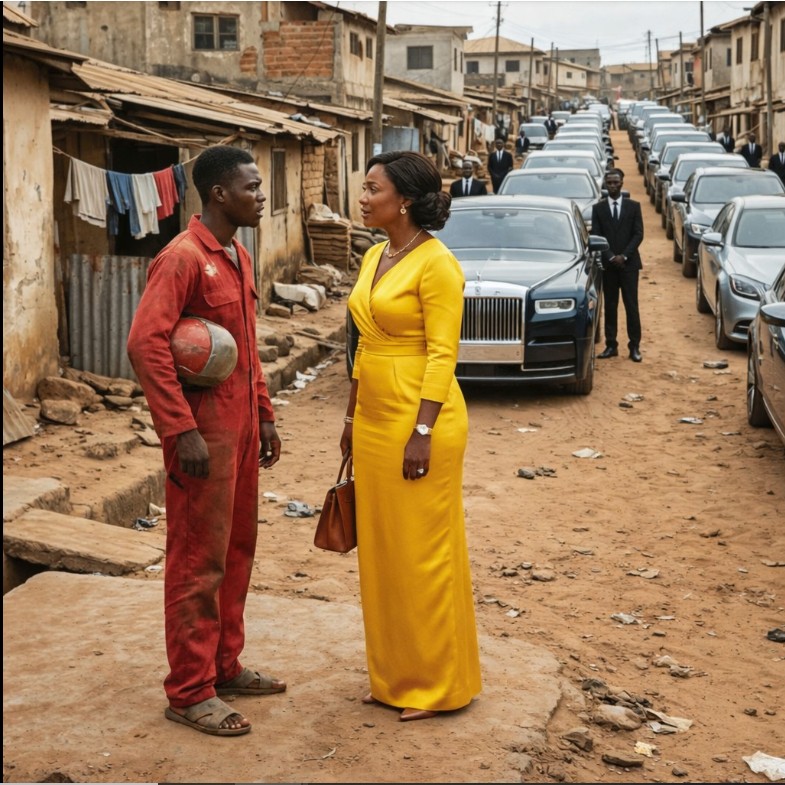
Florence Kingsley, one of the richest women in the country, rode on the back of his dented motorcycle wearing a spare helmet with a cracked visor. They delivered six orders that day. She climbed broken staircases beside him, stood at strangers’ doors, carried food, and sat with him at a roadside stall eating beans that cost almost nothing.
“This is very good,” she said, genuinely surprised.
“Mama Linda’s been making it the same way for twenty years,” Richard said.
“There’s wisdom in that,” Florence answered. “Knowing what works and not disturbing it.”
Over beans and cheap plastic cutlery, they spoke of Henry.
No one else had asked her what her husband had been like. They had mourned the loss, not the man.
“He remembered everything,” she said. “How people took their tea, what they said years ago, the names of their mothers. In a life where I was always the important one in the room, he made me feel like I could become less important in the best possible way.”
“And Olivia?” Richard asked.
Florence’s face changed.
“My daughter,” she said, “was going to be better than me at everything.”
She spoke of Olivia’s eye for buildings, of how she could walk down a street and see structural truths no one else noticed. She spoke again of the interview clothes, of the small human detail that somehow held the whole tragedy inside it.
The visits continued.
She ate more. Laughed more. Helped him organize his delivery receipts with ruthless efficiency. He kept extra water ready without admitting why. The second plastic chair became permanent.
But reality was gathering outside their small refuge.
One morning, Richard saw a headline on his cracked phone:
KINGSLEY GROUP IN CRISIS. WHERE IS FLORENCE KINGSLEY?
The article spoke of instability, investor concern, executive panic, a company drifting without its leader.
When Florence arrived that afternoon, Richard was waiting outside.
He showed her the article.
“I know,” she said.
“Are you reading the reports they send you?”
“A few.”
“Florence.”
It was the first time he said her name like that—plainly, directly, as someone speaking to a person rather than a title.
She looked up.
“The chair is not the solution,” he told her. “It’s a break from the problem.”
Her jaw tightened. “You don’t understand what it’s like to go back. You don’t understand that house. That office. Everywhere I look, there’s something missing.”
“I know I don’t understand that specific pain,” Richard said. “But I understand running.”
She went still.
“You’ve been running for five weeks,” he said, “and the pain is still exactly where you left it.”
His voice stayed gentle, but steady.
“Stopping doesn’t make it real. It’s already real. It was real the moment it happened. You don’t need to escape your life, Florence. You need to learn how to live in it again.”
The road was quiet. Somewhere nearby a child laughed.
Florence stood in her expensive casual clothes on his broken street with tears swelling in her eyes. Then, for the first time since the police told her about the crash, she let herself break.
Not dramatically. Not in the loud, cinematic way. Quietly—like old wood giving under patient weight.
Richard did not touch her. He did not rush forward. He simply stayed close enough for her not to be alone and still enough not to steal the moment from her.
When the tears passed, she wiped her face.
“I hate that you’re right,” she said.
“I know.”
She left that evening differently. Her back was straighter—not armored, just decided.
At the car, she turned to him. “I don’t know if I can do it.”
“I know,” Richard said. “But you can try.”
And she did.
Over the next three weeks, Florence walked back into her life one painful step at a time. She sat in her office until she could open the laptop. She reopened Olivia’s bedroom door and stood there until standing became bearable. She took meetings. Made decisions. Corrected mistakes. Spoke honestly. Her company stabilized. Investors quieted. Her team began to breathe again.
She was not the woman she had been before. That woman belonged to another life.
But she was building a new one.
And while she rebuilt herself, Richard was doing the same in his own quiet way. Counting dollars. Working long hours. Moving steadily toward the dream in the notebook beneath his mattress.
One Friday afternoon, Florence drove back to his street carrying warm beans from Mama Linda’s stall.
His door was locked.
The plastic chairs were gone.
The jacket no longer hung from the nail.
She asked the neighbor.
“He moved,” the woman said. “Last week. Said he finally saved enough for his shop. He was singing while he carried his things.”
Florence stood very still.
He was gone.
No note. No message. Just an empty room, a locked door, and the outline of a life that had briefly made space for her when she had nowhere else to land.
She sat on the edge of the road holding the warm container of beans. Around her, the city kept moving—children shouting, oil frying somewhere, radios playing, life going on in its ordinary, indifferent way.
And sitting there, Florence understood something.
Richard had not fixed her. He had not rescued her. He had not become an escape or a solution. He had simply been present—honestly, quietly, without asking for anything. At the exact moment her money, her power, and her name could not manufacture what she needed most, he gave her the one thing that mattered.
A place small enough for truth.
A chair.
A meal.
A night of safety.
A refusal to lie to her when the truth was the only useful thing left.
Eventually she found him. It took two weeks and the same people who always found things for her.
His shop was exactly as he had once described it: small, on a narrow road, hand-painted sign above the entrance.
Richard George Motorcycle Repairs.
The lettering was uneven. The door was open. Inside, Richard bent over an engine, focused, calm, fully inside the work of his own life. Beside him, a young apprentice handed him tools with careful attention.
Florence watched from across the road through her windshield.
She did not go in.
She sat there for a long moment, holding gratitude and grief and something unnamed where the two met. Then she started the car and drove away.
This time she drove with a destination. With both hands on the wheel. With her eyes on the road ahead, not the road behind.
The same city moved around her. The same noise, color, traffic, life. But now somewhere in that city was a small repair shop on a narrow road and a man who had almost kept riding.
She rolled down the window. Warm air rushed in.
And for the first time since everything had shattered, Florence Kingsley did not feel healed, or whole, or fine.
She felt something quieter.
She felt present.
She felt like a woman learning, one road at a time, how to live inside the life that remained.
And for now, that was enough.