
“Some.” She looked embarrassed. “I missed a lot. Mom said we’d catch up.”
“What about friends? Neighbors?”
Maisie’s face took on the solemn patience of a child humoring a question that did not belong to her life. “Nobody came.”
He understood then that the old house was likely outside town limits, too far from the nearest porch light for accidental witnesses. Isolation is rarely accidental when a vulnerable person is involved.
Twenty minutes later Dr. Markham came back out, stripping gloves from her hands as she walked. Nolan stood before she reached them. Maisie stood too, all at once, as if pulled upright by invisible wire.
“He’s still critical,” Dr. Markham said, and she said it plainly because false comfort wastes time. “He was dangerously cold and severely dehydrated, but he is responding. We have fluids going. His blood sugar was very low. His breathing is better on support. Right now he’s fighting, and that matters.”
Maisie made a sound that was almost a sob and almost a laugh and neither exactly. “Can I see him?”
“Not just yet. We’re moving him to neonatal intensive care so we can watch him closely.” Dr. Markham knelt until she was level with the little girl. “Did you know he was getting too quiet?”
Maisie nodded, tears beginning again. “I tried to wake him up.”
“And when you couldn’t, you brought him here.” Dr. Markham’s voice lost none of its firmness, but warmth entered it. “That is why he has a chance tonight. Do not let anyone tell you otherwise.”
Something shifted across Maisie’s face then, not relief exactly, but the first flicker of permission to set down a fraction of the blame. Nolan saw it and silently thanked the doctor for being the sort of person who knew how to aim truth where it could heal.
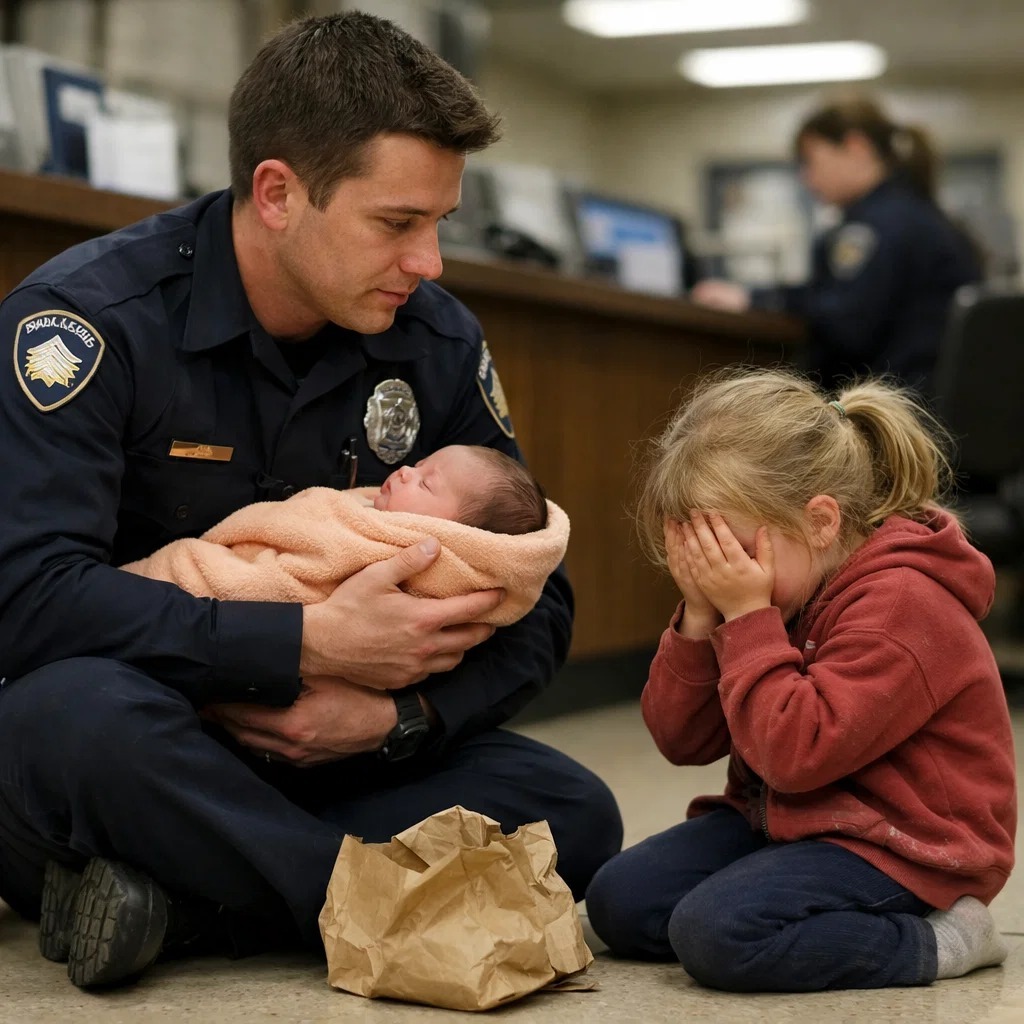
He stepped aside to make a call, and when the line to the sheriff’s office picked up, he did not bother easing into it. “Rhea, it’s Nolan. I need you at Regional. We’ve got a neglected child situation, maybe worse. Seven-year-old girl walked into the station carrying a hypothermic newborn in a grocery bag. Mother missing or incapacitated. There’s an old house off County Road Nine, likely outside municipal.”
Sheriff Rhea Langford did not waste words. “On my way.”
By the time she arrived, Maisie had been given a peanut butter sandwich she picked at without appetite and a hoodie from the donation closet because her sweater was damp. Rhea entered the waiting room like a cold front, broad-shouldered, silver-haired, her county sheriff’s star clipped above a flannel shirt under her jacket. She had spent twenty-five years turning chaos into lists of things to do next, and it showed in the way the room itself seemed to sharpen around her.
Nolan briefed her in low tones while Maisie sipped apple juice and watched them with the wary intelligence of someone who had learned that adult whispers usually meant decisions made over her head. Rhea glanced at the child once, then back at Nolan. “We go now,” she said. “If the mother’s there, she may not last the night in whatever condition that house is in.”
Nolan hesitated only because his gaze went to Maisie. “I don’t want to leave her.”
Rhea followed his look. “Then don’t vanish. Tell her where you’re going and that you’re coming back.”
So he did. He knelt again, his knees objecting more than they used to these days, and said, “Maisie, Sheriff Langford and I are going to find your mom. Dr. Markham and the nurses will stay with Rowan. I am coming back here after I check the house. You can ask for me. Do you understand?”
Her fingers tightened around the edge of the blanket in her lap. “Will you really?”
“Yes.”
She searched his face for something. Adults promised things too easily around children. They promised to be back in a minute and vanished for months. They promised food tomorrow and forgot by morning. Nolan knew that, and maybe she saw in his face that he knew it, because after a second she nodded. Then, in a voice so small it almost disappeared under the waiting room television, she said, “Please don’t let Mom be in the dark if she’s scared.”
Those words rode with him all the way out of town.
The roads beyond Cedar Hollow were nearly empty, just the occasional barn light or porch lamp set far back from the asphalt, and the darkness between them had that deep rural quality that felt less like absence than like something watching. Nolan drove the lead vehicle. Rhea sat beside him with a flashlight on her lap and her county map folded open though GPS still worked in most of the area. The address, when dispatch finally pieced it together from tax records and Nolan’s landmarks, belonged to a property that had been in the Kincaid family for decades and had not had utilities properly updated in years. Nolan wasn’t surprised. Neglect loves old houses because old houses can swallow it for longer.
He turned onto the gravel lane Maisie had described and found the dead tree exactly where she said it would be, its bare limbs clawed against the sky. Beyond it a broken fence leaned into waist-high grass. The little bridge creaked under the cruiser tires. Then the house appeared, set back from the road in a clearing that looked less chosen than abandoned.
Even in the wash of the headlights it looked tired. Paint peeled from the clapboards in curling strips. One porch post leaned enough to make the roofline look uncertain. Two windows had been patched from inside with plastic. The yard bore the signs of life without maintenance: a rusting tricycle frame with no wheels, a pile of split logs gone soft with damp, weeds grown tall around an old metal tub. But some things were too recent to belong to long neglect. Fresh tire tracks cut the mud of the drive. On the porch sat a plastic grocery bag with condensation still pearling the inside. Someone had been here recently enough that the milk, if there was milk, might still be cool.
Nolan killed the engine and the silence fell hard. No dog barked. No television glowed. The house held its breath.
They approached the porch together. Rhea swept her flashlight beam over the tracks, the new bag, the scuffed boards where small bare feet had moved in and out. Nolan called, “Sheriff’s office. Cedar Hollow Police. Kara Kincaid?” He knocked. Waited. Knocked again. The only answer was the dry rattle of weeds.
Rhea tried the knob. “Unlocked.”
Inside, the air smelled of stale damp, old dust, spoiled formula, and the sour fatigue of rooms where nobody has had the energy to open windows in far too long. Nolan’s flashlight moved over a kitchen with three mismatched chairs, a sink full of cloudy water, grocery items on the counter that did not belong to long-term abandonment: a loaf of bread, canned soup, diapers, a bottle of infant acetaminophen, two frozen dinners beginning to sweat on the laminate. The food was basic but specific, chosen by someone who knew there was a child and now a baby. A bright package of baby wipes sat beside a cracked cereal bowl. An adult male size boot print was visible in dried mud near the back door, overlaying smaller tracks.
“Someone’s been supplying,” Rhea murmured.
“Someone’s been watching,” Nolan said.
The living room held a sagging couch with a blanket tossed over one arm, a space heater unplugged in the corner, extension cords looped like dead snakes. On the coffee table lay a stack of coupons clipped neatly, a half-finished coloring page, and a baby bottle clouded with old formula. There were no photos on the walls. No recent mail. No signs of one organized adult making a bad best of things. This was survival stripped down to whatever got through another day.
They moved room by room, announcing themselves, opening doors. In what had probably once been the master bedroom, the bed was unmade and stained, the nightstand cluttered with pill bottles bearing different names, some expired, some with labels peeled off. A bucket sat beside the bed with towels soaked and stiff. Nolan’s jaw tightened. Childbirth had happened here, or near enough. There was no sign of Kara.
The room at the back of the house might once have belonged to a child. Someone had painted one wall yellow years ago. A paper moon still hung crooked near the window. Now the room held a thin mattress on the floor, two blankets, a crate of stuffed animals missing buttons and fur, and a plastic bin used as a bedside table. On it sat a notebook the size of a school composition book, its cover bent and softened from use. The front said MAISIE in careful block letters, each letter colored a different shade with crayon.
Nolan opened it because there are few things in the world as honest as what children write when no one expects to read it.
The first pages were filled with uneven spelling and drawings so direct they hurt. A house with no smoke from the chimney. A stick-figure woman lying down with hair spread across a bed. A smaller figure beside her carrying a glass of water. Another page showed the same little figure standing on a chair at a stove with three circles meant to be burners and a black scribble above them that was almost certainly smoke. Then the words: made soup but it burned. after that came tallies, days marked not by weekdays but by events. Helper came. Mom slept all day. Got crackers from top shelf. No lights in bathroom. Rained inside by window. On one page, scrawled in letters that pressed so hard the pencil had nearly torn the paper: Mom says be quiet if the car comes.
Farther in, the entries changed. Mom’s belly is bigger. The helper knows. He brought towels and soap. How did he know? Another page showed a bowl, towels, a dark pool of red crayon, and beneath it: Mom screamed and then Rowan. He was purple then pink then little. I cut the thing with scissors from kitchen because Mom said do it quick.
Nolan had to stop reading for a second. He could hear Rhea’s breathing somewhere just behind his shoulder. She took the notebook gently and read a page herself, then another. Her face, usually composed enough to read like carved wood, hardened by degrees.
“This isn’t charity,” she said quietly. “This is surveillance.”
They found more. In the kitchen trash, recent pharmacy receipts paid in cash. In the back hall, a bag of baby formula unopened because no one had mixed it correctly. In a drawer by the stove, envelopes with small amounts of money inside and no names on them. In the refrigerator, little besides condiments and two bottles of water. On the counter, a list written in an adult hand not matching Kara’s signature on old records found near the phone. Soup. Bread. Diapers sz 1. Pedialyte. Blankets. Tidy, practical, detached. Someone had been keeping track the way one keeps track of animal feed.
Outside, Rhea stood on the porch and stared toward the tree line. “Search grid at first light,” she said. “If the mother’s hiding out here somewhere and she’s in labor depletion or psychosis, she could freeze by morning.”
Nolan looked back through the doorway at the yellow-walled room and Maisie’s little notebook lying open on the mattress. “The girl asked me not to let her mother be in the dark if she’s scared.”
Rhea’s mouth thinned. “Then we don’t.”
They searched the immediate property by flashlight until nearly two in the morning, calling Kara’s name into weeds and around the collapsed shed and along the ditch behind the house, but darkness changes distance and swallows sound, and after a point searching in it becomes its own kind of risk. Nolan returned to the hospital only because Rhea ordered it. “You promised the girl you’d come back,” she said. “I’ve got deputies canvassing by dawn.”
At Regional the waiting room had thinned to the peculiar intimacy of night hospitals, where everyone still awake looks like they belong to the same exhausted tribe. Maisie was asleep at last, curled sideways in a chair under a donated quilt, her feet in the new tread socks, one hand still fisted in the edge of the blanket. Someone had washed her face. Without the dirt, the bruised shadows under her eyes were more visible. A social worker Nolan knew by reputation sat nearby typing notes. Her name was Tasha Bell, and she had the alert, practical stillness of someone who understood that helping people in crisis was mostly about doing several unglamorous things well in rapid succession.
“How is Rowan?” Nolan asked quietly.
“Stable enough to buy more time,” Tasha said. “Dr. Markham says if he keeps responding through the next twelve hours, odds improve. They think he was born at home maybe three or four days ago, possibly premature, definitely underfed. He’s got a small nasal cannula now, warming mattress, fluids, antibiotics as a precaution.” She glanced at sleeping Maisie. “She asked three times whether babies are allowed to be angry at sisters.”
Nolan closed his eyes for a second. “Jesus.”
“She also asked whether there would be trouble because she took him outside without a hat.” Tasha’s voice softened. “I told her the opposite of trouble.”
He told Tasha what they’d found at the house, the notebook, the supplies, the missing mother. She listened without interrupting, then wrote down two phone numbers and slid the paper to him. “If the mother turns up alive, the psychiatric liaison’s on call. And if there’s any chance an adult has been covertly controlling that environment, I want notified immediately. Quiet neglect and coercive dependency often walk in holding hands.”
By dawn Nolan had been awake nearly twenty-four hours, but fatigue sharpened rather than dulled him. Search teams spread across the Kincaid property as the sun rose pale and cold over the fields. Frost silvered the weeds. Deputies moved in measured lines, their calls of Kara’s name carrying across the damp ground. Nolan walked the rear boundary of the house toward a stand of scrub trees and nearly missed the storm-cellar doors because vines had grown over the top. It was Maisie’s earlier words that made him stop. She hides. When she gets scared she hides.
The metal handles were rusted but not locked. Nolan pulled one door open and a smell of earth and stale air climbed up from below. “Kara?” he called into the darkness. “Ms. Kincaid? It’s Officer Mercer. Maisie is safe. Rowan is at the hospital. We need to help you now.”
At first there was only the creak of the hinges and the soft crumble of dirt under his boots as he descended. Then, from the back corner, a sound so small it was almost not a sound at all: the wet inhale of someone trying not to be found.
He swept the flashlight beam low and found her crouched behind a stack of old canning jars and a broken lawn chair, knees tucked to chest, arms wrapped around herself so tightly it seemed impossible she could still breathe. Her hair was matted. Her clothes hung loose and damp on a body too exhausted to inhabit them properly. Her eyes were open, but whatever was looking through them was not fully attached to the room. She did not flinch when the light found her. She looked like a person whose mind had retreated somewhere safer and left the body to wait.
“Kara,” Nolan said, because names matter even when people are far away. “Your children are alive. Maisie is safe. Rowan is getting help.”
At the word children, something flickered. Her mouth moved once before any sound came. “Maisie?”
“Yes.”
“She took him?”
The question was so flat it might have been asked from underwater. Nolan crouched several feet away, careful not to crowd her. “She brought Rowan to the station because he was very sick. That saved him.”
Kara blinked slowly. Tears gathered without expression and slid down both cheeks. “I was supposed to get up,” she whispered. “I told her I would just close my eyes for a minute. I heard him and then I couldn’t—” Her gaze drifted past Nolan’s shoulder into the dirt wall. “I couldn’t find the way back.”
Paramedics came down with a stretcher and blankets. Kara did not resist when they touched her. She moved only when told, as if following instructions from a very long distance away. Nolan walked beside the stretcher as they brought her up into the thin morning light. At the top of the cellar stairs she squinted hard, one hand lifting instinctively to cover her face. The house stood a little way off, sagging and ordinary in daylight, and for a second Nolan wondered what it must feel like to emerge from a hole in the ground and see the place where your life has been collapsing in plain view.
Back at the hospital Dr. Markham examined Kara while another physician from psychiatry was called in. Nolan caught enough of the conversation to understand the broad shape: severe malnutrition, dehydration, postnatal blood loss not properly treated, probable untreated mental health crisis layered on longer trauma, cognitive shutdown as survival response. Nothing about her condition looked new. This had been coming for a long time. Bodies rarely collapse without warning; more often they send messages no one is positioned or willing to answer.
Maisie was awake when they brought Kara through a side corridor to keep the emergency room from swallowing the scene whole. She saw her mother on the gurney and stood so abruptly her chair toppled backward. “Mom!”
Kara turned her head toward the voice. For one clear second recognition broke through whatever fog had hold of her. “Birdie,” she said, the pet name soft and shocked together, as if she’d just found something lost in a drawer. Maisie burst into tears and tried to run to the gurney, but Tasha caught her gently and asked her to wait. There would be time later. Treatment first. Safety first. Children learn too early that love often means waiting outside doors.
That afternoon, after a few hours of sleep grabbed in the break room with his coat over his face, Nolan sat across from Arthur Kincaid in Interview Room Two and understood almost immediately why some failures are harder to look at than outright cruelty. Cruelty at least admits its shape. Arthur was sixty-two, neatly barbered, clean hands, church-bulletin face. He wore a plaid button-down tucked into pressed jeans and answered the initial questions with the stunned courtesy of a man who believed respectability should still count for something in a room like this. But the traffic camera stills lay on the table between them. The grocery receipts. The cash envelopes. A still photograph of the house at dawn. Nolan had seen enough by then to know the difference between a person blindsided by guilt and one slowly collapsing under the weight of choices he’d justified for months.
“You want coffee?” Nolan asked.
Arthur stared at the table. “No.”
“Then start with how you knew Kara was out there.”
Arthur’s fingers worried at each other. “I checked on the property after taxes came due. I found her living there with the little girl.” His voice thinned. “Maisie. She was maybe six then. Maybe younger. Time gets away.”
“Did you notify anyone?”
“No.”
“Did you offer to bring them somewhere safe?”
Arthur looked up as if the word safe offended him on some technicality. “Kara was not in a state to accept help. You don’t know how she gets when she thinks people are going to take Maisie. She bolts. She stops eating. She won’t answer the phone. I thought if I kept her supplied and calm, I could convince her eventually.”
“How long did that plan take?”
Arthur swallowed. “Months.”
“And during those months you left groceries after dark and told a child not to tell anyone.”
He flinched. “I never meant—”
Nolan leaned forward. He did not raise his voice. He didn’t have to. “A newborn nearly died in a paper bag because you decided secrecy counted as help.”