
Nolan had not asked much about Cecilia’s past before then, only enough to know she was licensed and reliable. Over the following weeks he learned more because guardianship cases are built not only on love but on details. Cecilia had spent twenty-two years as a pediatric nurse before retiring after her husband died. She lived in a modest but stable house ten minutes from the elementary school. She had taken foster placements for four years, most of them short-term emergency children who arrived after midnight with plastic bags of clothes and eyes that stayed open too long. She knew how to keep logs, attend meetings, give medicine, and make grilled cheese for a child who had not eaten enough to recognize hunger until it became nausea. More importantly, Nolan noticed, she knew how not to turn care into performance. She did not tell anyone she was “saving” Maisie. She asked which socks didn’t itch. She let Maisie choose between dinosaur and stars for Rowan’s receiving blanket. She wrote appointments on the refrigerator in thick marker because unpredictability had become, for that little girl, another word for danger.
Rowan came home from the hospital to Cecilia’s house in December wearing a knitted blue cap donated by a volunteer named Mrs. Pine who made three thousand infant hats a year and considered this a completely normal hobby. Maisie stood by the door holding a paper chain she had made while waiting, one loop for every day he’d been gone, and cried so hard when Cecilia carried him in that she nearly frightened herself. Rowan, perhaps sensing the weather of the room, opened his tiny mouth and let out the most indignant squawk Nolan had ever heard from someone his size. Everyone laughed then, the kind of laughter that comes not from humor but from pressure finally finding a release.
Life after crisis did not become easy simply because it became safer. Maisie had nightmares. She hoarded crackers in dresser drawers. She followed Cecilia from room to room for the first two weeks as if terrified the woman might disappear if not visually monitored. When Rowan cried at night, Maisie shot upright before the baby monitor finished crackling and sometimes reached the nursery before Cecilia did, standing by the crib rigid with urgency until reminded, again and again, “I’ve got him. You can be his sister now.” Such sentences sound gentle on paper. In practice they require repetition, patience, and the willingness to watch a child grieve the burden she never should have carried in the first place.
Kara, meanwhile, began the slow and uneven work of returning to herself. Stabilization did not happen like magic in a montage. She moved from hospital to an inpatient psychiatric unit and then to a step-down program with close medical supervision. Some days she could speak clearly about Maisie and Rowan and cry in appropriate places. Other days she drifted, ashamed and unreachable, convinced everyone would be better off if she vanished entirely. Tasha and Maren kept reminding the teams around her that trauma plus malnutrition plus postpartum depletion plus long coercive entanglement can look like madness from the outside while still containing a human being worth guiding back. Nolan respected them for that. Small towns are full of people who say they care about mothers and babies until the mother becomes inconveniently symptomatic.
The first supervised visit between Kara and the children took place in a family room at the treatment center three weeks before Christmas. Nolan was not part of the formal plan, but he happened to be there dropping off supplemental documentation, and Tasha asked if he wanted to observe from the corridor in case Maisie bolted. He stood by the half-open door and watched.
Kara entered looking smaller than Nolan remembered from the cellar, though more present. Her hair had been washed and braided. She wore gray sweatpants and a cardigan someone had donated. Her hands shook visibly. Cecilia carried Rowan in his car seat. Maisie walked beside her with both fists clenched. When Kara saw them she stopped as if hit.
“Birdie,” she whispered again.
Maisie did not run this time. She went forward slowly, like a child approaching a skittish animal she loved. When she reached her mother, she touched the sleeve of Kara’s cardigan first, perhaps needing confirmation that this woman occupied matter. Then Kara knelt and Maisie stepped into her arms and both of them began to cry with a quiet that was somehow harder to witness than wailing.
“I’m sorry,” Kara said against her daughter’s hair. “I’m so, so sorry.”
Maisie pulled back enough to look at her. “Are you still lost?”
Kara’s face broke open. “Not right this second,” she said.
That answer, more than any tidy reassurance, convinced Nolan she might have a chance. False certainty had no place in that room. Honest struggle did.
As winter settled over Cedar Hollow, the criminal cases ground forward in parallel tracks. Arthur took a plea sooner than Harvey did. Men ruled by shame often fold earlier than men ruled by entitlement. In his statement Arthur admitted that he had repeatedly observed dangerous conditions and chosen secrecy over reporting because he feared social fallout and believed Harvey’s assurances that “discreet support” would prevent worse consequences. Nolan read that phrase in the file and thought about Maisie carrying Rowan in the bag. Discreet support. Language can be a crime scene all by itself.
Harvey fought harder. There were lawyers, of course. There were statements through counsel about concern for a vulnerable former student and denials of exploitative intent. There were whispers that Nolan and Rhea were overreaching, that old consensual matters were being retrofitted into scandal because the county wanted a villain. But evidence has a dull persistence that public charm cannot outtalk forever. Texts. Emails. buried complaints. Financial transfers timed to silence. Records showing Harvey had intervened repeatedly to keep Kara’s earlier accusations from formal review. Testimony from two former students emboldened by the case to come forward. Cedar Hollow Community College announced an independent review under mounting pressure, which Nolan privately interpreted as institutions finally noticing fire once smoke threatened the lobby.
The family court hearing for guardianship arrived on a gray January morning with sleet tapping at the courthouse windows and everyone in attendance looking as if they had slept poorly for a month. Nolan sat behind Cecilia at counsel table, there under subpoena and willingly besides. Maisie wore a navy dress borrowed from a donation closet and little patent shoes Cecilia had found at a consignment store. She looked both heartbreakingly young and unnaturally composed, hands folded in her lap, eyes moving carefully from person to person as if cataloging threat levels. Rowan remained at Cecilia’s house with a respite caregiver because the courtroom was no place for an infant who measured time in bottles and naps. Kara was present too, thinner than before, medicated, steadier, accompanied by her treatment advocate. She kept glancing at Maisie with an expression Nolan recognized from the hospital: astonishment that the child was still there and still willing to look back.
Denise Kline was there as well, less certain than she’d been at Cecilia’s kitchen table. Systems become humbler when enough professionals hand them evidence.
Judge Patrice Ellison entered with the quiet authority of someone long past mistaking loudness for control. She was a woman in her sixties with reading glasses low on her nose and the sort of attention that made people straighten unconsciously. Nolan liked her on sight because she did not look at the docket before looking at the room. Some judges see files. Good ones see people first and files second.
The attorneys spoke. Medical reports were summarized. Maren’s assessment was entered. Cecilia testified simply about routines, therapy, school enrollment, Rowan’s follow-up appointments, Maisie’s night terrors, the hidden food now slowly disappearing from odd corners of the house because the child was beginning to believe meals would continue. Tasha spoke about the hospital intake. Dr. Markham, appearing by video between rounds, described Rowan’s arrival without embellishment, which made it more devastating. Nolan testified about the station door, the bag, the condition of the house, the notebook, the cellar. At one point the attorney representing the state asked whether he believed Maisie was overly attached to the infant due to parentification. Nolan chose his words with care.
“I believe she is attached because she had to keep him alive,” he said. “And I believe any plan that treats that bond as disposable is failing to understand what kept both children alive long enough for us to be here.”
Judge Ellison’s gaze lifted briefly from her notes and rested on him in a way that suggested the sentence had landed where it needed to.
Then she addressed Maisie directly.
“Maisie,” the judge said, her voice calm enough to step on, “do you understand why you’re here today?”
Maisie nodded. “You’re deciding if me and Rowan can stay together.”
“And what do you want me to know before I decide?”
The courtroom went still in the particular way rooms do when everyone senses the most important testimony may come from the smallest person. Maisie looked at Cecilia first, then at her mother, then finally at the judge. When she spoke, her voice was not loud, but it carried.
“I want to stay with my brother,” she said. “And I want Ms. Hart to take care of us because she tells the truth even when it’s not the answer I want. She said she’d fight to keep us together and she did. My mom loves us, but she’s getting help right now and I don’t want anyone to think she’s bad.” Her chin wobbled once, but she kept going. “She was sick in her mind and in her body and she got lost. But she loves us. I know because even when she forgot stuff, sometimes she still sang the pancake song. And I don’t want Rowan somewhere else because he knows my voice.”
There are many kinds of silence. The one that followed was not empty. It was full of people refusing to breathe too loudly.
Judge Ellison turned to Kara. “Ms. Kincaid, do you wish to be heard?”
Kara stood. Her hands shook so badly her advocate touched her elbow once and then let go. “Yes, Your Honor.” She swallowed. “I love my children. I know love is not the same as safety, and right now I am not safe enough to do this alone. I want treatment. I want supervised contact until I can be more. I want them together. They have been alone too much already.” She looked at Maisie, and her face crumpled with a pain so naked Nolan had to look briefly at the floor. “My daughter should never have had to become the person in charge of keeping us alive. The fact that she did is not proof she can lose her brother. It’s proof adults failed her.”
Judge Ellison sat with that for a long moment, fingers steepled over the file. She read something, then removed her glasses and set them down. When she spoke, there was no ceremony in it, only decision.
“This court grants temporary full guardianship of Maisie Kincaid and Rowan Kincaid to Cecilia Hart, effective immediately, with the expectation that the siblings remain placed together. The court further orders continued treatment and supported visitation for Kara Kincaid, whose parental bond the court does not find irredeemable but does find presently compromised by documented medical and psychiatric instability. The state’s proposed separation of the siblings is denied. In this court’s view, maintaining that bond is not a complication to be managed away but a protective factor to be honored.”
Maisie inhaled sharply, as if she had been waiting permission to breathe. Cecilia turned and opened both arms. The child went into them so fast her chair tipped. It was not triumph, exactly. More like a body finally released from bracing against impact.
After the hearing, in the corridor outside the courtroom, Denise Kline approached Nolan with the air of someone choosing her humility one sentence at a time. “I was following protocol,” she said.
Nolan looked through the window at the sleet darkening the courthouse steps. “That’s often where the damage comes from.”
She winced, which was something, and nodded once. “I’ve revised my recommendation for future sibling trauma cases.” She hesitated. “The report from Dr. Sloane was clarifying.”
So was a little girl on a hospital floor, Nolan thought, but he only said, “Good.”
Life did not resolve neatly after the hearing. It deepened. That is different. Maisie began school regularly at last, the elementary office careful and kind in ways that did not draw public attention. Her teacher learned that abrupt schedule changes caused panic and that unexpected fire drills required advance warning and noise-canceling headphones. Cecilia installed a night-light in the hall and another in Rowan’s room because darkness still meant too many things in Maisie’s nervous system. Kara moved into outpatient treatment and started supervised visits twice a week, then three times, each one complicated and tender and exhausting. Sometimes she showed up grounded enough to braid Maisie’s hair and hold Rowan with tears in her eyes. Other times she dissociated midway through and had to step out shaking. Healing did not walk in a straight line, and Nolan came to respect that more than the public prefers to.
Harvey Keaton’s criminal case made spring headlines beyond Cedar Hollow. Reporters came, then left when they realized the county was not going to supply a tidy morality play in exchange for sound bites. Nolan refused every interview. Rhea gave one statement about institutional responsibility and the welfare of children, then went back to work. The college board placed Harvey on permanent leave and later terminated him after the independent review confirmed what women had been trying to say for years. There would be civil cases too, Nolan suspected. There should be. Some debts are not financial, but money is often the only language institutions understand once shame fails.
Arthur accepted probation terms that included community service and mandatory reporting education, which struck Nolan as both insufficient and better than nothing. The law is often an awkward tool for moral failure. It punishes what it can name cleanly and leaves the rest to live in people’s mirrors.
Summer came green and hot. Rowan grew round wrists and a laugh that sounded like surprise. Maisie lost one baby tooth and insisted on wrapping it in a note to the tooth fairy explaining that she preferred coins because paper money was easier to lose. Cecilia put two quarters under the pillow. Nolan attended Rowan’s first birthday in Cecilia’s backyard and stood near the grill holding a paper plate while Maisie showed him how Rowan could now clap whenever anyone said the word duck. Kara was there too, on an approved day pass from a transitional housing program tied to her treatment. She looked healthier, though fragility still lived in the pauses between her movements. When Rowan reached for her, she cried so hard she had to sit down. Maisie climbed into the chair beside her and leaned against her arm without fanfare. Nolan watched from a respectful distance and thought that if hope had a sound, it might be a baby smearing frosting onto his sister’s sleeve while the adults nearby tried not to cry.
By the time winter returned, Cedar Hollow had developed a strange new reflex around the Kincaid children. People who had once let the family become invisible now noticed them with that complicated mixture of guilt and tenderness communities sometimes manage when they realize, too late, how badly they missed something. The elementary school kept extra gloves in the office without making a scene about it. The local diner sent soup home with Cecilia “by accident.” Mrs. Pine, the hat knitter, began making increasingly elaborate sweaters for Rowan and pretending this was merely a way to stay busy. Nolan approved of all of it as long as no one demanded gratitude from the children in return. Help that requires a performance is only another kind of tax.
The winter concert at Cedar Hollow Elementary fell on a Thursday evening in December. The auditorium smelled of construction paper, wet coats, and the faint electric warmth of stage lights. Folding chairs scraped. Programs fluttered. Parents tried to photograph children who were already squirming out of formation. Nolan arrived a little late from a minor traffic accident on Route 6 and slipped into the front row beside Cecilia just as first graders in red and green took their places on the risers. Rowan sat on Cecilia’s lap in a tiny cardigan with reindeer on the front, one shoe already half kicked off. He had Cecilia’s finger in a death grip and the solemn expression babies reserve for public events they do not understand but intend to judge.
Maisie stood near the middle of the front row in a plain red dress, hair brushed smooth and tied back with a ribbon. Nolan had to look twice because there was something altered in the set of her face. The vigilance had not vanished, not entirely; children do not simply outgrow what saved them. But another expression lived beside it now, one he was still getting used to seeing there. Anticipation, maybe. A child’s ordinary wish to be seen by the right people for the right reasons.
When the music teacher lifted her hands and the piano began, the children launched into “Winter Bells” with all the imprecision and sincerity elementary school concerts have always had. Some sang on key. Some shouted. One boy near the back picked his nose through an entire verse. Maisie sang earnestly, eyes scanning the audience exactly once before finding Cecilia and Rowan and staying there. Halfway through the second song Nolan noticed movement at the back of the room. Kara had come in quietly with her counselor and taken a seat near the aisle. She looked thinner than the other parents, more deliberate in her stillness, but she was present, truly present, and when Maisie spotted her the child’s face changed in a way Nolan would remember for a long time. Not shock. Not fear. Recognition mixed with relief, as if some part of her had remained on watch for this exact attendance.
After the concert children spilled from the risers like released birds. The room filled with coats and camera flashes and the hot, damp smell of families. Maisie ran first to Cecilia, then leaned over Rowan’s little body to kiss the top of his head. He slapped happily at the ribbon in her hair. Then she turned and saw Kara making her careful way down the aisle. For one heartbeat Maisie looked frozen between them, held by old habits that said choose fast, hold everybody up, make sure no one falls. Then she did something better. She took Cecilia’s hand in one of hers and reached the other toward her mother.
Kara stopped in front of her, eyes already wet. “You were beautiful,” she said.
Maisie shrugged, suddenly shy. “Did you hear me?”
“I heard every word.” Kara’s voice cracked. “You sounded like you.”
Maisie studied her mother’s face as if testing the sentence for steadiness. Then, with the serious tenderness children sometimes show when they have grown up around breakable adults, she placed Kara’s hand on Rowan’s little back while keeping hold of Cecilia with the other. Nolan stood a few feet away and felt the moment settle into him. No one spoke for several seconds. They simply stood there linked together in a chain that did not erase what had happened but refused to let damage be the last architect of their lives.
Outside, the air had turned sharp with frost. Parents gathered children and instruments and construction-paper snowflakes. Someone laughed too loudly in the lobby. The janitor began folding unused chairs. Maisie stepped through the school doors between Cecilia and Kara, one hand in each of theirs, Rowan bundled on Cecilia’s hip, and looked up at the night sky where the first clear stars had begun to show. Nolan saw her pause there for a second under the gymnasium lights. Not because she was afraid to go into the dark, but because she no longer had to measure it alone.
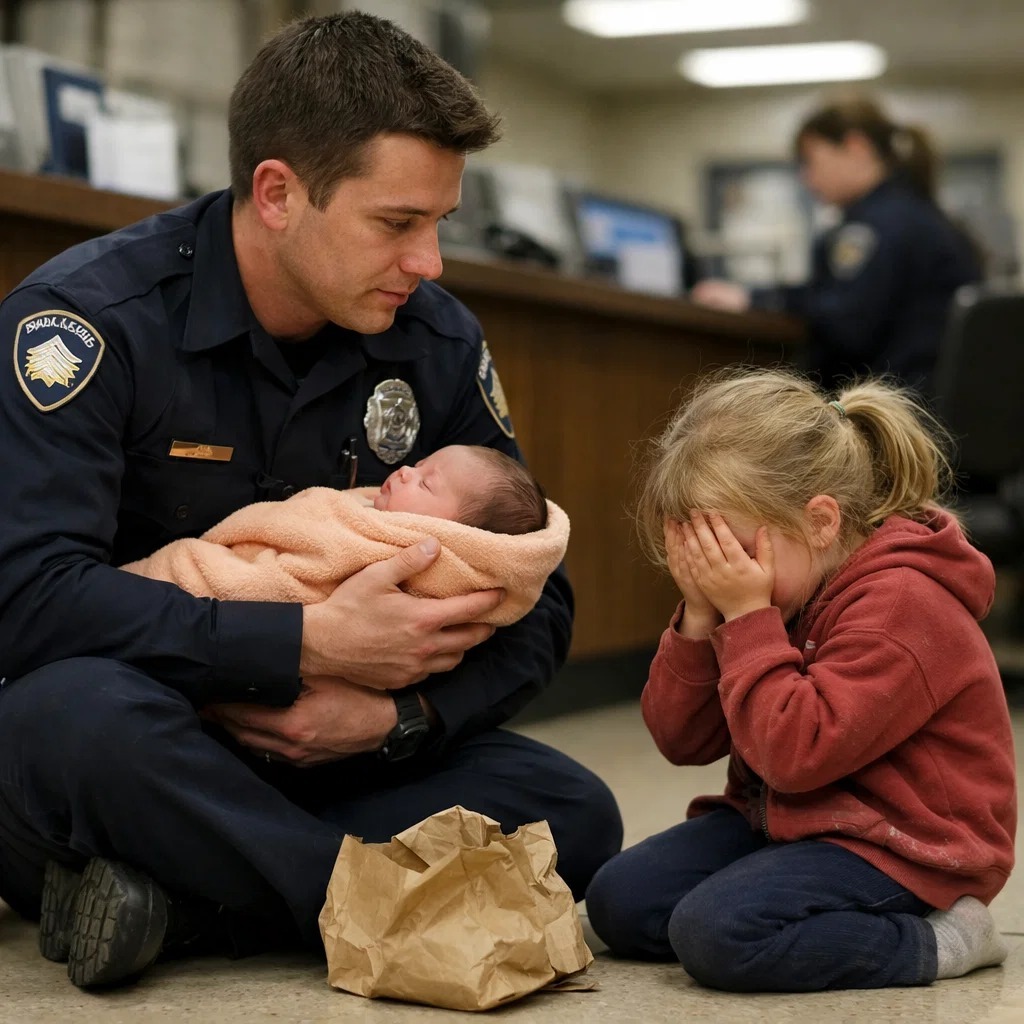
He thought back, not for the first time, to the small chime of the station door on that Tuesday night and to how close the whole future had come to closing around a baby in a paper bag and a girl with blood on her toes. People liked stories where rescue arrived with one dramatic act and ended cleanly. Real rescue, Nolan had learned, was slower and messier and made mostly of people who chose not to look away once the emergency lights were turned off. It was Dr. Markham saying the hard truth without letting blame touch the child who needed her. It was Tasha building resources out of clipboards and coffee and tenacity. It was Maren listening to the drawings. It was Cecilia keeping promises so carefully that trust could grow around them. It was Kara fighting her way back from the place her mind had hidden. It was a judge who looked closely enough to understand that attachment was not pathology just because it had formed under terrible conditions. It was even, in its smaller and more shameful way, the town finally learning that discretion without action is only neglect in a nicer coat.
Maisie turned back from the stars and spotted Nolan by the doors. She slipped free long enough to run to him, ribbon flying loose. “Officer Mercer!”
He bent automatically and she threw both arms around his waist with the force of a child who had once had no one reliable to run toward and now had a shortlist. Nolan hugged her back carefully, mindful of the years that had already taught her too much about what hands could do and not do. When she pulled away, she looked up at him with the solemn directness she had carried into the station that first night.
“Did you know,” she asked, “that Rowan claps when I sing now?”
“I did not know that.”
“He likes the loud songs best.” She considered him. “Thank you for believing me right away.”
The sentence struck deeper than anything said in court or in interviews or over case files. Believing me right away. It should not have been rare enough to deserve thanks. Yet he knew, from too many calls and too many careful adult excuses, that it was.
“You made it easy,” he said.
“No I didn’t.” Maisie’s brow furrowed with almost comical offense. “I was crying a lot.”
He laughed then, real and surprised. “Fair point.”
Cecilia called gently that it was time to go. Maisie nodded and ran back to the others. Nolan watched them walk toward the parking lot together: Cecilia steady, Rowan bundled and curious, Kara slower but present, Maisie between them no longer carrying the whole weight of survival in both arms. Just a girl after a school concert, cheeks pink from the cold, chattering about songs and cookies and whether ducks would like snow if they had sweaters. There would still be hard days. Nolan was not naive enough to imagine otherwise. Trauma leaves weather behind. Court orders need renewing. Treatment falters and resumes. Children ask questions at inconvenient ages. But the shape of their story had changed, and once a shape changes, sometimes an entire life can grow differently around it.
Long after the parking lot emptied and the auditorium lights dimmed, Nolan stood for a minute beneath the awning listening to the winter quiet. Somewhere down the street a church bell marked the hour. He thought about the reports still waiting on his desk at the station, about the endless ordinary work that continued regardless of revelation: stolen mowers, noise complaints, overdue warrants, all the small daily frictions of town life. He thought, too, about how easy it would have been on that first night to assume the child at the door was confused, or dramatic, or someone else’s problem to route elsewhere. He had not done anything extraordinary, not really. He had opened the bag. He had believed her. He had kept moving. Sometimes that was the whole dividing line between tragedy and its interruption.
As he walked to his cruiser, he glanced once more at the school doors, now closing with a softer sound than the station’s chime had made months earlier. A different door, a different night, but the same truth humming quietly under both: lives turn on who answers when the frightened knock comes. Cedar Hollow would forget parts of the story in time. People always do. They would compress it into something easier to repeat over coffee, a version with edges sanded down and complicated adults turned into labels. But Nolan hoped, for Maisie’s sake and perhaps for the town’s, that one detail remained stubborn. A little girl arrived barefoot in the cold carrying what mattered most to her, and this time, finally, the door opened in the direction of safety.
THE END.
See more on the next page
Advertisement