

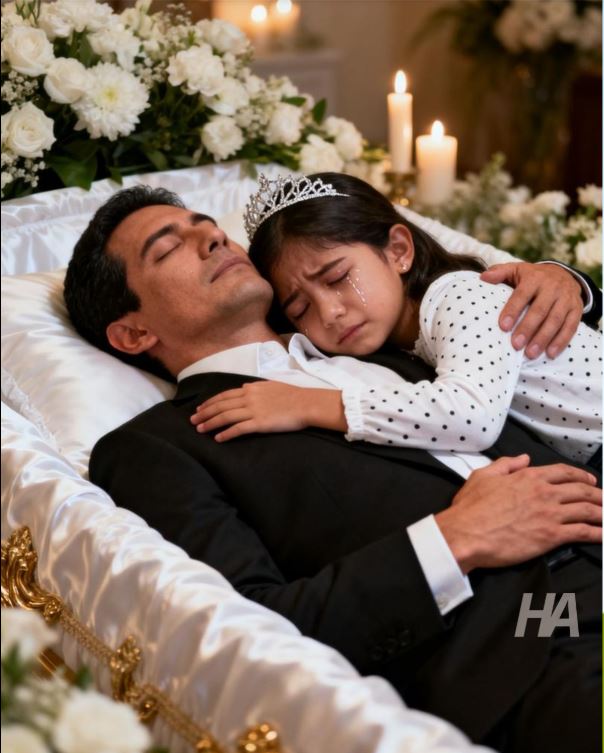
The nurse looks down.
“Rivas shut him up,” she whispers. “He said, ‘Stop making a scene.’ And then he signed the papers fast.”
You feel your stomach twist.
“Why,” you whisper.
The nurse’s eyes flick left and right like she’s checking for shadows.
“I don’t know,” she says. “But… he got a phone call right before. He stepped out. When he came back, he was different. Rushed. Angry.”
A phone call.
Your mind starts building shapes out of dark.
You go home after three days, because the hospital forces you to.
Camila sleeps in your bed now, curled against your side like she’s guarding you the way she guarded her father.
You lie awake staring at the ceiling, listening to the quiet, and you realize you’re terrified of silence now, because silence is where endings hide.
On the fourth night, your phone rings.
Unknown number.
You answer, and a man’s voice speaks, calm, cold.
“Stop asking questions,” he says.
Your blood turns to ice.
“Who is this,” you demand.
The voice chuckles softly.
“You already have your husband back,” he says. “Be grateful. Don’t dig.”
Your hand tightens around the phone.
“You tried to bury him alive,” you hiss.
Silence.
Then, quieter, sharper.
“People die every day,” the voice says. “Some are just… inconvenient.”
The call ends.
You sit there breathing hard, phone pressed to your ear, and you realize the truth is worse than a mistake.
This wasn’t negligence.
This was intention.
You look at Camila sleeping, her face soft in the dark.
You remember how she refused to leave the coffin, how she stared like she was waiting.
And a terrible thought crawls into your mind like a spider.
What if she wasn’t just waiting for a miracle.
What if she was waiting for danger.
The next day, you ask Camila gently, in the hospital cafeteria, over a cupcake she barely touches.
“Sweetheart,” you say, “why did you climb into the coffin.”
Camila licks frosting off her thumb, eyes down.
“So he wouldn’t be alone,” she says first.
Then she glances up, and her voice drops.
“And so they couldn’t take him,” she adds.
You go still.
“Who,” you whisper.
Camila shrugs like she hates the memory.
“The man,” she says. “The man who came to our house two weeks ago.”
Your pulse spikes.
“What man,” you ask, fighting to keep your voice calm.
Camila frowns, searching her head.
“He had shoes like shiny rocks,” she says. “And he smelled like… like smoke but not fire. He talked to Papá in the kitchen. Papá told me to go to my room.”
Your throat tightens.
“Did you listen,” you ask, already knowing the answer because children hear everything.
Camila nods slowly.
“I was by the door,” she admits. “The man said Papá owed money. Papá said no. The man said, ‘Then you will pay another way.’”
You feel your skin go cold.
“What did he mean,” you whisper.
Camila’s eyes get heavy.
“He said,” she murmurs, “‘Accidents happen.’”
The cafeteria noise fades around you.
Your husband’s “accident” suddenly feels like a message, not a random tragedy.
And Dr. Rivas signing papers too fast starts to look like fear, not error.
You bring this to the abuela.
Her face goes hard, like old stone exposed again.
She nods slowly and says, “Julián always tried to protect everyone by handling problems alone.”
Your voice breaks.
“And it almost killed him,” you whisper.
The abuela grips your hands.
“Then we don’t handle this alone,” she says. “We make it loud.”
Loud is risky.
But quiet is a coffin.
You contact a lawyer, then another.
You file for an inquiry.
You send the nurse’s statement anonymously to a journalist who owes your cousin a favor.
You request security at the hospital, because the unknown caller’s voice still lives in your ear like a threat that never hangs up.
And through all of it, Camila stays close to Julián’s room like a shadow made of love.
Every time a stranger walks by, she watches their hands.
Every time a doctor enters, she studies their face like she’s memorizing it for a future she refuses to fear.
One afternoon, Julián wakes more fully.
His eyes find you, and you see confusion, pain, and then recognition bloom slowly like a sunrise.
He tries to speak, but his throat is raw, and the words come out broken.
You lean close.
“Don’t talk,” you whisper. “Just listen.”
Julián’s eyes flick to Camila sitting by the bed.
He blinks slowly, and tears gather in the corners of his eyes, making him look younger.
“You,” he rasps, barely audible, “were… in there.”
Camila nods, fierce.
“Yeah,” she says. “Because you’re not allowed to leave me.”
A faint sound escapes Julián.
Not quite a laugh, not quite a sob.
He squeezes her fingers weakly.
Then his gaze lifts to you, and he whispers, “I’m sorry.”
Your throat tightens.
“For what,” you ask, though you already know.
Julián’s eyes close briefly, like the memory hurts.
“I thought,” he breathes, “I could keep it away from you.”
It takes days, but the story comes out piece by piece.
A debt Julián refused to pay.
A man with shiny shoes and a smile that didn’t reach his eyes.
A warning disguised as a joke.
Then the “accident” on a wet road, a truck that appeared too fast, a skid, darkness.
And in the hospital, a phone call that reached Dr. Rivas before a heartbeat could be found.
A signature rushed.
A body transferred.
A funeral prepared.
You realize with a sick clarity that if Camila hadn’t been stubborn, if she hadn’t listened to her body instead of adult certainty, Julián would be underground right now.
Not dead from fate.
Dead from convenience.
When the journalist publishes the story, it hits like a shockwave.
People share the video someone took at the wake, shaky footage of panic, the coffin, the little girl, the hand.
Some call it a miracle.
Some call it horror.
But the important part is, everyone calls it real.
An investigation opens officially.
Dr. Rivas is suspended pending inquiry.
The hospital scrambles to save its reputation, but paperwork can’t outshout a child’s face.
And then the police knock on your door at 6:40 a.m. one week later.
You open it with your heart hammering.
Two detectives stand there, serious, polite.
Behind them, a third man in a suit watches you with eyes like polished stone.
“We need to ask you some questions,” one detective says.
Your stomach drops.
“About Julián,” you say.
The detective nods.
“And about the man who called you,” he replies. “Because we traced the number.”
Your breath catches.
“You found him,” you whisper.
The suited man steps forward.
He flashes a badge you didn’t expect to see in your small town.
Federal.
“We found a network,” he says, voice calm. “Your husband’s case is not isolated.”
Your blood turns cold.
“How many,” you whisper.
The agent doesn’t answer with a number.
He answers with a look that tells you it’s too many.
Over the next month, arrests happen like dominoes falling.
The man with shiny shoes is taken in.
A tow truck company is investigated.
A private “collections” group is exposed.
Dr. Rivas is charged with misconduct, then more charges follow when evidence shows the call, the timing, the pressure.
Julián leaves the hospital with a cane and a face that looks older than it used to, but his eyes are alive.
He holds Camila’s hand so tight it’s like he’s afraid oxygen might steal him again.
You take them both home, and your living room looks strange at first, like a place that almost became a museum of grief.
But then Camila puts a blanket on the couch for Julián and declares it “Papá’s recovery throne.”
Julián smiles, real this time, and the sound is so precious you almost cry from relief.
You realize laughter returns the way spring returns in stubborn places: slowly, and then all at once.
On the night the case goes to court, you sit at the kitchen table with the abuela, filing papers, drinking tea that tastes like courage.
Camila is drawing at the other end of the table, tongue between her teeth, focused.
You glance at her page and your breath catches.
It’s a picture of a coffin.
Inside it, a stick-figure father.
And a stick-figure girl curled against him like a guardian.
Above it, she’s written in shaky letters: I DIDN’T LET HIM GO.
You swallow hard.
“Camila,” you say gently, “does it still scare you.”
She looks up, eyes bright.
“It scared everyone else,” she says. “But I knew he wasn’t finished.”
You blink.
“How,” you whisper.
Camila shrugs, like the answer is obvious.
“Because love doesn’t turn off like a light,” she says. “It fades. And he wasn’t faded.”
Years later, people in town still talk about that wake.
Some keep calling it a miracle.
Some insist it was a medical mistake, rare but possible.
But everyone agrees on the part that matters.
A little girl refused to accept an ending just because adults announced it.
A grandmother refused to panic just because fear demanded it.
And a family learned that sometimes, the inexplicable isn’t magic at all.
Sometimes it’s just a child hearing a heartbeat the world forgot to check.
And every birthday after that, Julián kisses Camila’s forehead and whispers the same words, voice steady now, alive and warm.
“Mi luz,” he says. “You brought me back.”
THE END
See more on the next page
Advertisement