
“Oh, my sweet, sweet girl,” she whispered, dropping her handbag and kneeling beside me on the carpet.
I couldn’t even form a coherent sentence. I just pointed at the door where Stephanie had stood moments ago, then down at the blackened satin in my hands. “She did it, Grandma. She waited until today. She actually destroyed it.”
My grandma didn’t cry. She didn’t even gasp. Instead, I watched a transformation take place that I will never forget. A fire ignited in her eyes—a steel-cold, ancient determination that reminded me exactly where my mother’s hidden strength had come from. She picked up a corner of the dress, examining the chemical tang of the ink and the messy geometry of the torn seam with the clinical eye of a woman who had spent forty years as a master seamstress.
“Get up off this floor, Megan,” she commanded, her voice low and sharp, cutting through my hysteria. “Go to the laundry room. Find the peroxide. Find the white vinegar. Get me a bag of lemons from the kitchen and a clean toothbrush. And fetch me your father’s heavy-duty sewing kit from the hall closet.”
“Grandma, look at it,” I sobbed. “It’s gone. The ink is everywhere.”
“I have been fixing things your mother broke since 1975,” she said, her gaze fixing on mine with unshakable authority. “We are not letting that woman win, Megan. Not today. Not on your night. Now, move!”
For the next several hours, my bedroom was transformed into a field hospital for memories. Grandma took the dress to the master bathroom, laying it across the white marble counter—the very counter Stephanie had installed to replace my mom’s old vanity. It was a poetic workspace.
Grandma worked with a fury that was mesmerizing to watch. She didn’t just scrub; she treated the fabric like a patient in surgery. She created a paste of lemon juice and salt, dabbing it onto the ink stains with the precision of an artist. She used the peroxide to bubble the darkness out of the delicate fibers, whispering to the dress as she worked.
“You’re still in there,” she’d mutter to the satin. “You’re not going anywhere.”
Downstairs, the house was eerily silent. Stephanie didn’t come near us. She never did when Grandma was around; there was something about the way Grandma looked right through her, as if Stephanie were made of cheap glass, that made her deeply uneasy.
As the sun began to dip lower, casting long, orange shadows across the room, the impossible began to happen. The dark, sticky coffee stains lifted. The black ink, which I was certain had permanently claimed the lavender silk, began to fade under Grandma’s relentless care. She used a hair dryer on the cool setting to prevent water rings, her hands moving with a rhythmic, practiced grace.
Then came the needlework. The side seam had been shredded, but Grandma didn’t just sew it shut; she reinforced it. She used a silk thread that was a near-perfect match, her stitches so tiny they were practically invisible to the naked eye. She breathed life back into the embroidered flowers, tamping down the frayed edges of the petals until they looked like they were blooming again.
I sat on the edge of the bathtub, handing her tools like a surgical assistant, my heart hammering a frantic rhythm against my ribs. Time was slipping away. The pre-prom photos were supposed to happen in an hour. My date would be arriving. My friends were already posting photos of their “modern” gowns online.
“It’s getting late, Grandma,” I whispered, checking my phone.
“Let them wait,” she said, not looking up from her needle. “A queen arrives when she is ready, not when the clock tells her to.”
When she finally pulled the needle through the last stitch, she held the dress up against the light of the bathroom vanity. The stains were not entirely gone—if you looked very closely, there was a faint, ghostly shadow where the ink had been—but to anyone else, it looked like a natural shimmer in the vintage silk. The seam was stronger than it had ever been.
“Try it on,” she said, her voice finally softening.
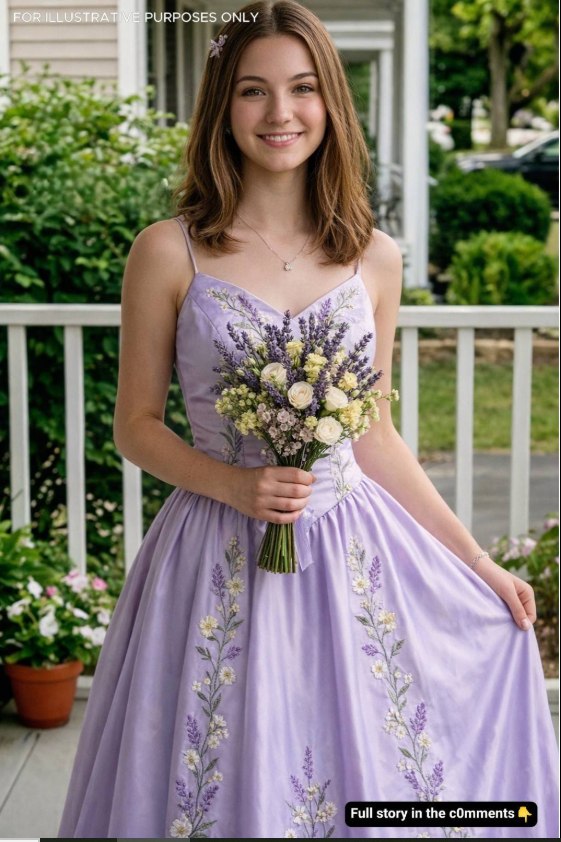
I slipped into the lavender satin. As the fabric slid over my shoulders, it felt different. It didn’t feel like an old dress anymore. It felt like a suit of armor. It felt like it had absorbed the collective will of the women in my family—the woman who had worn it first, and the woman who had saved it.
I looked in the mirror, and for the first time since my mother died, I didn’t see a girl trying to hold onto a ghost. I saw a young woman who was carrying her heritage forward. The dress fit a little tighter around the ribs where Grandma had reinforced the seam, and the scent of lemons and peroxide had replaced the faint floral perfume, but it was still her dress. And it was still mine.
Grandma stepped up behind me, resting her hands on my shoulders. Our eyes met in the glass.
“You look like a miracle, Megan,” she whispered. “Now, wipe those tears, fix your lipstick, and walk down those stairs like you own every inch of this house. Because you do.”
I did exactly that. I grabbed my heels, pinned the lavender clip into my curls, and walked out of my room with my head held high.
Downstairs, Stephanie was sitting in the living room, a magazine open on her lap, waiting for me to emerge in the emerald green designer gown she had bought to claim me. When she heard my footsteps and looked up, the magazine slipped from her fingers.
She didn’t say a word. She couldn’t. She looked at the lavender dress—the dress she had spent the morning destroying—and her face went a sickly shade of gray. She saw the stitches. She saw the clean satin. But mostly, she saw the look in my eyes. It was the look of someone who knew that her power was an illusion, and that no amount of ink or shears could erase a love that was woven into the very fabric of my life.
I didn’t acknowledge her. I just walked straight past her, through the front door, and into the evening air where my future was waiting.
At the dance, under the strobe lights and the thumping bass of the music, the lavender dress shimmered like a star. My friends crowded around me, their eyes wide.
“Is that the one?” one of them gasped. “The one from the photos?”
“It is,” I said, and the pride in my voice was louder than the music. “It was my mom’s. And it’s the most beautiful thing I’ve ever worn.”
I danced that night with a lightness I hadn’t felt in five years. I let myself be seventeen. I let myself be happy. Every time I felt the stiff reinforcement of the seam against my side, it wasn’t a reminder of Stephanie’s cruelty; it was a reminder of my grandmother’s hands and my mother’s smile. It was proof that love is the one thing that can always be repaired.
Chapter 6: The Unshakable Truth
I went to prom. I danced until my feet ached. I laughed with my friends, and when they told me I looked like a dream, I told them, “It was my mom’s.” I wore that dress like a suit of armor.
I returned home just before midnight. The house was quiet, but the lights were on. My dad was standing in the hallway, still in his work uniform, looking like he’d just walked through a storm. When he saw me, he stopped. He didn’t speak for a long time. His eyes filled with tears, and he just shook his head slowly.
“You look just like her, Megan,” he whispered, his voice breaking. “Exactly like her.”
He pulled me into a hug, and I felt the lavender satin crush against his work shirt. It was the first time in years I felt like the two of us were truly on the same side of the wall.
“I’m proud of you,” he said.
“James? Is that you?” Stephanie appeared at the top of the stairs. She saw me, and her face went through a series of contortions—shock, then disbelief, then a cold, bubbling resentment. “What is she doing in that rag? I told you, James, this is an embarrassment. People will think we’re struggling. It makes us look small.”
My dad turned to look at her. He didn’t raise his voice. He didn’t have to. The quietness of his tone was far more terrifying.
“She looks radiant, Stephanie,” he said. “She honored her mother tonight. And she showed more grace than anyone else in this house.”
“Oh, don’t be so sentimental!” Stephanie scoffed, descending the stairs. “You’re choosing a five-dollar vintage dress over our family’s image? You’re choosing a memory over the woman who is actually here?”
“I’m choosing my daughter,” Dad said, stepping in front of me. “And I’m choosing the promise I made to her mother. You tried to destroy that. You tried to break a seventeen-year-old girl’s heart because you were worried about what the neighbors would think.”
Stephanie’s face twisted. “I was trying to upgrade our lives! I was trying to give you something better than this mediocrity!”
“My mother’s memory isn’t mediocre!” I shouted.
From the kitchen, my grandma walked out, her arms crossed. “I’d watch your mouth, Stephanie. I told James everything. About the ink. About the shears. About the way you talked to this child.”
Stephanie went pale. She looked at my dad, searching for the usual patience, the usual “let’s keep the peace” attitude. But she found a wall of stone.
“I think it’s time you re-evaluated where you belong, Stephanie,” Dad said. “Because if there’s no room for Megan’s mother in this house, then there’s no room for you.”
The silence that followed was the loudest thing I’ve ever heard. Stephanie grabbed her designer purse from the table, her heels clicking one last time on the floor she’d tried so hard to perfect. She walked out the door and into the night, leaving behind a house that was suddenly, finally, ours again.
The next morning, the three of us—me, Dad, and Grandma—sat at the new, cold kitchen table. But as we ate breakfast together, the sunlight hitting the lavender dress hanging on the door of the closet, the table didn’t feel so cold anymore.
We had survived. We had kept the promise. And as I looked at my dad, I realized that some things—like love, and memories, and the strength of a father—don’t break. No matter how hard someone tries to tear them down.