
Part 1
The air show always smelled like the same three things: jet fuel, burned sugar, and sunburn. If I closed my eyes, I could sort them by layer. Kerosene first, sharp and metallic at the back of my throat. Then the sweet fry-oil haze drifting from funnel cake stands. Then hot skin and sunscreen and cheap beer and damp ocean wind coming in off the water.
It was why I kept coming.
Not for the crowd. God, no.
The crowd was strollers and lawn chairs and men who liked hearing themselves explain airplanes to whoever got trapped beside them. It was plastic flags and sticky little hands and loud patriotism bought six dollars at a time. I never came for that part. I came for the noise that hit your ribs before it hit your ears. I came for the split second when a jet cut across the sky and your body remembered before your mind did.
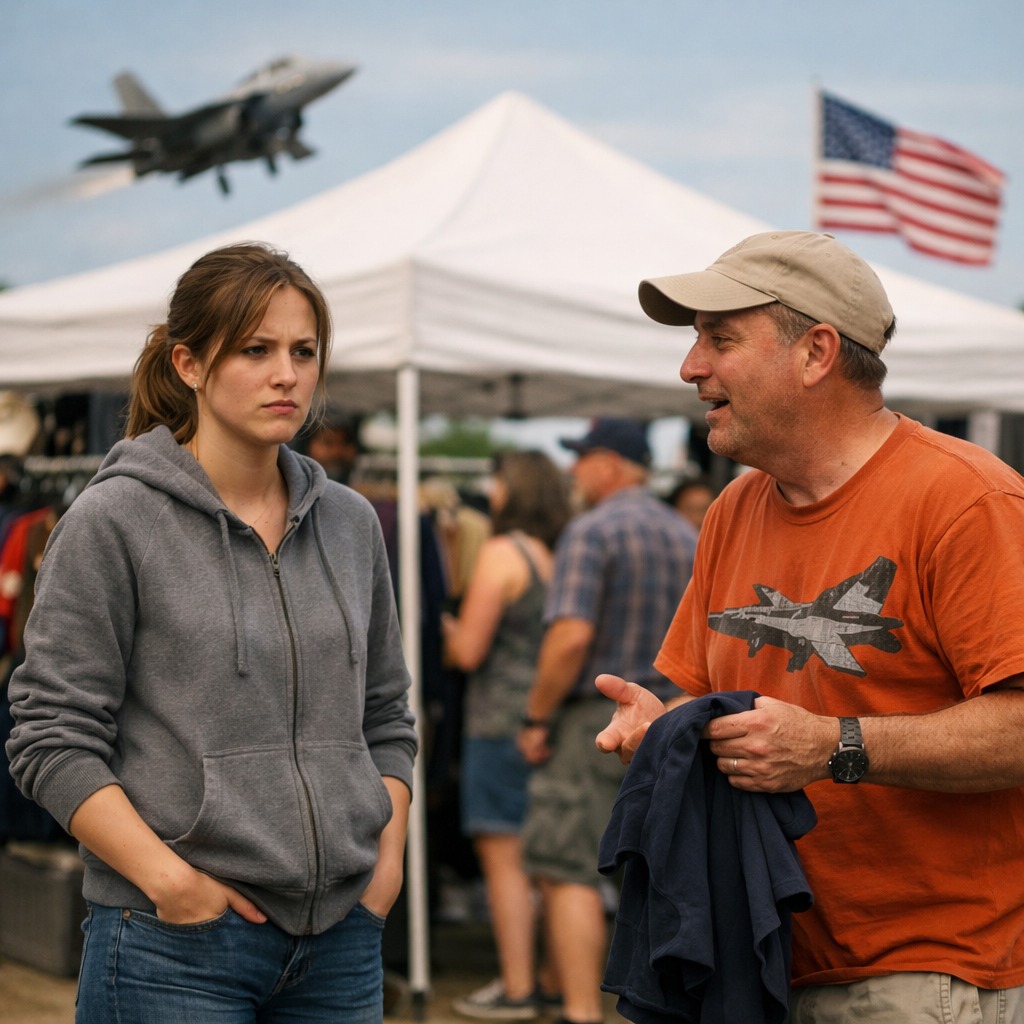
I stood near the back fence in faded jeans, gray hoodie, scuffed sneakers, dark sunglasses. I had my hair tied back low because it was windy and because I didn’t like feeling anything brush my neck when I was watching the sky. In my pocket, my thumb worked over the tiny metal jet on an old keychain until the edges pressed half-moons into my skin.
Twelve years is long enough to build a life that looks ordinary from the outside.
In town, I taught yoga at the community center three mornings a week. I helped an older neighbor carry groceries on Tuesdays. I bought tomatoes from the Saturday market and remembered to pay my electric bill and smiled when people asked if I’d always lived here. Most of them thought I was divorced. A few thought I was widowed. None of them asked hard enough for the truth.
That was one thing about being a woman alone in a small coastal town. People invented a version of you that made them comfortable.
A man at the T-shirt booth noticed me standing by myself and decided I needed commentary.
“Hey, ma’am,” he called over the rack of neon shirts. “You lose your book club?”
The men around him laughed. A couple of boys in mirrored sunglasses looked me over like they were trying to figure out what category to file me under. One of them said, too loud, “She probably came for the food trucks.”
I didn’t answer. I rarely did anymore. Silence unsettled people in a way anger never could.
A little girl in a star-spangled T-shirt tugged on her dad’s sleeve a few feet away and pointed right at me. “Why is she by herself?”
Her father squinted at me, then back up at the sky. “Probably doesn’t know what’s going on, sweetheart.”
I almost smiled at that. Not because it was funny. Because if I didn’t smile sometimes, the bitterness would settle in my face for good.
Above us, an F-22 climbed in a near-vertical line and vanished in the glare. The crowd gasped on cue. Phones went up. A toddler started crying from the sound. I tracked the jet without thinking, my eyes following the angle, the roll rate, the rhythm of the engine note as it came screaming back across the field.
There was a hitch.
Tiny. Easy to miss if all you saw was speed and smoke and a shape worth cheering for. But I saw the right wing drop a fraction too hard coming out of a turn. I saw the correction come late. I heard a roughness under the engine harmony that didn’t belong there.
My thumb stopped on the keychain.
Not yet, I thought. Come on. Level it.
The Raptor climbed again, banking left this time. The sun flashed silver off the canopy. There it was again—that small wrong wobble, like a shoulder slipping under a shirt.
A woman in a bright sundress sidled up near the barrier, looked me up and down, and gave me one of those sweet little smiles women use when they want to be cruel without wrinkling their lipstick.
“You look miserable,” she said. “This maybe isn’t your thing.”
“My thing?” I asked.
She made a vague motion toward the runway. “All this.”
The hot wind pushed the smell of fuel and salt between us. I kept my eyes on the jet.
“Funny,” I said. “I was just thinking the same about you.”
The smile fell right off her face. She turned away fast, muttering something to her friend, and I would have enjoyed it more if the engine note above us hadn’t dipped again.
On my left, an older man in a Navy cap had been watching me instead of the planes. Weathered face, liver-spotted hands, mirrored aviators old enough to be honest. He narrowed his eyes like he was trying to pull my name from somewhere he hadn’t opened in years.
I looked away first.
The F-22 pitched into another high-speed pass. Too low. Too aggressive. Whoever was flying was either showing off or compensating for something. The crowd loved that kind of flying. They always did. They never understood the difference between confidence and correction.
I did.
A crack split the air.
It wasn’t the theatrical boom the announcer had primed everybody for. This one was ugly. Wrong. Mechanical. The kind of sound that made every muscle in my body lock before my mind caught up.
The Raptor lurched.
Black smoke punched out of one engine. Not a trail at first, just a sick violent cough. Then more. The aircraft rolled harder than it should have and kept going.
People around me screamed. Someone dropped a tray of lemonades. Ice bounced across the asphalt like glass marbles.
The announcer’s voice cut off mid-sentence. A second later, emergency sirens started up from the base, thin and shrill under the roar.
Then the radio traffic burst over the loudspeakers from somebody in the tower who’d forgotten to kill the feed.
“Mayday, Mayday, this is Ghost Two. I’ve got asymmetric response—repeat, loss of control authority—”
The pilot was young. You could hear it in the strain. He was trying very hard to sound trained instead of terrified.
Everything inside me went cold.
The crowd folded in on itself like paper set to flame. Parents grabbed children. The boys in sunglasses stopped laughing. The T-shirt vendor ducked behind his table as if folding cotton would save him from a crashing jet.
The aircraft spiraled lower, a dark slash in the blue.
A base officer’s voice boomed over a portable speaker near the tower. “Any qualified Raptor pilot on site, report immediately to control.”
Nobody moved.
Of course nobody moved. This wasn’t a movie. Most people’s courage ended exactly where the fence line did.
I looked at the spiraling jet. Looked at the smoke. Calculated altitude, turn rate, remaining options. Too low to eject clean if the rotation worsened. Maybe enough room if someone could get in the air fast and talk him through the descent, maybe pace him, maybe give him something steadier than the panic building in his own cockpit.
I felt the old part of me wake up so suddenly it was almost violent.
Not nostalgia. Not pride.
Habit.
The volunteer at the barrier stepped in front of me when I started walking. She had a clipboard, a sun visor, and the brittle confidence of someone who had never been told no in an emergency.
“Ma’am, you can’t go past this point.”
I kept walking.
She put a hand out. “This area is restricted.”
“So is crashing an F-22 into a crowd,” I said.
She blinked. Behind her, the older man in the Navy cap straightened like he’d just been struck by recognition.
One of the boys in mirrored sunglasses laughed, nervous and sharp. “What are you gonna do, yoga lady? Breathe at it?”
That one almost got to me. Not because it was clever. Because for a split second I saw exactly how I must have looked to them: plain hoodie, forty-two years old, nothing flashy, nobody important.
Twelve years ago they would have called me Captain Sarah Mitchell.
Twelve years ago they would have called me Valkyrie.
Now they looked at me and saw a woman alone.
Good. Let them.
I stepped over the low barrier anyway.
A security guard reached for my arm. I took one look at his hand and he thought better of it. You’d be surprised how often men mistake quiet for weakness right up until the moment they don’t.
Inside the control room, the air was colder and smelled like burnt coffee, printer toner, and fear. Radios crackled. A young lieutenant was pale as paper over a console. A major with a square jaw and too much certainty turned when I came in.
“No civilians,” he snapped.
I pulled the old leather case from my pocket, flipped it open, and laid it on the nearest desk.
For one second, nobody breathed.
The badge was scuffed. The photo was old. But my name was still there.
Captain Sarah Mitchell
TOPGUN Instructor
Call sign: Valkyrie
The commander at the center station stared at it, then up at me, and all the color drained from his face.
“Mitchell?” he said softly.
Around us, every head turned.
I looked past them all, toward the smoking speck falling out of the sky.
“Open the hangar,” I said.
And for the first time in twelve years, the room went silent because of me.
Part 2
People think the hardest part of stepping back into an old life is making the decision.
It isn’t.
The hardest part is what your body remembers before you give it permission.
The major recovered first. Men like him usually did. Pride had a faster restart time than humility.
“With respect, sir, she’s been out for years,” he said to the commander, as if I wasn’t standing there. “We can’t put a civilian in a Raptor.”
“I’m not a civilian,” I said.
His eyes flicked over my hoodie, my jeans, my hair escaping its tie in the damp heat. “You are now.”
The commander didn’t answer him. He was still looking at my badge like it might change if he stared long enough. “Captain Mitchell,” he said, careful with the rank, “when was the last time you flew?”
There are questions with practical answers and questions with emotional ones. He’d asked the first kind. My mind gave him the second.
The last time I flew, my best friend burned alive in a cockpit over the Pacific and the man I was going to marry asked me to help bury the truth.
What I said out loud was, “Long enough.”
The young lieutenant at the radio station ripped off one earcup. “Ghost Two’s still airborne, sir, but he’s losing the right side every time he corrects. He’s panicking.”
Over the speaker came the pilot’s breathing, fast and shallow, then a ragged, “I can’t make it settle. I can’t make it settle.”
That decided it.
The commander pointed at the major. “Open the hangar.”
The major’s jaw tightened so hard I could see the pulse in front of his ear. “Sir—”
“That’s an order.”
Nobody argued after that. Not out loud.
The hallway to the hangar was all cinder block and fluorescent light. My sneakers slapped the waxed floor while people flattened themselves to the walls to let me pass. Somewhere behind me boots pounded in the other direction. A radio kept spitting numbers I didn’t need to hear because I was already doing the math in my head.
Altitude. Fuel. Wind off the coast. If the fire stayed contained and the pilot stopped over-controlling, maybe. If he got fixated on the warning lights instead of the horizon, maybe not. If the flight control issue spread to the remaining surfaces, nobody on earth was bringing that jet home.
The hangar doors were already yawning open when I got there.
Inside, the backup F-22 sat under white industrial lights like something assembled by people who hated compromise. Angles sharp enough to cut on. Skin the color of storm clouds. Ground crew swarmed it with ladders and carts, all quick hands and clipped voices and the smell of hydraulic fluid.
That smell hit me harder than it should have. It had always been my favorite part of a flight line. Oil, rubber, hot metal, ozone—everything ugly and honest in one breath. Now it landed in my lungs and woke up twelve years at once.
A crew chief with gray at his temples looked up from the left landing gear and froze.
“Holy hell,” he said.
He knew me.
I knew him a beat later. Chief Benitez. He’d been leaner back then and louder. He’d also once told a room full of arrogant young aviators that half of them didn’t deserve the planes they flew. I liked him instantly.
“Chief,” I said.
He stood up fast enough to crack his knee on the wheel chock and winced. “I heard a rumor you moved inland and married a dentist.”
“I teach yoga.”
He stared at me a second. “That is somehow weirder.”
It almost pulled a laugh out of me, and then the radio in the hangar barked with Ghost Two’s voice again and the moment vanished.
Another technician, young enough to still think confidence and knowledge were the same thing, muttered to the guy beside him, “This is insane. She hasn’t flown in forever.”
Benitez didn’t even look at him. “And you haven’t shut up in twenty-three years. Yet here we all are.”
The kid went red.
They rushed me through gear that almost fit. G-suit, harness, helmet. The pressure straps felt foreign for exactly three seconds. Then they felt like language. My fingers found buckles by instinct. My shoulders adjusted to the weight. The edge of the oxygen mask brushed my cheek and some old locked room inside me opened with a hiss.
I saw Fallon in summer. Heat rising off the tarmac in liquid waves. Lena Park grinning around a coffee cup and saying, “If they ever name a maneuver after me, I want it to sound expensive.”
I shoved the memory down hard.
Benitez climbed the ladder to the cockpit rail while I checked the panel. “You remember her?” he asked quietly.
He didn’t say Lena’s name. He didn’t have to.
“Every day,” I said.
His face settled into something careful. “Then listen to me. This bird’s got the same software family as the old—”
“Don’t,” I said.
He stopped.
Not because I was angry. Because if he finished that sentence right then, I didn’t know if I’d still be able to take off.
The young pilot on the radio made a choking sound. “I’m getting lag. It’s like—I move and it answers late.”
Every hair on my arms stood up.
Lag.
The old memory I’d shoved down kicked against the door.
I climbed into the seat and lowered myself in. The cockpit wrapped around me, tight and familiar. Switches. Screens. The clean chemical smell of plastic warmed by electronics. My left hand settled on the throttle. My right found the stick. There was a tremor in my fingers for half a second. Then the canopy started down, sealing me in with my own breath.
The outside world dulled to mechanical thumps and radio voices.
“Mitchell, comms check,” the tower said.
“Loud and clear.”
Hearing my own voice like that—flat, controlled, mission-ready—did something strange to me. It felt like seeing a woman I had buried stand up and smooth her uniform.
Taxi clearance came. I rolled.
Out beyond the runway, the crowd pressed against the barriers in a bright blur of phone screens and open mouths. They looked smaller from here. Their laughter from twenty minutes earlier couldn’t reach me. That was one mercy of a cockpit. Stupidity didn’t survive the canopy.
On the far side of the field, the smoking F-22 dipped hard and nearly vanished behind a bank of marine haze before clawing up again.
“Ghost Two, this is Valkyrie,” I said before I had time to think about whether I meant to use the old call sign.
There was a beat of static.
Then the young pilot answered, voice cracking. “Say again?”
“This is Valkyrie. You listen to me now. No hero moves. No guessing. You do exactly what I tell you and we get you home.”
The frequency went silent long enough that I wondered if he’d blacked out.
Then, smaller this time, “Copy, Valkyrie.”
I pushed the throttle forward.
The engines came alive with a force that shoved me back into the seat and rattled loose every ghost I had ever packed away. The runway blurred. The shoreline flashed. The jet took weight, then sky, and I was airborne before fear had time to catch up.
Cloud glare swallowed me for a second. When I broke through, I saw him.
Smoke trailing. Right side scorched. Nose hunting.
And then I heard him say the words that froze my blood all the way to my teeth.
“It feels thick,” he gasped. “Like I’m flying through syrup.”
Twelve years dropped out from under me.
Because those were the last clear words Lena Park had ever spoken.
Part 3
Trauma is rude that way. It doesn’t knock. It doesn’t ask whether this is a good time. It just walks in wearing an old face and sits down in your chest.
For one ugly second, the sky in front of me split into two versions.
In one, the present: a damaged F-22 off my nose, smoke dragging behind it like a torn black ribbon, a terrified young pilot fighting a machine that wasn’t answering the way it should.
In the other, the past: Lena’s voice in my headset, tight and confused. Controls feel delayed. Something’s wrong. And then the impossible half-second where an elite pilot sounds like a child because every skill she owns has just become useless.
I blinked once, hard.
Training kicked the memory in the teeth.
“Ghost Two, eyes outside,” I said. “Not on the lights. Find the horizon.”
“My right side’s not responding—”
“I know. Find the horizon.”
He did. You could hear it in the change in his breathing. Still fast, but following.
I slid in wide first, not close. No point crowding a pilot already overloaded. His jet was ugly up near the right intake. Heat bloom, flutter, soot pattern. The kind of damage that made your teeth hurt just looking at it. On my left display, his telemetry came in choppy from the tower link. Roll inputs. Delayed reaction. Corrective overbank. Same pattern. Same damn pattern.
“Ghost Two, this is going to feel wrong,” I said. “You are over-controlling because the aircraft is late. I need you to get ahead of it.”
“I can’t tell where it’s going.”
“Yes, you can.” I kept my voice level enough to lean on. “You’re just scared, and scared makes everything look faster than it is.”
That got a breath out of him. Almost a laugh. “Is that supposed to help?”
“It means you’re normal. Now listen.”
Below us, the Pacific looked cold and flat as hammered steel. The coast curled in a pale line under the haze. The showground was a bright toy scatter of tents and vehicles. Too many people. Too little room for error.
I eased my jet closer until he could see me clearly off his left.
“Match me,” I said. “Small inputs. Smaller than you want. Let the jet answer before you add more.”
He tried. The nose dipped. He yanked too much. The right side lagged, then bit back, and the aircraft snapped into a harder bank.
“Easy!” I barked. “Relax your grip.”
“I’m trying!”
“I know. Do it anyway.”
That was something my old instructor used to say. Flying wasn’t about feelings. Feelings came after you landed, if you earned the luxury.
My palms were damp inside the gloves. Not from fear, exactly. From concentration so complete it became physical. Every tiny change in his pitch made my shoulders tense. Every pause before his control surfaces caught up scraped a nerve raw inside me.
Warning tones screamed in his cockpit over the open channel.
He made a sound like he might be sick. “I’m getting FLCS disagree.”
There it was. The letters punched through me harder than the alarms.
Flight control system disagreement.
Same family of fault. Same lie. Same buried grave climbing out of the ground because men in pressed uniforms had decided once was an acceptable price for momentum.
Not today.
“Ghost Two, we’re taking altitude out of the equation,” I said. “We’re setting up long and shallow for runway one-eight. No sudden corrections. If you get into a diverging roll, you eject. You hear me?”
Silence.
“Ghost Two.”
“I hear you.”
His voice was thinner now. Younger. It made me think of every barely grown kid I’d ever seen climb into a machine older men had romanticized for him.
Behind us, tower fed vectors, emergency crews, wind. I barely heard any of it. The world had narrowed to two jets and the strip of ground between them.
I slid closer, close enough to see sunlight flash on his canopy. Close enough to imagine his eyes behind the visor, wide and white around the edges.
“Follow my wing,” I said. “Not the runway. Me.”
He did, then didn’t, then did again. The damaged jet wallowed and recovered by inches. My own aircraft shuddered in light turbulence off his wake. The smell inside the mask was rubber and my own breath and the faint hot-wire scent of overheated electronics. My pulse thudded in my ears.
“You’ve got this,” I told him.
It surprised me, how much I meant it.
On final approach, the runway stretched ahead in gray bands through the haze. Foam trucks staged at both ends. The whole base braced like a held breath.
“Ghost Two, you let it settle,” I said. “Do not force it.”
“My right side’s dropping again.”
“I see it. Left rudder. Wait. Wait. There. Now ease.”
The jet answered late, just like before.
My stomach clenched so hard it hurt. Twelve years ago that lag had killed Lena before anybody in command would admit what they were hearing. Now it was right in front of me, undeniable as sunlight, and some cold mean part of me felt almost grateful.
Not for the danger.
For the proof.
The runway came up fast. I touched down first, keeping speed, giving him a clean picture. Tires screamed. The airframe rattled through my bones. I held centerline, decelerated, and looked in the mirror just in time to see Ghost Two flare high, drift, correct, and slam harder than he wanted onto the asphalt.
The right gear sparked. Smoke and foam erupted around him.
But he was down.
He was down.
The sound that came out of me was not graceful. It was half breath, half prayer, half twelve years of rage with nowhere else to go.
“Stay in it,” I snapped into the radio. “Ride it. Ride it. Brake straight.”
The damaged F-22 fishtailed once, then settled. Emergency crews flooded around it. The aircraft rolled to a stop in a cloud of white suppressant and heat shimmer.
I didn’t realize my own hands were shaking until I tried to release the throttle.
Ground came at me all at once after that. Procedures. Shutdown. Canopy rise. Air rushing in hot and salted and full of shouts. My legs felt fine until they didn’t.
I climbed down and the world tilted sideways.
Faces moved through it in slices. Medics. Ground crew. Phones held too high. The T-shirt vendor staring at me like he’d seen a ghost. The bright sundress woman with both hands over her mouth now. The boys in mirrored sunglasses unable to meet my eyes.
Ghost Two stumbled out of his jet with help from two crash crewmen. His helmet came off crooked. He was younger than I’d thought. Mid-twenties, maybe. Sweat plastered his hair to his forehead. He looked at me with the stunned, emptied-out expression of somebody who hadn’t fully accepted he was alive yet.
“Ma’am,” he said, and his voice broke on the single word.
I started toward him and my knees folded.
As the asphalt rushed up, I caught one more thing. A tech running past with a tablet, screen lit bright in the sun.
On it, for the shortest instant, I saw a diagnostic tag I had not seen in twelve years.
14-BLACK.
I hit the ground hard enough to skin my palms.
Voices swarmed. Hands reached. Somebody said, “Get medical over here.”
Then, somewhere above me, just before the dark came in from the edges, I heard another voice say a name I’d spent twelve years teaching myself not to hear.
“Rear Admiral Cole has been notified.”
And that hurt worse than the fall.
Part 4
When I woke up, there was a ceiling fan wobbling above me with an uneven click every third turn.
That was my first clue I wasn’t in a hospital.
The second was the smell. Hospitals smell aggressively clean, like bleach trying to win an argument. This room smelled like starch, old wood, aftershave, and the ocean leaking in around bad window seals. Barracks. Officer quarters, maybe repurposed for medical overflow during the event.
My mouth tasted like copper and stale adrenaline. Somebody had changed me out of the flight gear and into gray sweats and a base T-shirt that was too big in the shoulders. My keychain sat on the bedside table next to a paper cup of water and two unopened crackers.
I pushed myself up and every muscle between my neck and knees objected.
The room tilted once, then steadied. Outside the window, the runway lay in afternoon light, quiet now, heat shivering over the blacktop. The crowd was gone. Only service trucks moved.
A knock hit the door frame before it opened.
The commander from the control room stepped in, cap tucked under one arm. He looked less like command and more like a tired man who had aged five years in one afternoon.
“Captain Mitchell,” he said.
“I’m not in uniform.”
“You were in the air.”
He had me there.
Before I could answer, I noticed movement in the hallway behind him. Boots. Lines. A lot of them.
He cleared his throat and stepped aside.
The corridor outside was packed shoulder to shoulder with pilots, maintainers, Marines, sailors, ground crew. Men and women in crisp uniforms, some dress, some flight suits, all standing in two silent rows facing my door.
And then, as I stared, every one of them came to attention.
You can spend years telling yourself you are done with a life. Done with its hierarchies, its rituals, its damage. Then one salute walks in and reminds your bones they still know the language.
I stood because not standing felt impossible.
The commander said quietly, “Word spread.”
I looked from face to face. Some were too young to know my name from anything but rumor. Some were old enough to remember. A few looked ashamed. One or two looked wrecked in that specific way people do when they realize they misjudged you in public and there’s no place to put the embarrassment.
At the very front stood a crewman I recognized from the hangar—the one who’d muttered about me being out too long. He saluted like his arm was trying to make up for his mouth.
I didn’t smile. I didn’t give them anything big and cinematic. I just lifted two fingers to my temple and returned the salute because it would have felt cruel not to.
They held it. So did I.
Then the commander dropped his hand first, and the room exhaled.
“Thank you,” he said, and his voice came out rougher than before. “For the pilot. For all of it.”
“I want to leave before reporters turn this into a circus,” I said.
His expression shifted in a way that told me this was already a circus.
“About that,” he said.
He moved aside again, and a young man stepped into view.
Ghost Two.
Up close, he looked even younger. Twenty-four maybe. A smudge of burn soot still lingered near one ear that no one had fully cleaned. He held his cap in both hands like he didn’t know where else to put them.
“Lieutenant Eli Cross,” he said.
His voice was steadier now, but not by much.
“I know,” I said. “Call sign Ghost Two.”
He gave a short breath that might have been a laugh on a different day. “They’ll probably change it after today.”
“That would be sensible.”
Another almost-laugh. Good. He needed one.
He looked at me for a second too long, then said, “I filed a maintenance note yesterday.”
The sentence landed oddly. Too precise for nerves.
“What kind of note?”
His jaw tightened. “Control response lag in advanced maneuvering mode. Minor, intermittent, not enough to ground the aircraft by itself, but I wrote it up. I checked the log after the briefing this morning. It wasn’t there.”
The room around me sharpened like glass.
“Gone?”
“Yes, ma’am.” He swallowed. “I thought maybe I imagined entering it until I saw the fault today.”
The commander’s face went hard. “Why was I not told this?”
Eli looked at him, then away. “I told my immediate chain.”
That answer said more than the words.
I got out of bed too fast and had to catch myself on the table. The paper cup tipped. Water ran across the wood and dripped to the floor beside the keychain.
Nobody moved to help me. They were all watching my face.
“Who signed off on the demo aircraft?” I asked.
The commander’s mouth thinned. “Rear Admiral Mason Cole is overseeing the joint program review.”
There he was. Not just notified. Involved.
I laughed once, and there was nothing amused in it. “Of course he is.”
The commander noticed. So did Eli. That was the trouble with old names. They dragged history in behind them whether you invited it or not.
Before anybody could ask the obvious question, a commotion rose from outside. Raised voices. Fast footsteps. The distinct clipped cadence of public affairs trying to control something already loose.
The commander muttered, “Reporters found the building.”
He was about to shut the door when a woman’s voice called from the hall, “Captain Mitchell, one question!”
I caught a glimpse of sprayed hair, a microphone, and a camera lens before security pushed them back. Same reporter from the runway, if memory served. The one who’d sounded almost disappointed when I didn’t explode on takeoff.
Eli flinched toward the sound. “They’ve been calling you the mystery woman.”
“Terrible branding,” I said.
He smiled despite himself, then his face sobered. “There’s one more thing.”
From under his arm, he pulled a kneeboard card folded in half. The edge of the paper was blackened like it had been too close to something hot. He handed it to me.
On the inside, in cramped hurried writing, were three items.
Lag in right roll.
FLCS disagree.
14-BLACK flashes before response delay.
The room went very quiet.
I looked up slowly.
Eli’s expression had changed from gratitude to something more dangerous: suspicion sharpened by survival.
“You knew that phrase,” he said. “When I said it felt like syrup. Over the radio. You knew exactly what it meant.”
I could feel the commander watching us both now.
“Who told you?” Eli asked.
Before I could answer, another knock landed on the open door.
Nobody in the hallway saluted this time. They went still.
The man standing there wore dress whites so perfect they looked machine-pressed. Silver in his hair now. No silver in the eyes. Mason Cole had always been handsome in the way institutions rewarded: clean lines, steady posture, expensive calm. He’d just grown into it harder.
For a second, I smelled cedar and starch and the faintest note of the cologne he used to wear when we were twenty-nine and stupid enough to think love meant shared ambition.
He looked at the commander first, then Eli, then me.
His face barely changed, but I knew him well enough to see the impact travel through him anyway.
“Sarah,” he said.
No rank. No call sign. Just my name, quiet and personal, like he still had any right.
The temperature in the room seemed to drop.
He stepped inside and closed the door behind him.
“We need to talk,” he said. “About Cortez.”
Twelve years, and that was the first time he had said the name to my face.
Part 5
Some people still think betrayal arrives loud.
It doesn’t. Not usually.
Usually it comes in a beautifully cut uniform with a calm voice and a face you once trusted enough to fall asleep beside.
Mason and I ended up in a small briefing room off the hallway because the commander had the good sense to clear everybody else out. The room had no windows, a scarred conference table, stale air-conditioning, and a burnt coffee smell ground so deep into the carpet it felt structural.
Mason waited until the door closed before he spoke again.
“You look well,” he said.
I actually stared at him.
That was his opening line. After twelve years, after a crash, after the sky dropping my old life in my lap like a body, he went with you look well.
“You still lead with the wrong thing,” I said.
A muscle ticked near his jaw. Once upon a time I knew every version of that expression. This one meant he had imagined the conversation going differently and was trying not to let it show.
He took a measured breath. “You saved a pilot today.”
“No thanks to whoever erased his maintenance report.”
His eyes changed then. Not wide. Not guilty in any theatrical way. Just one precise shutter lowering.
“I’m looking into that.”
“No,” I said. “You’re managing it. Different verb.”
He moved a fraction closer to the table. “Sarah, please.”
There was the old voice. The private one. The one built for late hours and persuasion. I hated that part of me still recognized it.
“Don’t,” I said quietly. “Don’t use that tone like we’re two reasonable people having a hard week.”
He held my stare. “Then tell me what tone you’d prefer.”
“The truth would be novel.”
For the first time, something like genuine fatigue crossed his face. He looked older in that instant. Not softer. Just worn in places ambition hadn’t been able to sand smooth.
“The system fault appears similar,” he said carefully.
“Similar?”
“The data is still preliminary.”
“Eli told someone yesterday his controls were lagging. The report vanished. Today the jet throws 14-BLACK and flies through syrup.” I leaned both hands on the table and felt the old rage come up clean and steady. “Do not stand there and hand me the word similar.”
He looked away before he answered. That bothered me more than if he’d argued.
Behind the door, reporters shouted something muffled down the hall. A camera case clattered. The whole building felt pressurized.
Mason turned back. “There will be an internal review.”
I laughed again, sharper this time. “You think I’m still twenty-nine.”
“No,” he said. “I think you’re angry, and I think you have a right to be.”
That was the trouble with him. He could say the correct sentence and still make it sound like a strategic asset.
He reached into a folder on the table and slid a printout toward me. Eli Cross’s flight data summary. Sanitized. Condensed. A neat row of timestamps. Nowhere in the visible notes did 14-BLACK appear.
I looked up slowly.
“This what you call preliminary?”
His mouth flattened. “That packet is for external review.”
“You edited it already.”
“I redacted incomplete diagnostics.”
“You buried them.”
“Lower your voice.”
That did it.
I straightened. The room felt suddenly too small for both of us. “You don’t get to tell me what volume my anger is allowed to have.”
He swallowed whatever response he had lined up. Smart man. Twelve years ago he used to push back first and regret it later. At least he’d learned something.
For a moment neither of us spoke. The air unit hummed. Somewhere down the hall someone said my name too loudly.
Mason took off his cap and set it on the table. Small gesture. Deliberate. He was trying to turn admiral into man.
“I never wanted you dragged into this again,” he said.
“There it is. The protective lie.”
“It isn’t a lie.”
“It always was.”
His shoulders tightened. “You think this is simple.”
“I think people are alive or they’re dead. That part stays simple.”
At that, something real flashed across his face—pain, maybe, or memory. If I’d been a weaker woman I might have softened. Once, that look could make me cross a room.
Now it just made me tired.
He rubbed a hand over his mouth. “We should not do this here.”
“We should have done it twelve years ago.”
He flinched so slightly most people wouldn’t have seen it.
A knock interrupted us. Before Mason could answer, the door opened and Chief Benitez stuck his head in like he owned the building.
“Sorry to ruin whatever this is,” he said, not sounding sorry at all, “but Mitchell, you’ve got company. And sir”—he nodded at Mason with all the warmth of a closed freezer—“public affairs says if the press tears down one more barricade they’re going to have to start tranquilizing people.”
Mason looked like he wanted to be annoyed but didn’t have the bandwidth.
“Five minutes,” he said.
Benitez looked at me instead. “Your call.”
I loved him a little for that.
I walked out without asking permission.
At the end of the hall stood the older man from the fence line in the Navy cap. Up close, his face unlocked for me too. Hank Brennan. Retired. Instructor class two years ahead of me. One of the few old-school pilots who could admit out loud when a woman had just flown better than a room full of men.
“Hank,” I said.
He shook his head once, slow. “I knew it was you when you stepped over that barrier.”
“You said nothing.”
“Didn’t know if you wanted saving from the crowd or from recognition.”
That was fair.
He held out a manila envelope. “Found this on a chair near the media tent. Somebody asked a volunteer to bring it to ‘the woman in the gray hoodie.’ Figured that narrowed it down.”
I took it. No name on the front. Just a faint grease smudge and the smell of old paper.
“Who sent it?”
He shrugged. “No one admitting to it.”
Inside were three things.
A photo of me, Mason, and Lena standing on a Fallon flight line twelve years earlier, squinting into desert sun. I had forgotten that picture existed. Mason had an arm slung around my shoulders. Lena was between us, grinning like she knew a joke nobody else had earned.
A photocopy of a maintenance header from the year of the Cortez crash.
And a handwritten note on plain white paper:
He lied to you before he lied about the jet.
I read it twice.
Then I flipped the maintenance header over and saw, half-covered by a copier shadow, an old diagnostic designation typed in military block font.
14-BLACK.
My heartbeat went so hard it blurred the edges of the paper.
Hank watched my face. “You all right?”
“No,” I said.
Down the hall, the briefing-room door opened behind me. I could feel Mason there before he said a word.
“Sarah,” he called.
I turned the note over in my hands and understood with terrible clarity that this hadn’t ended over Cortez. It had only gone underground.
And someone wanted me to start digging.
Part 6
Twelve years earlier, before the lies hardened, before I learned how quiet a woman could make herself if she had to, the desert taught me how heat could look alive.
At Fallon, the air above the runway shimmered so hard at noon it turned every aircraft into a mirage with sharp edges. Everything smelled sun-cooked—rubber, fuel, dust, hot paint. Even the coffee tasted like metal by ten in the morning.
I was thirty and mean with ambition.
That’s the version of me people don’t picture now when they see me buying avocados or rolling yoga mats back into a storage closet. They imagine grief made me serious. The truth is, I had always been serious. Grief just took away the audience.
Back then I had my name on a small office door, instructor bars on my shoulder, and a call sign I’d earned the hard way. Valkyrie had started as a joke after I beat three men in a vertical ladder drill they’d sworn a woman couldn’t muscle through. Then it stuck because I kept backing it up.
Lena Park used to say it sounded like an expensive perfume.
“If they ever bottle your ego,” she told me one morning, walking beside me toward briefing with her helmet bag bumping her hip, “the top notes will be kerosene and vengeance.”
“Jealousy is ugly on you,” I said.
“It’s beautiful on me. Everything’s beautiful on me.”
That was Lena. Quick smile. Faster mouth. She flew like the sky owed her room and laughed like rules were for people with slower reflexes.
We were alike in all the dangerous ways. Too competitive. Too stubborn. Too good at pretending exhaustion was discipline. She was the closest thing I’d ever had to a sister.
Mason was waiting outside the briefing room with two coffees and that polished look he could put on even at 0500. He had charm the way some men have blue eyes—unfairly, usefully, without ever needing to think much about it.
“One black, one barely coffee,” he said, handing them over.
“I hate that you know my order.”
“You hate many of my strengths.”
Lena stole his coffee, took a sip, and made a face. “Your strengths taste like arrogance.”
“Then why are you drinking it?”
“Because I’m adaptable.”
He looked at me over her head and smiled. Small. Private. Enough to change my whole pulse.
That was the thing about us then. We had a secret with a deadline on it. Two months earlier, on a weekend pass in San Diego, he had asked me to marry him with his hands shaking so hard he nearly dropped the ring in the harbor. We hadn’t told command yet. Hadn’t told many people at all. We were waiting for the right posting, the right paperwork, the right window where our lives might line up without one of us having to step back.
Waiting, in hindsight, is a stupid faith.
Inside the briefing room, the projector hummed. The day’s demo schedule sat on every chair in neat stapled packets. VIP observation, contractor reps, Senate defense committee delegation. A lot of polished shoes and important opinions coming to watch pilots make danger look elegant.
I hated demo days. They took real work and wrapped it in theater.
Mason loved them. Not because he was shallow—he wasn’t, not exactly. He loved what visibility could do. What being seen by the right people opened up. Even then he had a future-pointing quality to him, as if every room were a runway and every conversation a takeoff roll.
The joint systems update had been the talk of the week. New flight-control refinement, improved response smoothing in edge-envelope handling, a bunch of language written by engineers who wanted very badly to sound reassuring. The patch had passed formal review, but pilots were still doing what pilots always do with new software: testing it, swearing at it, pretending not to distrust it.
After briefing, Lena and I ran a sim block before lunch. Halfway through a hard right correction in the virtual environment, she came out of the turn swearing.
“What?” I asked.
She rolled her shoulders. “Stick felt mushy for a second.”
“Mushy is not a technical term.”
“You know what I mean.”
I did. I just didn’t like hearing it.
Later that afternoon, down in maintenance, Chief Benitez had his torso buried inside an access panel and his boots sticking out when I asked about the update. He slid himself out on a mechanic’s creeper, face streaked with grease.
“Official answer or useful answer?” he asked.
“Useful.”
He sat up and wiped his hands on a rag. “Useful answer is I don’t like rushing software because a senator wants to clap near a jet. There’s one module in the new package I’d have rather seen another week of stress testing on.”
“Which module?”
He named it. I didn’t remember the exact alphanumeric at the time. I remembered the tone.
“Did you flag it?”
“Maintenance doesn’t overrule program pressure, Captain. We write. They decide.”
That sat in me all afternoon like a stone.
That night a bunch of us ended up at the O-club because of course we did. Low light, bad whiskey, old songs, the kind of laughter that always got louder when tomorrow might be dangerous. Lena beat two lieutenants at pool while insulting both their mothers. Somebody bought me a drink I didn’t ask for. Mason’s hand found the back of my chair every time he passed, never enough to be obvious, just enough to keep our secret warm.
When we finally stepped outside, the desert air had gone cool and wide. Stars over Fallon don’t twinkle much. They stare.
Mason walked me to my quarters. Gravel crunched under our shoes. Somewhere far off, a generator thrummed.
“You’re thinking too hard,” he said.