
The Empty Coffin
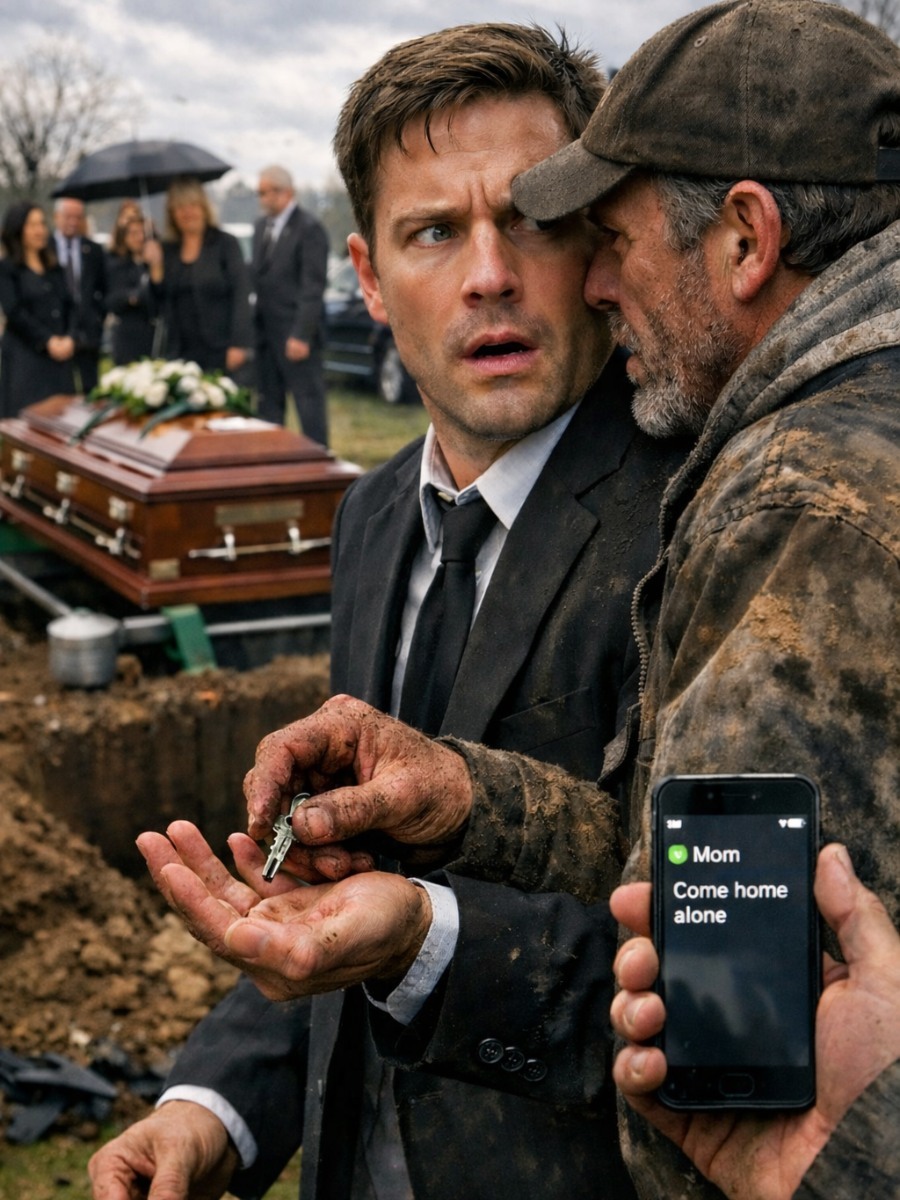
The gravedigger caught my arm just as I turned away from my father’s grave.
“Sir.”
His voice was low, rough, urgent enough to cut through the muffled sound of weeping relatives, the rustle of black coats, and the quiet scrape of shoes moving across wet cemetery grass. I almost shook him off without looking. My mother was waiting by the car. My wife had texted twice. My children were with my sister-in-law. My head was pounding from three sleepless nights and the strain of delivering a eulogy I could barely finish.
My father was dead.
That was the only thing in the world that mattered.
“Not now,” I said, trying to pull free.
But the gravedigger held on.
“Your father paid me,” he said.
I turned then.
He was a lean man in his mid-fifties, sunken-cheeked and weathered, with dirt embedded beneath his fingernails and eyes that looked like they’d spent a lifetime watching the living surrender the dead to the earth. There was no grief in his face, but there was something else. Fear, maybe. Or the strain of carrying something too heavy for too long.
“What did you say?”
“Your father paid me,” he repeated, glancing over my shoulder to make sure no one was close enough to hear, “to bury an empty coffin.”
For a second I didn’t understand the words. I heard them, but they refused to mean anything. They floated in the air between us like a language I should know but didn’t.
Then the meaning struck.
I laughed.
A short, sharp sound with no humor in it.
“That’s not funny.”
“I’m not joking.”
“My father is dead.”
“You saw what he wanted you to see.”
My chest tightened. “I saw his body at the viewing.”
The gravedigger swallowed. “No, sir. You saw a body. Not his.”
I stared at him, waiting for the punch line, the explanation, the correction—something sane. All around us, the funeral was ending. People were returning to their cars in dark little clusters, their faces damp with cold and sympathy. My uncle was helping my mother into the back seat of a sedan. A priest stood a few rows away, speaking softly to my cousin. The grave behind me held a polished coffin lowered into the ground only minutes earlier.
I had watched it descend.
I had stood there while earth and silence and finality swallowed my father whole.
And this stranger was telling me the coffin was empty.
“You need to leave me alone,” I said.
Instead of backing away, he reached into the pocket of his work jacket and pressed something into my palm.
A key.
Small brass, old, worn smooth in places. The number 17 was stamped into the head.
My hand closed around it automatically.
“What is this?”
“Storage facility on Route 9,” he said. “Unit 17.”
I looked down at the key, then back at him.
“What are you talking about?”
“He left instructions.”
“My father died three days ago.”
The gravedigger shook his head, a small movement full of grim certainty. “Your father planned this a long time ago.”
Before I could answer, my phone buzzed in my pocket.
I pulled it out.
A text from my mother.
Come home alone.
I frowned immediately.
Not because of the words themselves, but because of the way they were written.
My mother never texted like that.
She was one of those women who still treated text messages like handwritten notes. She opened with honey or sweetheart, added too many commas, too many exclamation points, and somehow managed to sound warm even through a phone screen. She would have written: Honey, come home when you can. I need you. Or: Julian sweetheart, please come by the house alone.
Not this.
Not three cold words that felt more like an order than a request.
The gravedigger saw my face change.
“Let me guess,” he said quietly. “She wants you to go home.”
I looked up sharply.
“How did you—”
“Don’t go.”
My fingers tightened around the phone.
“What?”
“Whatever you do, don’t go home. Not yet. Go to unit 17.”
“Who are you?”
“Marcus Webb.”
“That doesn’t answer my question.”
He hesitated, then drew an envelope from inside his coat. It was old, yellowed at the edges, sealed, my name written across the front in handwriting that made my stomach drop.
It was my father’s.
I would have known it anywhere. Strong, slanted, careful. The handwriting from birthday cards, permission slips, notes left on the kitchen counter all through my childhood.
Marcus held out the envelope. “He gave me this twenty years ago. Told me if the day ever came that I had to hand you that key, I was to give you this too.”
My mouth went dry.
“Twenty years?”
“He said you’d ask questions.” Marcus gave a tired, humorless smile. “Said you were a lawyer and you’d want proof.”
I took the envelope slowly, as though it might vanish if I moved too fast.
“Why you?” I asked.
“Because your father trusted me.” His gaze shifted toward the road bordering the cemetery. “And because I owed him.”
“Owed him for what?”
Marcus looked at me, and in that moment he seemed older than the graveyard itself.
“For a kindness nobody else would have given me.”
My phone was still warm in my hand. The text from my mother glowed on the screen, wrong in ways I couldn’t explain. The key pressed into my palm felt suddenly heavier than metal should.
Marcus leaned closer.
“Go to the storage unit now. Don’t stop anywhere. Don’t go home. And if that message feels wrong to you, trust that feeling. Your father was afraid of exactly this.”
“Afraid of what?”
I read it three times.
On the second reading, I noticed the pressure marks where his pen had dug into the paper on the words They have her.
On the third, I noticed that he had written Dad instead of Father.
He always signed notes to me that way.
I leaned back in the driver’s seat and closed my eyes.
It made no sense.
None of it.
And yet every instinct in my body, every buried animal part of my brain that recognized danger before logic could name it, told me the letter was real.
My father had known about the text.
He had predicted it.
He had known I would receive it at the cemetery.
Which meant someone had been watching.
I looked up sharply and checked the rearview mirror.
Nothing but rows of graves, polished stone, damp ground.
Still, my skin crawled.
I started the car.
Route 9 Storage sat on the outskirts of town, past the strip malls and chain restaurants, beyond the hardware store where my father used to take me on Saturday mornings when I was a kid. The farther I drove, the more the town thinned out into warehouses, fenced lots, and stretches of empty road lined with scrub grass and utility poles.
Clouds hung low and gray above the highway. The kind of afternoon that made every color seem washed out.
I kept checking my mirrors.
Every black SUV made my pulse jump. Every car tha