
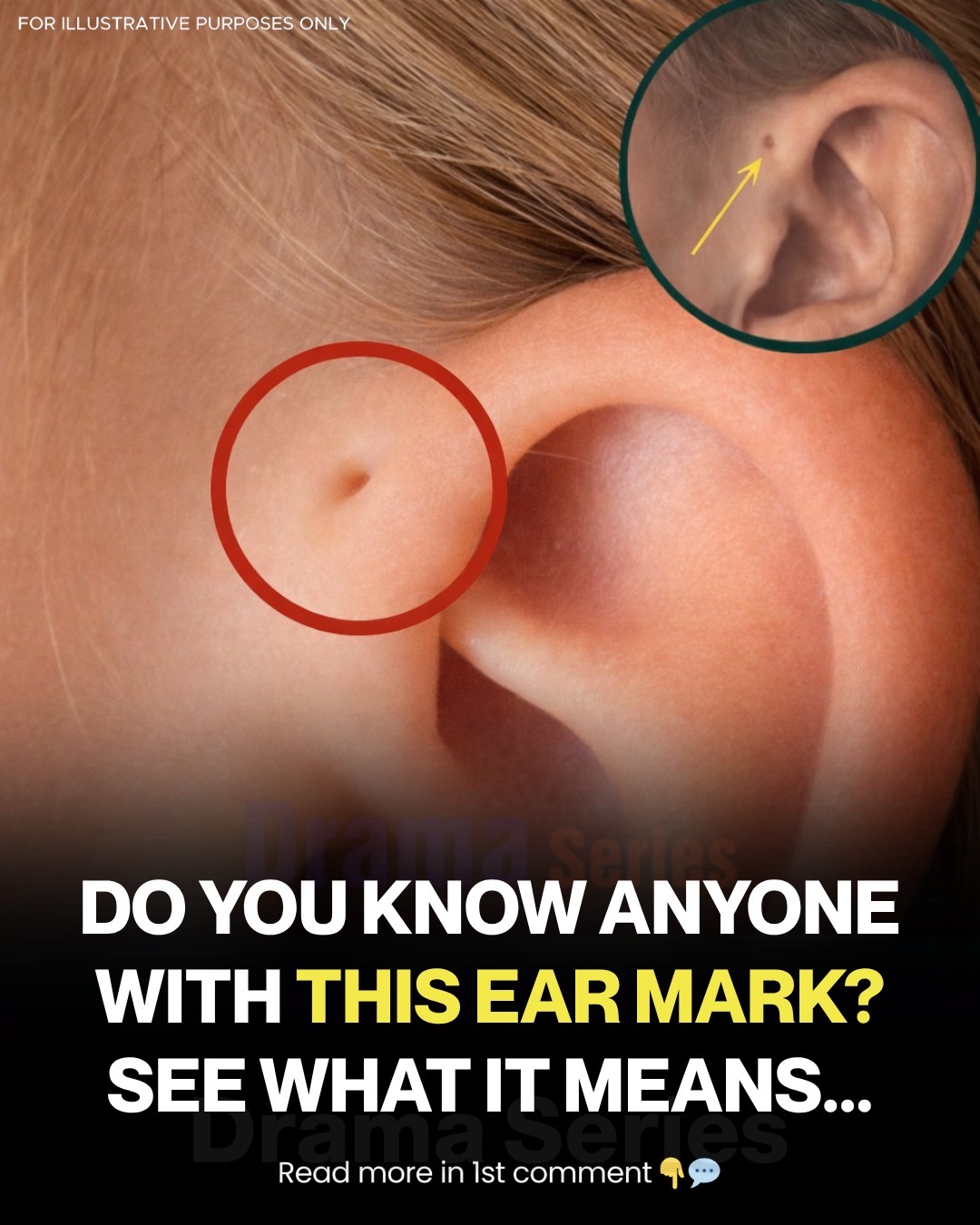
Take a quick trip to the mirror and look closely at where the top of your ear cartilage meets the side of your face. Do you see a tiny, barely-there indentation that looks like a pinprick? Or maybe you’ve noticed this subtle little mark on a friend, a family member, or a newborn baby, and assumed it was just a remnant of an old, abandoned cartilage piercing.
As it turns out, that tiny hole is completely natural. It is not the result of a needle, a scar, or an accident. It is a fascinating, relatively rare congenital quirk known in the medical world as a preauricular pit (or preauricular sinus).
While it might look like nothing more than a microscopic dimple, the story behind how it gets there—and what it might mean about the ancient history of the human body—is absolutely mind-blowing.
For illustrative purposes only
What Exactly Is a Preauricular Pit?
To understand what this tiny mark is, we have to go all the way back to the womb.
A preauricular pit is essentially a minor developmental anomaly that occurs very early in pregnancy, usually around the sixth week of gestation. During this crucial period, the human face and ears are rapidly forming from structures known as pharyngeal arches. Sometimes, these arches don’t fuse together completely seamlessly. When there is a microscopic gap or a slight hiccup in the fusion of the tissues that form the outer ear, a tiny tract or sinus is left behind.
The result? A tiny hole that leads to a narrow tract underneath the skin. Some people have them on just one ear (most commonly the right side, for reasons scientists still don’t entirely understand), while others hit the genetic lottery and have them on both.
The Mind-Blowing Evolutionary Theory: Are We Part Fish?
Here is where the story shifts from a standard medical explanation into something straight out of an evolutionary biology thriller.
While anatomists have known about preauricular pits since they were first documented by scientist Van Heusinger in 1864, it was Neil Shubin, a renowned evolutionary biologist and author of the groundbreaking book Your Inner Fish, who popularized a much more dramatic theory.
Shubin hypothesized that these tiny holes are actually an evolutionary leftover—specifically, an evolutionary remnant of fish gills.
It sounds like science fiction, but it makes incredible sense when you look at how human embryos develop. Those pharyngeal arches we mentioned earlier? In fish embryos, those exact same structures develop into gills. In human embryos, they develop into our jaws, our throats, and our ears.