
I thought about asking her. Going through the whole conversation again: the fork set down, the even voice, the category she had already decided I belonged in.
I thought about what it would feel like to hand her that form and watch her not sign it. To give her one more opportunity to close one more door in my face.
I picked up a pen.
I signed her name.
I told myself it wasn’t deception.
It was correction.
I was correcting an outcome she would have gotten wrong.
I submitted the application in November.
The interview invitation arrived in January.
It was a Tuesday when I came home to find Mom standing in the kitchen holding the opened envelope. She had a habit of opening mail she thought might be relevant to the household. She considered my future a household matter.
She looked at me when I walked through the door. Then she looked at the letter. Then back at me.
“West Point,” she said.
“Yes.”
“You applied to West Point?”
“Yes.”
“Without telling me.”
“You would have said no.”
Something moved across her face. Not anger exactly. Something colder than anger. More controlled.
“Do you know what people will think?”
Her voice was very quiet.
“Do you know what my colleagues will say when they find out my daughter chose this over every other option available to her? Do you know what it looks like—that I raised a child who couldn’t get into Carnegie Mellon? That I failed as a mother?”
Not Are you sure this is what you want?
Not Tell me why.
Not I’m worried about you.
What she said was, “What will people think of me?”
I stood in the kitchen doorway with my school bag still on my shoulder and looked at my mother and understood something clearly for the first time.
This had never been about me.
Not the JROTC form she wouldn’t sign. Not the dinner she didn’t attend. Not the trophy in the laundry room.
None of it had ever been about me.
It had always been about the story she was telling about herself.
I was a supporting character in that story, and I had just gone off script.
Audrey was standing in the hallway behind me. I knew without turning around. I could feel her there. That particular stillness she had when she was listening and didn’t want you to know it.
Later that night, I heard her on the phone. I couldn’t make out all the words through the wall, but I heard her laugh and I heard her say, “Oh my God, my sister is trying to join the Army.”
And then another laugh.
Light. Dismissive.
The way you laugh at something that doesn’t matter.
I went to my room and sat on the floor with my back against the bed and stared at the ceiling for a long time.
I thought maybe they’re right.
I thought maybe I’m making a mistake.
I thought maybe I should just apply to Carnegie Mellon and stop making everything so difficult.
I thought all of those things.
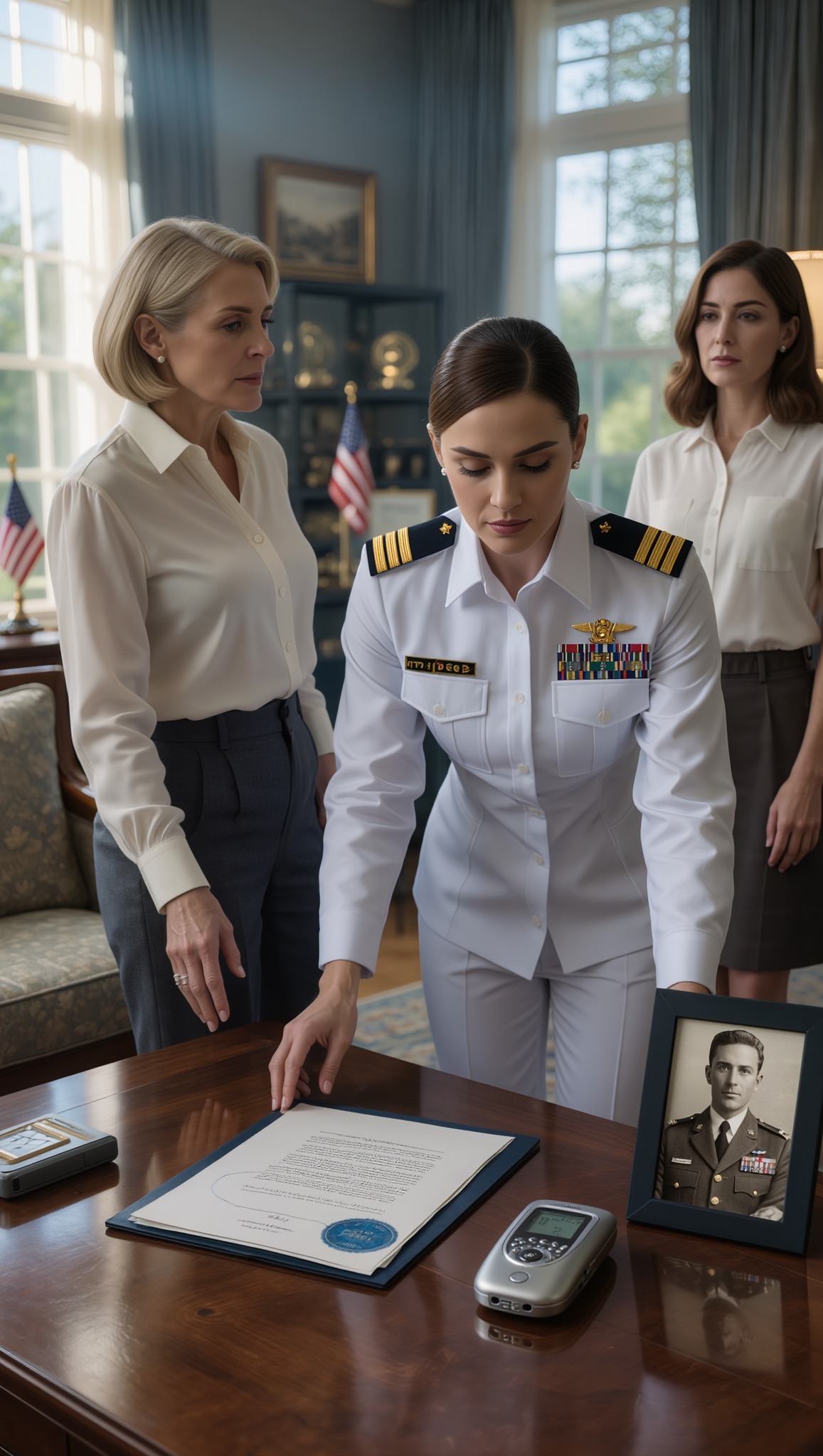
And then I opened my desk drawer and took out the photograph of my father and looked at it for a while.
Dress uniform. Straight spine. Eyes looking directly at the camera with an expression I had spent fourteen years trying to decode.
Not pride exactly.
Something quieter than pride.
Certainty.
I put the photograph back, closed the drawer, and decided I was going to that interview.
The West Point admissions office held regional interviews at a federal building in downtown Pittsburgh on a Saturday morning in February. I wore the one blazer I owned—navy blue, bought for a school debate competition two years earlier—and took the bus downtown alone.
The waiting room had six other candidates. All of them looked more prepared than me. Two of them wore actual blazers with matching trousers. One had a folder with tab dividers. I had my application notes folded in my jacket pocket and my father’s words somewhere in the back of my mind.
My interviewer was a man in his late fifties with close-cropped gray hair and the kind of posture that doesn’t come from good habits. It comes from years of being told that how you hold yourself tells people everything about who you are before you open your mouth.
He stood when I entered the room and extended his hand.
“Marin Holloway.”
He said my name like he had already read it several times and was confirming something.
“I’m Colonel Edmund Callaway. Sit down.”
He opened my file and read for three minutes in silence.
I sat across from him and kept my hands flat on my knees and breathed.
Then he looked up.
The interview lasted forty minutes. He asked me about my mathematics work, about my leadership experience, about why West Point specifically and not ROTC through a civilian university. I answered everything directly and without performance. No rehearsed speeches. No strategic framing. Just the truth stated plainly, the way my father had taught me to do small things.
When it was over, he closed the folder and looked at me for a moment.
“Your file is one of the strongest I’ve reviewed in eleven years,” he said. “Don’t let anyone talk you out of this.”
“My mother doesn’t support this,” I said.
I don’t know why I told him. I hadn’t planned to.
He didn’t look surprised.
“I know,” he said. “I could tell the moment you walked in. You have the look of someone who got here alone.”
He paused, straightened the folder on the desk in front of him.
“I grew up in a family that didn’t believe in this either,” he said. “My father thought the military was something you did when you had no other options. He never changed his mind.”
He looked at the window for a moment.
“The people who try hardest to stop you from going, sometimes they’re the ones most afraid of losing you to something bigger than themselves. That’s not about you, Marin. That’s about them.”
I nodded. I didn’t trust my voice right then.
He stood and extended his hand again.
“We’ll be in touch,” he said.
I took the bus home, sat in the back, watched Pittsburgh go past the window—the bridges, the rivers, the gray February sky over the rooftops of Shadyside. I turned Colonel Callaway’s last words over in my mind the whole way home.
The people who try hardest to stop you. Sometimes they’re most afraid of losing you.
I didn’t fully understand it yet.
But I didn’t forget it.
Three weeks after that interview, I came home to find a different kind of envelope waiting.
Not from West Point.
From a law office on Fifth Avenue in downtown Pittsburgh. The firm whose name I recognized because I had seen it on documents in my father’s files after he passed.
The letter inside was not addressed to me.
It was a copy of a letter sent to the West Point admissions office, signed by my mother, requesting that my application be withdrawn immediately on the grounds that the applicant had submitted forged parental consent and, quote, “made a mistake that requires family intervention.”
She had tried to pull my application entirely.
And she had never said a single word to me about it.
I didn’t confront her right away.
That might surprise you.
After everything—the unsigned form, the dinner she didn’t attend, the trophy in the laundry room, and now this—you might expect me to have walked into that kitchen and laid it all out on the table. Said, I know what you did. I have the letter. Explain yourself.
I didn’t.
Not because I was afraid. Not because I didn’t have the words.
But because I had learned something important about my mother over seventeen years of living under the same roof as her.
Celeste Holloway did not respond to confrontation the way normal people did.
She didn’t get flustered. She didn’t apologize. She didn’t even get genuinely angry.
She got strategic.
She reframed.
She reorganized the facts of a situation until the version she was presenting was so internally consistent, so reasonable-sounding, that you started to doubt your own memory of what had actually happened.
If I went to her with that letter before I was ready, she would turn it into something else entirely. My forged signature. My deception. My lack of judgment.
By the time she was finished, the story would be that she had done the responsible thing, the only thing a loving mother could do when her reckless daughter had gone behind her back and made a decision she wasn’t mature enough to make alone.
I needed to wait.
I needed more ground under my feet before I could afford to stand on it.
So I folded the letter, put it back in the envelope, put the envelope in the same drawer as my father’s photograph and the state mathematics medal I had never displayed.
And I waited.
What I didn’t know—what I couldn’t have known—was that West Point had already responded.
Not by withdrawing my application.
By picking up the phone and calling me directly.
That call came on a Thursday evening in March while Mom was at a work event and Audrey was at a friend’s apartment in Squirrel Hill. I was alone in the kitchen making tea when my phone rang from an area code I didn’t recognize.
The woman on the other end identified herself as an administrator in the West Point admissions office.
She said they had received a request to withdraw my application.
She said it was their standard practice, in cases where a request of that nature came from a third party rather than the applicant, to contact the applicant directly to confirm their intentions.
“Is it your wish to withdraw your application, Miss Holloway?”
I stood very still in the kitchen. The kettle was beginning to hiss on the stove behind me.
“No,” I said. “It is not.”
“Thank you for confirming that. Your application will remain active. Please be aware that this call and its outcome will be noted in your file.”
She thanked me for my time and ended the call.
I stood there for a long moment after the kettle reached a full boil and clicked off. Steam rose from the spout and disappeared.
Outside the kitchen window, the last of the March light was fading over the rooftops.
My mother had tried to erase me from the one process that had ever treated me like I was worth fighting for.
And the institution she had called for dropouts had made a phone call to make sure I had a voice.
I poured my tea, sat down at the kitchen table, and began to understand for the first time exactly what I was dealing with.
The acceptance letter from West Point arrived six weeks later in May.
I collected the mail that morning before Mom was awake and brought it upstairs, sat on my bed, opened it carefully along the seam, the way you open something you want to keep intact.
I read it twice.
Then I put it back in the envelope, put the envelope in the drawer with the letter from the law office, my father’s photograph, the mathematics medal, and the two pages of Callaway’s file notes I had kept from my interview.
I closed the drawer.
And I waited again.
Because Celeste Holloway had one more move coming. I could feel it. She had tried the direct approach, the attorney’s letter, and it hadn’t worked. When that strategy failed, she would regroup. She would find a way to make her position seem reasonable. She would recruit allies. She would build consensus. She would make it a family matter.
I was right.
Six weeks into summer, she called a dinner.
Not a regular dinner.
A specific dinner.
Invitations issued in advance. A date confirmed by text.
Family dinner. Sunday the 12th. Important. Please be there.
The use of the word important was deliberate. It was the word she used for things she had already decided and was now going to announce.
I knew what it was before I sat down.
The table was set for six. Mom at the head. Me across from Audrey’s laptop. Audrey was in Philadelphia by then, in the apartment Mom was paying for while she did her first year at Wharton. Aunt Renata Keene had driven up from Philadelphia the day before and was staying in the guest room. Beverly Marsh, my mother’s closest friend and fellow financial consultant—a woman who wore geometric earrings and had never once asked me a question about myself in fifteen years of knowing her—was seated to Mom’s right.
The food was good. It always was when Mom wanted something.
Renata started.
“We just want to talk this through with you, sweetheart.”
She reached across and patted my hand once.
“We all care about your future. That’s why we’re here.”
I looked at her hand on mine. Then I looked at her face.
Renata had never come to a single school event. Had never called just to check in. Had never, in my memory, expressed any interest in my future that didn’t originate with my mother first.
I nodded, picked up my fork, started eating.
“There’s no upward mobility in the military,” Renata said, settling back in her chair. “I’ve had clients who served. Good people, smart people. And they come back and they can’t translate any of it into a real career. The private sector doesn’t know what to do with them.”
I chewed, swallowed, said nothing.
Beverly went next.
“I had a client. Brilliant young man. Could have gone anywhere. And he joined the Army straight out of college.”
She shook her head with the particular sadness of someone describing a natural disaster.
“He came back different. Not in a good way. You’re a bright girl, Marin. You have so many options. Don’t close doors before you’ve even opened them.”
The phrase don’t close doors landed with a specific irony she seemed entirely unaware of.
I drank some water and set the glass down quietly.
On the laptop screen, Audrey leaned forward into the camera. She was in her apartment. I could see the exposed brick behind her that Mom had helped her choose, the pendant light Mom had paid for, the bookshelf with the books arranged by color that Audrey had posted three photos of on Instagram.
“Marin, honestly,” she said, in the tone you use for obviously, “you’re going to regret this. I’m saying this as your sister.”
As your sister.
I looked at the screen for a moment. I thought about the text she had sent Mom the night before my competition in Washington, D.C. I thought about the laugh through the wall. Oh my God, my sister is trying to join the Army. I thought about every door she had nudged shut with one hand while keeping her expression perfectly neutral with the other.
I said nothing.
I looked back at my plate.
Then my mother set down her wineglass with a small, deliberate sound that meant she was ready to deliver the conclusion.
She looked at me the way she always looked at me when she wanted me to understand that what she was about to say was not a matter of opinion.
“I’m telling you this because I love you.”
Her voice was even. Careful. The voice she used with difficult clients.
“The military doesn’t want smart girls, Marin. It wants obedient ones.”
She let that sit for a moment.
“And you’re too smart to be obedient.”
The table went quiet.
Renata was nodding.
Beverly had her hands folded in front of her plate.
On the screen, Audrey was watching my face with the particular attention of someone waiting for a reaction they had already anticipated.
I sat in that silence for a long moment.
Seventeen years.
I had sat at tables in that house for seventeen years.
And not once—not one single time—had anyone asked me what I wanted. What I believed. What I was capable of. What I was working toward. What I felt when I read my father’s journals on the cold floor of the garage and understood for the first time what the word purpose meant from the inside.
Not once.
I looked at my mother.
Something had shifted.
Not cracked. Shifted.
The way a door shifts on its hinges when the foundation of a house settles. Quiet. Final. Irreversible.
I put my napkin on the table and looked at my mother and said the only thing I had left to say.
Then I stood up and walked out.
I never sat at that table again.
Let me tell you what I said.
I had rehearsed it. Not in the way you rehearse a speech, standing in front of a mirror, timing yourself, adjusting your phrasing for maximum effect. I had rehearsed it the way soldiers rehearse emergency procedures. Quietly. Repeatedly. Until the words were so familiar they required no effort to produce. Until I could say them in any condition—tired, afraid, shaking—and they would come out exactly the way I intended.
I stood up from the table. I set my napkin down on the chair beside me and smoothed it once with the back of my hand.
Then I looked at my mother. Not at Renata. Not at Beverly. Not at Audrey’s face on the laptop screen, wearing the expression that looked like concern but was really just curiosity about how this was going to go.
At my mother.
“I know you called West Point,” I said.
The room did not move.
“I know you tried to pull my application. I know you hired an attorney to send a letter saying I had made a mistake that required family intervention.”
I kept my voice level, the way you keep a level when you are building something and you need it to be right.
“And I want you to know they called me. The admissions office called me directly to confirm my intentions. They told me about the request. They told me everything. And they kept a record of your call.”
Fifteen seconds of silence.
I counted them.
Renata had put her fork down.
Beverly was very still.
On the laptop screen, Audrey had straightened up slightly, her expression shifting from anticipation to something she couldn’t quite organize into a recognizable shape.
My mother did not move.
She sat at the head of that table—the table she had chosen, in the house she had curated, surrounded by the people she had assembled.
And for the first time in my memory, she had nothing to reorganize.
No reframe available. No reasonable-sounding version of the facts that would make this into something else.
She looked at me.
I looked back.
“You didn’t do it because you love me,” I said. “You did it because you were embarrassed. There is a difference.”
I paused.
“You taught me that yourself.”
Then I picked up my napkin from the chair, set it on the table in the place where my plate had been, and walked out of the dining room, down the hallway, and up the stairs to my room.