
I closed the door.
I did not slam it.
Slamming would have been emotion.
This was something else.
This was a decision made so completely that it required no force to carry out.
You close a door firmly when you’re done with what’s on the other side of it. That is all.
I sat on the edge of my bed.
The room was the same as it had always been. Same desk. Same window looking out over the backyard. Same maple tree visible through the glass, full and green in the August heat.
I had lived in that room for eighteen years, and in a few weeks I would leave it for good.
And I felt not sad. Not angry. Not triumphant.
Clear.
That was the word.
Everything was clear.
The way the air goes clear after a storm, when the pressure drops and you can see farther than you could before.
I reached under my mattress and pulled out the acceptance letter. I had read it twice the morning it arrived and then put it away. I read it again now. All of it. Every formal sentence. The date of induction. The reporting instructions. The list of items to bring and the list of items to leave behind.
I folded it back along its original creases and put it on the desk in front of me.
Then I opened my laptop.
The West Point acceptance portal had a confirmation page I had not yet submitted. I had been waiting, not because I was uncertain. I had never been uncertain. But because I had wanted to wait until after this dinner, until after I had said what I needed to say in the room where I needed to say it to the person who needed to hear it.
Now I had.
I clicked confirm.
The page refreshed. A green banner appeared across the top of the screen.
Your enrollment has been confirmed. Welcome to the United States Military Academy, Class of—
I read it.
Read it again.
Closed the laptop.
I sat in the quiet for a while.
There was a knock at my door.
Mom’s knock. Two short, precise wraps. The knock of someone who considers entering a room a transaction that requires acknowledgment.
I didn’t answer.
She knocked again.
“Marin.”
Her voice through the door was controlled, not angry. She was never openly angry. Anger was untidy. And she didn’t do untidy.
But there was something underneath the control that I hadn’t heard before. Something I would have called uncertainty if I had thought she was capable of it.
I sat on the edge of my bed and looked at the door and said nothing.
After a moment, I heard her footsteps move back down the hallway.
I took out my phone and called Colonel Edmund Callaway at 7:02 the following morning.
He answered on the second ring. I could hear in the background the particular quiet of an early morning somewhere orderly: a coffee cup being set down, a chair adjusting.
“Miss Holloway.”
He said my name the same way he had said it in that interview room in February, like a confirmation of something he had already known.
“I’m accepting the offer,” I said. “I wanted you to know directly.”
A pause. Brief.
The kind of pause that isn’t hesitation. It’s just a person taking a moment to let something land the way it deserves to.
“I know,” he said. “We’ve been waiting for your call.”
Four words.
We’ve been waiting for your call.
I have thought about those four words many times since. What they meant about how he had read my file. What they meant about how West Point had handled my mother’s call. What they meant about the difference between institutions that protect the people inside them and institutions that protect the people in charge.
We talked for eleven minutes. Reporting date. What to pack. What to expect in the first week. His voice was the same as it had been in the interview: direct, unhurried, completely without performance.
Before we ended the call, he said one more thing.
“The first year is going to be the hardest thing you’ve ever done. There will be a night, probably around the third month, when you will be so exhausted that quitting will feel like the only rational option available to you. When that night comes, I want you to remember that you made this decision in full possession of every reason not to. That matters. Hold on to that.”
I wrote it down on a piece of paper after I hung up, folded it, and put it in my wallet.
I left Pittsburgh on a Tuesday morning in late July. My bags were packed and waiting by the front door at six o’clock. A taxi was coming at 6:30.
Mom did not come downstairs.
I stood in the hallway for a moment and looked up the staircase. The house was quiet the way it had always been quiet. Not peaceful. Just uninhabited. Like a hotel between guests.
I picked up my bags.
I looked once more at the framed prints on the walls, the abstract shapes and muted colors that had replaced my father’s photographs twelve years earlier.
Tasteful. Blank. Saying nothing.
I opened the front door and walked out.
My phone buzzed as the taxi pulled away from the curb.
A text from Audrey.
Good luck, I guess. Lol.
I read it once.
Then I opened the message thread with every text she had ever sent me going back years. The congratulations that weren’t really congratulations. The suggestions that were really warnings. The I’m saying this as your sister that was really just surveillance with a friendly label.
I selected all.
Deleted.
The taxi crossed the bridge over the Allegheny River, and I watched Pittsburgh go past the window—the water, the bridges, the skyline catching the early morning light—and I did not look away until it was completely gone.
Something shifted inside me that morning.
Something that would never shift back.
I want to tell you what West Point actually felt like.
Not the version you see in recruitment videos, the dramatic sunrises over the Hudson, the cadets in formation against a backdrop of gray stone and American flags. Not the version my mother imagined when she heard the word military, something blunt and undiscriminating, a place that took anyone with a pulse and turned them into something interchangeable.
The real version.
The one that started at five in the morning on the first day of Cadet Basic Training and did not let up for four years.
Plebe year—what West Point calls the first year—is designed to strip away everything you brought with you and find out what’s underneath. Not cruel. Precise. There is a difference.
You wake before dawn every morning. You make your bed to a standard that allows no interpretation. You eat meals in a specific posture in a specific amount of time, answering questions from upperclassmen while simultaneously attempting to consume enough calories to survive the afternoon. You run, you drill, you study, you sleep for fewer hours than your body wants, and wake up and do it again.
In the first week, I called no one.
There was no one to call.
The other plebes around me had parents who sent care packages and wrote letters and called on designated phone days with voices full of pride and worry in equal measure. I watched them collect their mail on distribution days and felt something I refused to name at the time.
I named it later.
It was grief.
Simple, uncomplicated grief for something I had never actually had.
I got letters from no one. I got a package from no one. Not a single call on phone day from Pittsburgh.
I told myself it didn’t matter.
I had told myself that so many times by then that the words had worn smooth, no texture left, no ability to catch on anything real.
I said them again and kept moving.
The night Callaway had warned me about arrived on schedule.
It was a Thursday in October, eleven weeks into plebe year. We had completed a twelve-mile road march in full gear that morning, followed by four hours of afternoon classes, followed by an evening session of military science that ended at 2200 hours.
I sat on the edge of my bunk in the dark after lights out with my boots still on because I didn’t have the energy to take them off, and I thought with perfect clarity:
I cannot do this.
Not as a dramatic declaration. As a simple assessment of available resources. A calculation.
I had run the numbers.
And the numbers said I was done.
I sat there for a long time.
Then I remembered the piece of paper in my wallet.
I got up, took out my wallet, unfolded the paper I had written on the morning after I confirmed my enrollment, sitting on the edge of my bed in Pittsburgh while my mother stood on the other side of my closed door.
The first year is going to be the hardest thing you’ve ever done. When that night comes, remember that you made this decision in full possession of every reason not to. That matters. Hold on to that.
I read it twice.
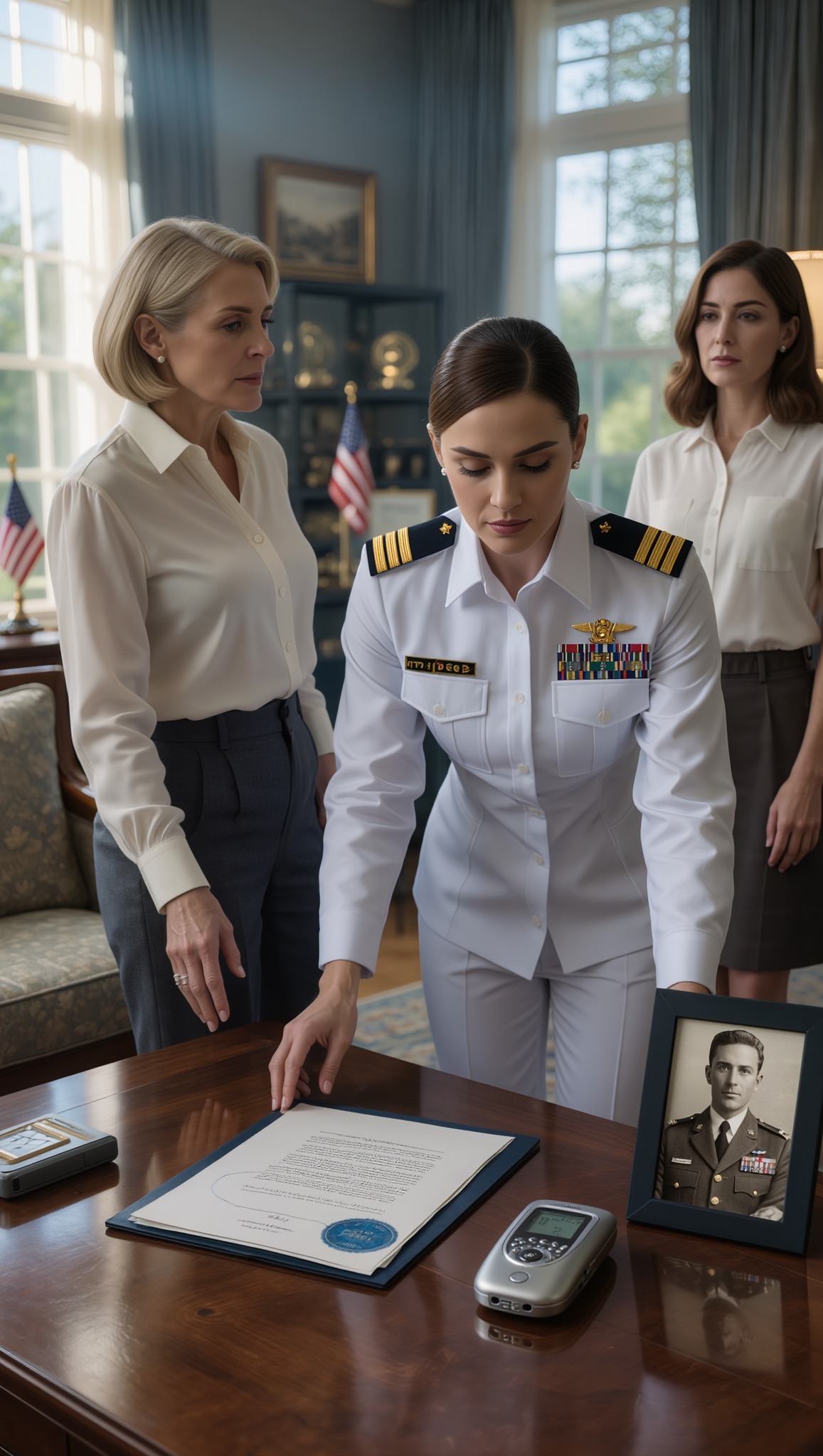
Then I went to my locker and found the small photograph I had carried since I was twelve years old. My father in his dress uniform. That expression I had spent years trying to decode.
I understood it now.
Sitting on the edge of a bunk at West Point at 11:15 at night, with twelve miles still in my legs and four hours of sleep ahead of me, I finally understood it.
It wasn’t pride.
It wasn’t certainty.
It was simply the face of a person who had decided what they were going to do and had made their peace with the cost of it.
I put the photograph back, took off my boots, set them correctly beside the bunk, and went to sleep.
I did not quit.
The next morning, I got up at 0500, made my bed to standard, and went back to work.
The following morning, I did it again.
By spring, I had been named a cadet squad leader, one of the handful of plebes selected to take on leadership responsibilities ahead of schedule based on demonstrated performance.
It was the first time in my life that people looked to me not because they had to, but because I had earned it. Because I had shown them something worth following.
I learned things about myself that year that I could not have learned anywhere else.
I learned that I was significantly more capable of discomfort than I had believed.
I learned that authority exercised calmly is more effective than authority exercised loudly.
I learned that the people who last longest are rarely the ones who arrive with the most natural ability. They are the ones who have already made their peace with difficulty before it arrives.
My father had known all of this. He had written about it in those green notebooks on the cold garage floor. I was learning it in real time on stone steps at five in the morning.
And every morning it felt like a conversation with him I was finally old enough to have.
In my second year, I taught a new plebe how to make his bunk to standard on the first morning of basic training. He was from a small town in Georgia, nervous in the specific way of someone who has worked hard to get somewhere and is terrified of being found inadequate now that he’s arrived.
I showed him the fold.
“Flat, clean, no wasted space.”
“Every fold matters,” I said, and heard my father’s voice underneath mine. “How you do small things is how you do everything.”
The plebe nodded, made the fold, and got it right on the second try.
I had to turn away for a moment. Just one moment.
Then I straightened up and moved on.
Third year brought the program I had not dared to hope for. West Point maintained an exchange program with the Royal Military Academy Sandhurst in England, one of the most prestigious military institutions in the world. Twelve cadets from the entire academy were selected annually. Selection was based on academic performance, leadership evaluations, physical fitness scores, and faculty recommendations.
I found out I had been selected on a Wednesday afternoon in February.
Colonel Callaway—who had by then become something between a mentor and the closest thing to a steady adult presence I had in my life—sent me a brief email.
Sandhurst confirmed. Well done. Don’t waste it.
Six months at Sandhurst taught me that excellence has no nationality. That the standards I had been holding myself to at West Point were not exceptional by global measures. They were simply the floor. That there was always another level of rigor, another degree of precision, another depth of commitment available to those willing to reach for it.
I reached.
I came back in my final year a different person than I had left. Quieter in some ways. More certain in others. The kind of certain that doesn’t need to announce itself.
Final year culminated in May with a graduation ceremony on the Plain, the great open parade ground at the heart of West Point where the Hudson curves past the gray stone walls and the mountains rise on the far bank and the whole place feels, on clear days, like something out of a painting.
Four years of accumulated effort, standing at attention in the morning light, about to be formally acknowledged by the institution that had, eleven weeks after my mother tried to erase me from its records, welcomed me in anyway.
I graduated in the top fifteen of my class.
I received the Superintendent’s Award for Leadership and Ethics.
The sword—an actual cavalry sword presented on the stage in front of everyone—was reserved for cadets who had demonstrated not just academic or physical excellence, but the specific, harder-to-measure quality of character under pressure.
I held it with both hands.
I thought about the kitchen counter where trophies went to disappear.
I thought about the laundry room shelf.
I thought about every “good job, honey” delivered to a turned back.
And then I thought about my father.
And I thought he would have known exactly what this was worth.
He would have stood in that audience with his back straight and his eyes clear, and he would have understood every single thing this moment cost and what it meant that I was standing there holding it anyway.
No one from my family was in the audience.
Not one person.
Colonel Callaway was in the third row.
When I came down from the stage, he stood, said nothing, and just nodded once, the way you acknowledge something that requires no words to be understood.
That nod was enough.
That week, back in my quarters, a letter arrived from Pittsburgh.
Not from Mom. Not from Audrey.
From a law office on Fifth Avenue, the same firm that had handled my father’s affairs.
Inside was an envelope sealed with tape yellowed slightly at the edges. On the front, in handwriting I recognized immediately, was my name.
Marin.
One word.
His handwriting.
My name.
I sat down on my bunk and held it for a long time before I opened it.
I opened it slowly, not because I was afraid of what was inside, but because some moments deserve to be entered carefully. The way you step into a room where something important happened. Not rushing. Not dragging your feet. Just moving at the speed the moment requires.
The envelope contained two things: a letter and a document from a law office dated eleven years earlier.
I read the letter first.
It was four pages handwritten on lined paper in my father’s deliberate, small script. The date at the top was October of the year I turned fifteen, four months before he passed. He had written it knowing he was running out of time. Not dramatically. Practically. The way he did everything.
He started simply.
Marin, if you are reading this, you graduated. I don’t know from where. I don’t know what you studied or what you chose or what it cost you to get there, but you got there. I know that the way I know certain things—not from evidence, just from knowing you.
I had to stop. Put the letter down on the bunk beside me. Look at the ceiling for a moment. Then pick it up again.
I want to tell you something I should have said out loud more often when I had the chance. You were always the one I worried about least. Not because your life was easier. I could see even when you were small that it wasn’t. But because you had something I recognized. A way of going quiet when things got hard instead of loud. A way of deciding things and then just doing them without ceremony, without needing anyone to agree first. That quality will cost you in some rooms. It will be worth everything in others.
I found your journals, Marin. The ones you keep under your mattress. Yes, I knew they were there. I read the entry where you wrote about wanting to join the military someday. You were thirteen. You wrote about it the way you write about mathematics, like it was a problem you’d already solved and were just waiting to execute.
I didn’t say anything to you about it because I knew your mother would make it harder if she knew I had encouraged you. That was a failure of courage on my part. I’m sorry for it. The Army will be lucky to have you. And one day, I hope you’ll forgive me for not being there to see it.
He had underlined that last sentence once, carefully.
The final paragraph contained instructions about the legal document.
He had established a trust in my name alone. Two hundred twenty thousand dollars, drawn from a life insurance policy Celeste had not known existed, managed by the law office on Fifth Avenue for the duration of my minority and released upon proof of graduation from any accredited institution.
The trust had one beneficiary.
My name.
No conditions beyond graduation. No joint access. No provision for anyone else.
Your mother is a capable woman, he wrote. She loves you in the way she knows how to love, which is organized, conditional, and deeply tied to her own idea of what success looks like. That is not the same as not loving you. But it is also not enough. And I think you have always known that.
This money is not a reward. It is not a statement about your choices versus anyone else’s. It is simply this: I saw you. I always saw you, and I wanted there to be something left behind that proved it.
Take care of yourself, Marin. You always have.
Keep going.
Dad.
I read the letter three times.
The third time I read it, I was not crying.
I want to be precise about that.
Not because crying would have been wrong, but because what I felt was not sadness. It was something larger and quieter than sadness. The specific feeling of being understood by someone who is no longer there to tell you, of receiving, eleven years late, the thing you had needed most and had long since taught yourself to live without.
I sat on that bunk for a long time.
Then I picked up the legal document and read it carefully. The trust was real. The amount was real. The instructions were clear.
I called the law office the following morning and spoke with the attorney who had managed the account for eleven years, a man named Mr. Gerald Fitch who had a voice like old wood and who said, when I identified myself, “Miss Holloway, we have been expecting your call for some time. Congratulations on your graduation.”
The trust would be transferred to an account of my choosing within thirty business days.
Two hundred twenty thousand dollars.
My father had seen me coming from eleven years away and had made sure I would land on solid ground.
I held that for a day before the second piece of news arrived.
It came from Audrey, indirectly, through a contact of mine from Pittsburgh—a woman named Priscilla who had gone to the same high school and stayed loosely in touch over the years through occasional messages.
Priscilla sent me a text on a Thursday evening with no preamble.
Did you hear about your sister?
I hadn’t.
Priscilla sent a screenshot. A post from a private Facebook group for Wharton students, one of those loose alumni networks that aren’t supposed to share internal information but always do.
The post was vague in the way of posts written by people who know more than they’re saying. Academic integrity proceedings. A well-known student. A dissertation. Ghostwriting service.
I did one search and found enough.
Audrey had been suspended from the Wharton MBA program for six months pending a formal academic integrity review after submitting a dissertation that had been identified by the school’s detection software as having been substantially written by a third-party service.
The LinkedIn post—the one with four hundred likes and the caption So proud of my brilliant daughter—had been quietly removed sometime in the preceding forty-eight hours.
I set my phone down.
I thought about Audrey at the dinner table the night I announced I wanted to join the military.
Yeah, Marin, you’re literally too smart for that.
I thought about the text to Mom the night before Washington, D.C.
I thought about the laugh through the wall.
I thought about the face on the laptop screen during the family dinner, watching me with that particular expression that looked like concern and was really just surveillance.
I did not feel triumphant.
I want to be honest about that.
I had expected, when this moment came in some form, to feel something sharp and satisfying.
What I actually felt was tired and sad in a distant way. The way you feel sad about weather.
It had happened.
It was not about me.
It was just the inevitable outcome of a person who had spent years performing competence instead of building it.
The third call came two days later.
Colonel Callaway, retired by then and living in Vermont, but still reachable by phone on Thursday afternoons when the weather was good and he was in his study.
I had called to thank him. To tell him about the letter from my father. To tell him I was officially commissioned and reporting to Fort Campbell in three weeks.
He listened, asked two questions, and said, “Good. Your father would have been satisfied.”
Then, before I could end the call, he said, “There’s something I’ve been waiting for the right moment to tell you.”
He told me about the call.