
What the Doctor Saw
A story about the people who show up, and the ones who eventually find their way back.
Clara Mendoza walked into St. Gabriel Medical Center on a cold Tuesday morning in January carrying a small rolling suitcase, a wool sweater she had owned since her sophomore year of college, and the particular kind of exhaustion that does not come from a single bad night but from nine consecutive months of getting through things alone. She had packed the bag three times. The first time she had included a novel she knew she would not read and a candle that the hospital would not allow, and she had stood there in her bedroom looking at the bag for a long time before she took those things out and replaced them with practical items. Extra socks. The phone charger. A photograph of no one in particular, just the view from her old apartment window, taken one afternoon when the light was doing something worth keeping.
There was no one beside her.
No husband. No mother who had flown in from San Antonio. No best friend who had been waiting for this call for months and had already cleared her calendar. There was only Clara, twenty-six years old, breathing through a contraction with the focused inwardness of a person who has learned that unavoidable pain cannot be negotiated with, only moved through, and the weight of everything she had not permitted herself to fall apart about since the previous July.
The intake nurse at the admissions desk had a kind face and the professional warmth of someone who had welcomed several thousand people through this particular door without ever making it feel routine. She looked up from her computer with an easy smile and asked the question she asked everyone.
“Is your partner on the way?”
Clara had been asked some version of this question eleven times in the past nine months. By nurses, by the obstetrician’s receptionist, by the woman at the birthing class Clara had attended alone and left twenty minutes early because sitting in a circle of couples who kept reaching for each other’s hands had been more than she could manage that particular week. She had developed a response that was smooth and automatic and cost her almost nothing to deliver.
“He’s coming,” she said, smiling back. “He just got held up.”
It was a lie so thoroughly practiced it no longer registered as one.
Emilio Salazar had left seven months ago, on the same night Clara had sat across from him at the kitchen table of their apartment in Austin and told him, with her hands wrapped around a cup of tea she could not actually drink, that she was pregnant. He had not yelled. He had not thrown anything or slammed doors or made any of the dramatic exits that at least announce themselves clearly and give you something concrete to be angry about. He had simply gone to the bedroom, returned a few minutes later with a backpack, told her he needed some time to think, and walked out with the quiet, clean efficiency of a man who had been deciding this for considerably longer than the conversation had lasted. The door had closed behind him with almost no sound at all, barely a click, politely almost, and that near-silence was somehow the worst part of everything that followed.
She had cried for three weeks.
Then she had stopped, not because grief had finished with her, but because grief had run directly into the practical reality of what came next, and practical reality does not wait for grief to resolve. She found a smaller apartment two miles east, negotiated the security deposit down by fifty dollars because she had asked and asking cost nothing. She picked up extra shifts at the diner where she had been working part-time, then more shifts, then doubles, until her feet swelled at the end of every night and she sat on the edge of her bed and rubbed them herself, talking quietly to the child growing inside her who could not yet hear her voice but who, the books all promised, would be able to soon.
“I’m going to be here,” she told the baby, her palm pressed flat against the side of her stomach, every night before she slept. “Whatever happens. I’m going to be here.”
The labor lasted twelve hours.
The contractions came in waves that built and broke and rebuilt without the mercy of a real interval between them, and Clara held the bed rail with both hands and breathed the way the nurse instructed and fixed her eyes on a water stain on the ceiling tile that she had already memorized and told herself every twenty minutes that she was still doing it. Which she was. Which was the only thing that mattered.
The nurses were competent and kind. One of them, a woman named Patricia who possessed the manner of someone’s favorite aunt deployed in a professional context, pressed a cool cloth to Clara’s forehead during the worst of it and said “you’re doing beautifully” in a tone that Clara chose to believe because she needed to believe something and the ceiling tile was not offering much.
“Is the baby okay?” Clara asked.
It was the only question she asked, the entire twelve hours, in its various forms. Is she responding normally? Are the numbers good? Is his heartbeat where it should be? Patricia said yes each time, and each time Clara nodded and returned to the work of the next contraction.
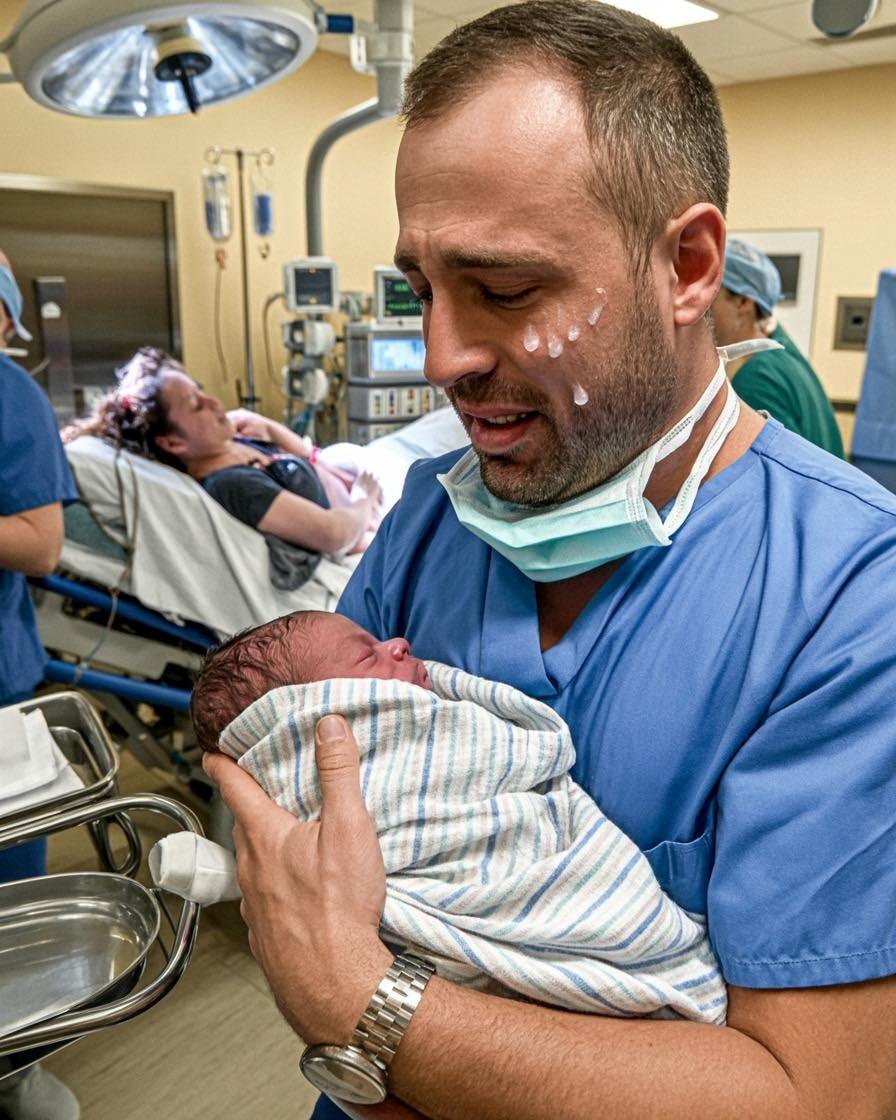
At seventeen minutes past three in the afternoon, her son was born.
The sound of his crying filled the delivery room with the quality that only a newborn cry has, high and insistent and entirely new, a sound that had never existed before this precise second in all the accumulated history of the world, and Clara let her head fall back against the pillow and wept with more force than she had wept even on the night the door had closed. This was different from that night. This was nine months of held breath releasing. This was fear discovering, at the last possible moment, that it had been unnecessary.
“Is he okay?” she managed. “Is everything—”
“He’s perfect,” Patricia said, wrapping the baby in a white blanket with the efficient tenderness of someone who has done this ten thousand times and still treats each one as though it is the first. “Absolutely perfect.”
They were carrying him toward Clara’s arms when the on-call physician came in to complete the chart review.
He was somewhere in his early sixties, with the unhurried presence of a man who has spent decades walking into rooms containing the most important moments of other people’s lives and has learned what those moments require from him. His hands were steady. His voice, when he spoke, had the calm authority of someone people reflexively trust without knowing why. He came in with the particular purposefulness of a physician closing a birth record, reading down the admission sheet, clicking his pen.
His name, on the badge clipped to his coat, was Dr. Richard Salazar.
He picked up the chart.
He looked at the baby.
He went completely still.
Patricia saw it first, the way experienced nurses notice things before anyone else in a room does, because they have learned to watch for the small deviations that precede larger ones. The doctor had gone pale, not the pale of someone feeling faint, but something different and harder to name, the particular pallor of a person whose blood has redirected itself to somewhere internal, somewhere that needs it more urgently than the surface of his face. His hand, which had been steady on the clipboard for more years than most people in the room had been alive, had developed a tremor that was just visible enough to see if you happened to be looking.
His eyes were filling with tears.
“Doctor?” Patricia said quietly. “Are you all right?”
He did not answer. He was looking at the baby.
Clara pushed herself upright against the pillow, still weak, still trembling in the aftermath of twelve hours of labor, with the reflexive alarm of a new mother whose first post-delivery moment was supposed to be her son in her arms and was instead a physician standing frozen at the foot of her bed with tears on his face.
“What’s wrong?” she said. “Tell me what’s wrong with him.”
“Nothing is wrong with your baby.” His voice had changed in some fundamental way that she could not have described precisely, still controlled, but only barely, like a held thing that has been held for as long as it can be. “He is completely healthy. I promise you that.”
“Then why—”
He looked up from the child to her face.
“I need to ask you something,” he said. “The father of your child. His name.”