
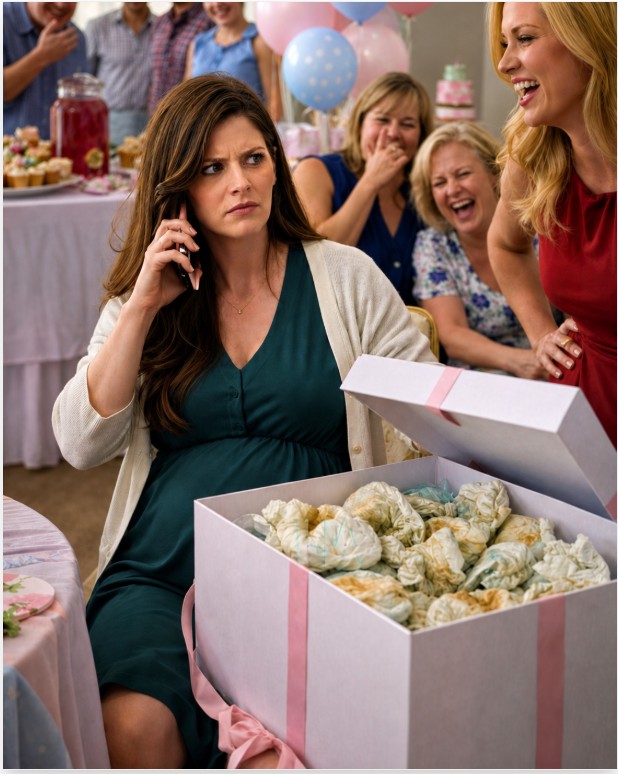
The words you had planned to say when the real gift came out rise in your throat and die there. You had pictured it so clearly for weeks. The big diaper box as a decoy, the laughter, then the envelope, then Mariana crying for the first time from gratitude instead of disaster. You had imagined a story your family could retell fondly years later, one where generosity became healing and your child arrived into a softer world than the one that raised you.
Instead, all anyone will remember is the smell.
Diego looks at Mariana as if he is trying to locate the edge where bad decisions end and cruelty begins. “You really thought this was funny?” he asks her. Mariana lifts her chin. “I thought she could take a joke. She’s always acting like she’s above everyone.” Her voice gets louder as she goes, because volume has been her substitute for dignity since she was twelve. “And don’t act like no one else laughed.”
That part is true.
Aunt Teresa stares at her plate. Your mother presses one hand over her mouth. Two of Mariana’s friends, both suddenly fascinated by the frosting on the cake pops, avoid eye contact completely. Shame moves differently when it spreads. Alone, people will watch someone get humiliated and tell themselves it isn’t their fight. Once consequence arrives, they remember instantly where their hands were.
You should have ended it then.
You could have. You could have had the used diapers thrown out, told everyone to go home, and let Mariana rot for a week in the house she no longer understood was hers. But families like yours have always survived on unfinished truths. You are tired of unfinished truths. And the baby inside you, turning gently beneath your dress as if sensing the room’s violence, deserves better than inheritance built on silence.
So you tell the rest.
“You want to know why the house was in foreclosure?” you ask.
Mariana goes still.
Your mother looks up. Diego turns toward you fully now. Teresa mutters, “Olivia, enough,” but her voice has no force behind it anymore. You are not loud. You never are when you are most dangerous.
“It wasn’t one bad month,” you say. “It wasn’t bad luck. It wasn’t inflation or some horrible landlord or a surprise medical bill. Mariana stopped paying because she spent the mortgage money somewhere else.”
Mariana steps around the table.
Her face has gone from pale to blotchy, and now it carries the naked animal fear of someone watching a door they thought was locked swing open. “Stop,” she says. “Shut up.” But when you finally stop protecting people from the full shape of themselves, shut up becomes the most powerless phrase in the world.
“You spent it on Iván,” you say.
The name detonates.
No one in the room knows it, not at first. No one except Mariana, whose whole body seems to jerk half an inch. You almost pity her for that. Almost. Because there it is, the hidden part of the story that made the rest so ugly. Not merely debt. Not irresponsibility. Not even envy. Desire. Vanity. Secrecy. A married man with a startup grin and one hand always in somebody else’s pocket.
Your mother grabs the back of a chair.
“What are you talking about?”
You pull up the second folder on your phone.
Transfer history. Boutique hotel deposits in Valle de Bravo. Jewelry purchases in Querétaro. Payments to a private rental with Iván Salgado’s name on the lease. The man owns no respectable business, only two failed bars, one “consulting” company that exists mostly on paper, and a talent for choosing women who mistake recklessness for devotion. You know all of this because when you bought the mortgage, your attorney did more than clear title. She looked at everything.
“While the bank was sending default notices,” you say, “Mariana was paying rent on a second apartment and covering a man who doesn’t even use his real address.”
“No,” your mother whispers.
Mariana’s hands shake visibly now, but still she reaches for anger. “You had no right to dig through my life!” she spits. That line almost turns the whole thing comic. As if rights are something she suddenly cares about, standing there with a box of used diapers and six unpaid mortgage installments hidden under a manicure.
“Actually,” you say, “once I bought the debt, I had every right to review the collateral risk.”
Rebeca would have laughed at that line if she had been there.
You hear your aunt Teresa stand up behind you. There’s the clink of a wineglass, the scrape of a shoe, the soft, messy noise of a party collapsing into factions. Some guests are already reaching for their purses. Others are staying, rooted to their seats by the terrible magnetism of a family finally saying out loud what it has spent years swallowing.
Then your mother does something you did not expect.
She turns to Mariana and slaps her.
Not hard enough to dramatize. Hard enough to sound. The room goes completely still. Mariana takes one shocked step back, fingertips flying to her cheek. Your mother’s hand hangs in the air for a second as if it no longer belongs to her.
“That money was from your father’s account too,” she says.
The words come out thin and broken. You hadn’t known she knew that part. Or maybe she didn’t, not fully, until just now. Among the mortgage file was one transfer from an old joint savings account your late father opened before he died, the one your mother still touched only for emergencies. Mariana had taken from there too, probably telling herself she’d replace it after the next rescue, the next miracle, the next man.
Mariana starts crying.
Real tears this time, angry and immediate, the kind people confuse with innocence because television trained them badly. “I was going to fix it!” she sobs. “Iván had a deal coming through. We were going to flip the apartment and pay everything back.” There it is. The sacred hymn of people who gamble with other people’s safety. I was going to fix it.
Your mother sinks back into her chair like someone shot the strength right out of her.
Diego steps between you and Mariana now, not because he is taking sides, but because he finally understands the temperature of the room. “Enough,” he says sharply. “Everyone stop.” It is the first time all afternoon he sounds like the man who negotiates contracts and gets people to leave meetings without throwing things. He turns to the guests, apologizes once, and asks those who aren’t immediate family to give everyone space.
No one argues.
No one even pretends not to enjoy having been present for the moment the baby shower became legend. They gather purses, murmur awkward goodbyes, and leave in clumps. A few women hug you on the way out. A few avoid your eyes completely. Mariana’s two closest friends disappear fastest, which doesn’t surprise you. Girls who love chaos seldom stay once receipts appear.
When the door closes on the last neighbor, the room shrinks.
Now it is only family. Your mother. Teresa. Diego. Mariana. You. The diapers are still there in the box, silently rotting beneath ribbon and tissue paper, as if the whole afternoon wants one visible object to stand trial for everyone’s ugliness. Diego picks up the box and carries it wordlessly to the kitchen trash. The gesture is so mundane it almost hurts.
Mariana collapses into a chair.
Mascara streaks down one cheek. Her mouth works around excuses, then silence, then blame, then silence again. Finally she looks at your mother and says the thing she has been training all her life to say at the exact moment consequences reach her.
“You always loved her more.”
The sentence hangs in the room like mold.
You close your eyes for one second, because this too is familiar. This is how Mariana survives. She turns accountability into abandonment and waits for the guilt to rescue her. It worked when you were children and she broke your birthday necklace then cried harder than you did. It worked when she crashed the car and made your mother comfort her for being scared. It worked every time she turned damage into need and need into power.
Your mother, to her credit, doesn’t reach for her this time.
“No,” she says hoarsely. “I expected more from Olivia because she gave me reason to. I let you hurt her because it was easier than facing what you are doing to yourself.” The honesty of it is so naked that even Aunt Teresa looks down. “And I kept calling it love.”
Mariana lets out a small sound, somewhere between disbelief and anger.
She looks at you next, desperate for some familiar softness, some sign you will step in and do what you have always done: translate the damage into something the family can survive without changing. But the baby moves again inside you, slow and firm, and the sensation anchors you better than any speech.
“I’m not asking twice,” you tell her.