
“I’m fine,” I said.
“Sure you are.”
That almost made me laugh for real.
He leaned against the desk. “I meant what I said earlier. We could use you here. Guest instructor, advanced marksmanship block. Couple days. Maybe more if it goes well.”
I stared at the dead monitor. “You offering that because you feel sorry for me?”
Valdez’s eyebrows went up. “Absolutely not. I don’t mix pity with live rounds.”
“Good answer.”
“It’s the only answer.”
I took a breath and let it out slowly. The basement smelled like dust, ozone, and old machinery warming under fluorescent light. My chest still hurt, but the hurt had shifted. Guilt is a closed fist. Grief is an open hand. One bruises harder, the other just never stops feeling the weather. I could work with grief. Maybe.
“When do you need me?” I asked.
Valdez smiled. “Today at thirteen hundred.”
By lunchtime I was back on range 208, this time with a dozen Marines seated on ammo cans under a shade awning and looking at me like I was either a novelty or a test.
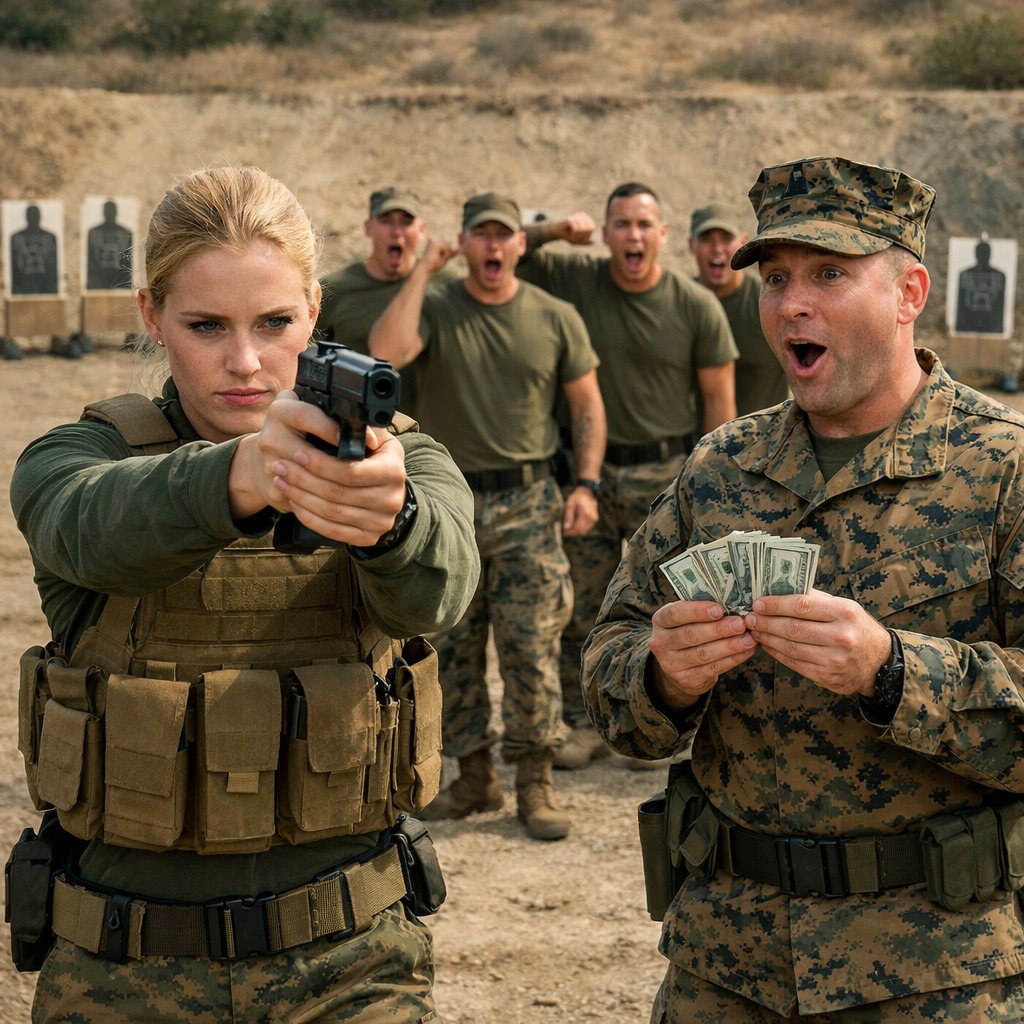
Most were corporals and sergeants. All had attitude. Two had talent. One had both and made that everybody’s problem. A female corporal named Fallon sat three seats from the end, posture ramrod straight, jaw set in that familiar way women get when they have spent too long pretending tension is professionalism. Chen was there too, quieter than the others, notebook open. Ducker stood off to one side with a clipboard, officially present as support staff and unofficially radiating the energy of a man chewing aluminum.
I started with observation instead of shooting.
That annoyed them immediately.
“Before you hit anything,” I said, “you have to see it. Not glance at it. Not assume it. See it. Wind. Light. Slope. Foot placement. Your own breathing. The habit your support hand gets into when you’re tired. The stupid lie you tell yourself right before you jerk a trigger because a timer made you emotional.”
That got a few looks.
Good.
I walked them through target discrimination with no rounds fired. Had them call out details on silhouettes at different distances. Small tears in paper. Mud splash patterns. Which target rail was slightly canted left. Who had adjusted their sling wrong without noticing. Fallon caught most of it. Chen caught all of it. The loud sergeant with the mustache caught almost none.
Ducker cut in halfway through.
“With respect,” he said, and whenever a Marine says that, disrespect has already packed a bag and moved in, “they’re here to shoot, not take an art class.”
A couple of the Marines chuckled.
I looked at him. “And that’s why half your good shooters plateau.”
The chuckles died.
I turned back to the class. “Shooting is boring when it’s done right. Ego is loud. Skill is quiet. If you need noise to feel competent, you’re going to miss when it matters.”
Fallon’s eyes flicked up at that. So did Chen’s.
We moved into live work an hour later—controlled drills, transition work, no theatrics. By the second string, the Marines were listening with their bodies even when their mouths stayed skeptical. That’s how you know you’ve got them. Shoulders lower. Hands stop fighting the gun. Jokes get shorter.
For a little while, it felt good. Cleaner than I expected. Passing along something Cam had asked me, maybe without even knowing how literally it would happen.
Then we hit the movement lane.
I briefed the order. Three targets left to right. Move to barricade. Transition. Two steel plates. Slow is smooth. Smooth is fast. Standard.
Fallon stepped up first.
The beep sounded.
She moved exactly as briefed—until target two dropped and a third silhouette popped up from the opposite side of the lane, unscheduled, unbriefed, turning her body across the line with another Marine stepping in on reset.
My stomach dropped.
Ducker had changed the target sequence without telling me.
I saw the muzzle start to swing a heartbeat before it became blood.
Part 8
“Freeze!”
My voice cracked across the lane before Fallon’s brain had time to obey the bad information her eyes just took in.
She locked up mid-turn, rifle half-mounted, breath held, confused as hell. The other Marine on reset—Hayes, unlucky enough to be in the wrong place at the wrong second—stopped too, eyes wide.
I was already moving.
Three quick steps, one hand on Fallon’s barrel guiding it downrange, the other on her shoulder grounding her physically before adrenaline could make her stupid. She was shaking, just a little, that fine electric tremor that comes right before embarrassment or panic decides to take over.
“Look at me,” I said.
She did.
“What did you hear in the brief?”
“Three paper, move, two steel,” she said, voice tight.
“What did you see?”
“An unbriefed pop target.”
“Good. You stopped. That’s the right answer.”
I could feel every set of eyes on us. Range work changes temperature fast when safety gets involved. One second it’s instruction, the next second every person there is quietly doing death math.
I turned toward the line. “Who changed the sequence?”
Nobody spoke.
They didn’t have to.
Ducker was standing ten yards back with that exact expression men wear when their little power play walks one step closer to catastrophe than they intended. Surprise first. Then defensiveness rushing in to cover it.
“I added complexity,” he said. “Stress inoculation.”
I stared at him long enough for the silence to become expensive.
“You do not ‘add complexity’ to a live lane after brief without telling the shooter and the line.”
“It was controlled.”
“No,” I said. “Controlled means planned.”
Valdez, who had materialized from nowhere the way good senior enlisted always do when something smells wrong, said, “Sergeant Ducker, with me. Now.”
Ducker opened his mouth, decided against whatever he’d planned to say, and followed.
The rest of the Marines were dead quiet.
I looked back at Fallon. “You okay?”
She swallowed. “Yes, ma’am.”
“Good. Then learn from it. The range will lie to you if people run it badly. Your job is still to stay safe.”
Her nod was tiny, angry, grateful, humiliated—all the flavors young Marines hate showing at once. I knew that taste.
We cleared the lane, re-briefed, and ran it again the right way. Fallon shot clean. Hayes reset the line with exaggerated caution that made a few of the others grin despite themselves. The tension broke, but it didn’t go away. Not really.
Later, after the class wrapped and the Marines drifted off in twos and threes toward the armory, Ducker came to find me behind the storage conex where the shade smelled like rust, dust, and hot canvas.
He didn’t bother with pleasantries.
“You trying to ruin me?” he asked.
I had been wiping down a training rifle. I kept doing it. “You did a fine job on your own.”
His jaw flexed. He looked tired now, which made him more human and, somehow, uglier.
“I didn’t think she’d swing.”
“That’s the problem.”
He rubbed a hand over the back of his neck. “You walk in here and every guy on this range starts looking at you like you’re the standard. You know what that does?”
I set the rag down and turned. “No. Tell me.”
“It makes everything I’ve built look smaller.”
There it was. The truth. Not pretty. But truth usually isn’t.
Up close, his anger had a different smell than before. Less hot, more sour. Fear does that. It changes people’s chemistry.
He looked past me toward the now-empty lanes. “All I’ve ever been good at is this. Shooting. Teaching it. Being the guy who knows. Then you show up and…” He laughed once without humor. “You don’t even try to impress anybody. You just are what you are.”
“And that scared you.”
“Yes.”
It came out immediate. Honest. Probably against his own will.
I let that sit between us for a second.
Then I said, “Fear I can work with. Ego tied to fear gets Marines hurt.”
He flinched like I’d slapped him.
Good.
“I’m not your enemy, Sergeant,” I said. “But I’m not going to shrink so you feel bigger either.”
He looked at me then with something I hadn’t seen from him before. Not warmth. Not exactly respect. More like the first rough outline of self-awareness, and how much it hurt.
He nodded once, tight, and left.
I stood there a while after he was gone, listening to a flag snap in the wind over the range office. Somewhere off base, or maybe just on the highway, a siren wailed and faded. The afternoon sun had gone brassy. My shirt stuck to my back under the red jacket. I was tired in that hollowed-out way you get after managing other people’s risk all day.
Chen found me by the parking lot just as I was tossing my range bag into the truck.
“I got something for you,” he said.
He held out a small evidence envelope with a property office stamp across the seal.
I frowned. “What is it?”
“Brooks’s effects file got flagged when Valdez reopened the archive request. Most of his stuff was sent to family. One item went unclaimed because the routing was messed up.” He hesitated. “He’d listed you as alternate recipient if next of kin declined.”
My fingers went cold.
Inside the envelope was a battered field watch with a cracked face and a worn black strap. I knew it instantly. Cam wore it loose because he hated anything tight on his wrist. There was a white scratch along the bezel at two o’clock from when he’d clipped a rock wall in training and pretended the wall had attacked him first.
I took it carefully, like it might bruise.
“There’s more,” Chen said. “Property clerk told me the back plate felt loose, like somebody had opened it once.”
I looked up.
Chen’s expression had gone very still.
“I didn’t pry,” he said. “Figured that part should be yours.”
The watch sat in my palm, heavier than it should have been.
If Cam had hidden something inside it all these years, what exactly had he been trying this hard to leave me?
Part 9
I opened the watch that night at my kitchen table with a precision screwdriver set, two paper towels, and the kind of patience my father always said matters most when your hands are shaking.
The kitchen in my little Vista duplex was barely a kitchen. Yellow overhead light. Cheap laminate counters with a burn mark near the stove from before I rented the place. Window over the sink looking out at a chain-link fence and my neighbor’s lemon tree. The room smelled like dish soap, black coffee, and the faint metallic tang of the watch lying under the lamp.
I turned the case over. The back plate was indeed loose, just enough to catch the edge of a blade.
For one second, absurdly, I thought maybe it would be a key. Or coordinates. Or some movie version of a secret that comes wrapped neat enough to fit in a pocket.
What slid out instead was a folded square of Rite in the Rain paper gone soft at the edges from time.
My chest tightened.
I unfolded it carefully.
Three lines, all in Cam’s handwriting.
Breathe.
It was never you.
Make them earn the rifle.
That was it.
No code. No extra clue. No thriller nonsense. Just Cam, all the way to the end—cutting through the clutter and leaving me exactly what I needed, not what would make the story prettier.
I sat there for a long time with the paper under my fingers and the hum of the refrigerator filling the room. Outside, somebody’s TV leaked laughter through thin walls. A car door slammed. The lemon tree branches scratched once against the fence.
Breathe.
It was never you.
Make them earn the rifle.
I laughed then, finally, because of course that was his message. Of course it wasn’t elaborate. Of course it was the bluntest, most useful thing in the world.
The next morning I tucked the paper into my wallet behind my driver’s license and wore the watch on my wrist.
At Pendleton, Fallon noticed it first.
We were on the observation deck before class, the air cool and clean before the sun burned the moisture out of it. The range below us was all straight lines and possibility. Coffee steamed in a paper cup near my elbow. The watch felt strange on my skin, not wrong, just unfamiliar in a place I had kept empty for too long.
“Old watch?” Fallon asked.
“Very.”
She nodded like that answered more than I’d said.
I liked Fallon more every day. She was tough without making toughness a personality. Grew up outside Bakersfield. Horse girl before Marine. Shot low-left under stress because she wanted control too badly and strangled it. She reminded me of myself if I’d had slightly better people around me at twenty-two.
The rest of the class filed in. Chen. Hayes. A couple sergeants. Two staff NCOs sent by Valdez after word got around that the civilian guest instructor was not, in fact, a joke.
Ducker came too.
Different energy now. Quieter. He stayed in his lane. Took notes. Didn’t freestyle the range into a death trap. Progress.
I spent the morning on prone work, wind reading, and the sacred art of shutting up long enough to see what the environment is telling you. Marines hate that lesson until they need it. Then they love whoever taught it to them.
By noon Fallon was tightening her groups at distance. Chen was already good and getting better. Hayes wanted to muscle every problem and was slowly realizing physics did not care how motivated he felt.
“Again,” I told him after another yanked shot.
He sighed. “I know.”
“Then why do I?”
A few of the others laughed. He did too, reluctantly.
That was the good part. The clean part. Watching understanding travel through someone’s body until the shot stopped being a fight.
The bad part arrived in paperwork.
Valdez found me after chow with a folder under his arm and annoyance written all over his face. We stood outside the range office while forklifts beeped somewhere near the storage cages and the wind carried the smell of hot rubber from the motor pool.
“Ducker filed a concern statement,” he said.
I blinked. “About what?”
“Civilian guest instructor conducting training while also raising allegations related to historical operational reporting. Says it could create undue command distraction and affect student confidence.”
I stared at him.
Valdez rolled his eyes. “I know.”
“He writes like a man trying to sound smarter than he is.”
“He had help.”
That made me look up. “From who?”
Valdez handed me the folder.
Attached to Ducker’s concern statement was a memo note routed from symposium staff. Avery Sloan had apparently raised “questions about the appropriateness of informal civilian involvement in advanced lethal-skills instruction pending clarification of prior-service claims and historical grievances.”
I almost smiled. There it was. The institution reaching for paperwork when discomfort failed.
“He’s scared,” I said.
Valdez shrugged. “Maybe. Or maybe he’s protecting his legend. Same difference.”
“What happens now?”
“Command’s not pulling you today. But Friday there’s an instructor demo and skills validation in front of battalion leadership. If you perform well and the students endorse the block, I can bury this complaint under results. If it turns into drama, they’ll thank you politely and show you the gate.”
That was clean enough. A shooting answer to a paperwork problem. Very Marine.
I nodded. “Then Friday it is.”
He gave me a long look. “You sure?”
I tapped the watch on my wrist. “Yeah.”
That afternoon Fallon ran a distance lane in gusting wind and missed her first shot by an inch right. She reset, breathed, corrected, and hit the second so clean the steel sang.
When she came off the line, trying not to smile too much, I said, “What changed?”
She touched two fingers to her chest. “I stopped trying to impress people.”
“Good. Keep that.”
Across the range, an SUV door shut.
I glanced over and saw Avery Sloan step out in sunglasses and a pressed polo, all silver hair and expensive confidence. He had the escort of a man who still expected rooms to tilt around him.
He looked toward the line.
Toward me.
And if he was here just to “observe,” why did it feel like he had come to make sure I lost?
Part 10
Friday started bright and windy.
By 0730 the range was already alive—vehicles rolling in, target crews moving, instructors checking score sheets, someone cursing at a stapler, somebody else burning coffee in a giant silver urn near the bleachers. The flag over the office snapped hard enough to sound irritated. Dust lifted in little curls off the berms and stuck to the sweat at the backs of knees.
Battalion leadership had turned the instructor demo into a whole production. Folding chairs. PA system that crackled every third word. A captain with a clipboard and the facial expression of a man trying to prevent both embarrassment and heatstroke. The instructors would each run a mixed skills course. Students from the block would shoot a short validation lane after. Times and hits would be recorded. Recommendations would follow.
In other words: a public decision disguised as training.
Sloan stood near the front with sunglasses on and his hands clasped behind his back like he still had a staff. Pierce was there too, off to the side, looking ten years older than he had at the symposium. Valdez stalked around making sure all the moving parts stayed honest. Ducker moved quieter now, less peacock, more man who had finally learned that attention can turn on you.
I didn’t look at Sloan much. Men like him feed on being centered.
Instead I checked Fallon’s sling. Had Hayes dry-fire his trigger press twice. Reminded Chen not to get cute just because he was good. The watch on my wrist sat warm under the sun. Every so often my thumb touched its cracked bezel without me thinking about it.
Fallon was pale.
“Nervous?” I asked.
“Yes.”
“Good.”
She frowned. “Good?”
“Nervous means you understand it matters. Panicked means you’re making the day about yourself. Don’t do that.”
That got a quick grin out of her. Better color too.
The demo started with instructors.
Ducker shot before me.
A week earlier I would have expected swagger. Instead he ran the lane with stripped-down seriousness, hit almost everything, and missed one steel in transition by trying to make up time he didn’t need. He looked angry at himself, not the world. Improvement again. Painful, but real.
When my turn came, the captain mangled my last name over the speaker and somebody in the bleachers corrected him under their breath. The course ahead was familiar enough to feel fair and different enough to punish routine. Pistol. Rifle. Barricade. Movement. Distance. Wind heavier now than on Monday, cutting across the lane with that dry coastal force that lies to people about how strong it is because the air still feels pretty.
The beep sounded.
I moved.
What I remember most wasn’t the shooting itself. That part lived where it always did—hands, breath, sight, press, follow-through. What I remember is the texture of the moment around it. Gravel shifting under my boots. Sun flashing off spent brass. A child at the back of the bleachers asking too loudly if that was the lady who beat the Marines. Someone shushing him. Fallon watching with her jaw set. Sloan turning his head when I hit the first moving steel fast enough to ring it before it finished swinging.
By the time I got to the final distance stage, everything had gone very clear.
There’s a stillness that isn’t calm exactly. More like total usefulness. No room for ego, fear, or performance. Just the shot and whether you deserve it.
I took the steel clean.
Then the second.
Then the last.
“Zero down,” Valdez called.
The bleachers broke into noise. Not wild. Not theatrical. Just real.
I came off the line breathing hard, sweat cooling between my shoulder blades under the jacket, and caught Fallon’s face in the crowd. She wasn’t looking at me like a miracle. She was looking at me like proof.
That mattered more.
Student validation started right after. Fallon shot third. Chen shot second. Hayes nearly argued with the wind and then reluctantly cooperated with it. One by one, they ran the lane. Not perfect. Better than they’d have been without the week. Fallon dropped one target, corrected, and cleaned the rest. When she stepped off the line, she had that stunned little look shooters get when their body finally does what their mind has been begging it to do for months.
Then Sloan made his mistake.
He rose when the captain invited comments from observers and took the microphone like it still belonged to his species of man by birthright.
“Impressive work,” he said, voice smooth as polished stone. “Though I would caution against romanticizing individual marksmanship detached from the larger command structure that makes combat effectiveness possible.”
I almost laughed.
There it was. The institution speaking through a clean shirt again.
He went on about systems, discipline, cohesion, accountability. Good words. Useful words. Rotten in his mouth.
When he finished, the captain—unwise, maybe curious—asked if I had any closing thoughts as guest instructor.
I took the mic.
The wind bumped the speaker with a low thump. Out beyond the range, gulls wheeled white in the hard blue sky. I could smell hot dirt, coffee gone stale, and the sweet sharp scent of sage warming on the hillside.
“Yes,” I said. “Actually.”
Every face turned.
“Command structure matters. Standards matter. Cohesion matters. But none of that means a damn thing if ego gets to dress up as certainty. The rifle doesn’t care about your rank. The wind doesn’t care about your résumé. And the Marine standing next to you definitely doesn’t benefit when you’re too proud to slow down, ask one more question, or admit somebody else saw something you missed.”
Nobody moved.
Good.
I handed the mic back to the captain before I could turn it into a speech. It didn’t need to be one.
Sometimes two inches of blade do more than a broadsword swing.
After the formalities, after the score sheets, after Fallon got her passing note and Hayes pretended he hadn’t cared before grinning like an idiot, Ducker approached me near the scoring table.
He held out a folded paper.
“Retracting the concern statement,” he said.
I took it. “Why?”
He glanced toward the line where the students were laughing and comparing times. “Because you were right. Again.” Then, after a beat, “And because if I’m going to teach Marines, I should probably stop acting like being corrected is the same thing as being diminished.”
That was the closest he’d ever get to wisdom in one sentence. I respected the effort.
Across the lot, Sloan was already leaving, his expression unreadable behind sunglasses. Pierce paused before getting into the SUV and gave me one small nod—no absolution, just acknowledgment.
Valdez came up with a contract packet in one hand.
“Three-month civilian instructor slot,” he said. “Consulting to start, with option to extend. Monday if you want it.”
I looked at the papers. Then at the range. Then at Fallon arguing with Chen about wind holds like she had all the time in the world.
For years I had stayed away from places like this because I thought they belonged to the worst night of my life.
Now one was offering me a way to build something inside it.
And that scared me more than any public shoot-off had.
If I said yes, I wasn’t just winning a bet anymore.
I was staying.
Part 11
I went to the ocean before dawn on Monday.
Not because I’m poetic. Because when I can’t think clean in a room, I go somewhere bigger than the room.
The beach north of Oceanside Harbor was almost empty that early. Just a couple surfers in black wetsuits standing by their trucks, waxing boards under weak yellow parking lot lights, and one old man walking a shepherd mix that kept trying to eat seaweed. The sky was the color of steel wool, then slowly thinned to silver over the water. The air smelled like salt, kelp, cold sand, and coffee from the travel mug between my hands.
I stood at the edge where the foam ran up over my boots and disappeared.
Cam’s watch sat on my wrist.
The folded note sat in my jacket pocket.
Breathe. It was never you. Make them earn the rifle.
When the first real band of sun split the horizon, the water caught fire in a line so bright it almost hurt to look at. I thought about my father out in Prescott teaching me on a beat-up .22 and never once telling me I was special, only teaching me to be exact. I thought about Cam on that rooftop, grinning like he had a private joke with death. I thought about Fallon’s face when she realized competence felt better than approval. I even thought about Ducker, stubborn enough to be a problem and maybe, finally, humble enough to improve.
Forgiveness is a fancy word people throw around when they want pain to behave itself.
That wasn’t what this was.
I didn’t forgive Sloan. I didn’t excuse Pierce. I didn’t suddenly become soft about the years I had lost to a lie polished into official language. But I also wasn’t interested in spending the rest of my life renting space to men who had already taken enough.
The tide reached my boots again, colder now.
I pulled out my phone and called my father.
He answered on the fourth ring sounding half-asleep and suspicious, which meant he was awake and pretending not to be.
“You dead?” he asked.
“Morning to you too.”
He grunted. “That means no.”
I smiled into the wind. “Got offered a job.”
Long pause.
“Doing what?”
“Teaching marksmanship at Pendleton.”
Another pause, longer this time. In the background I heard cabinet doors and the familiar scrape of a mug set on counter. He would be making coffee in his old kitchen, Arizona light just beginning to come in through the blinds.
“You taking it?” he asked.
“I think so.”
“Then why are you calling me instead of signing the papers?”
Because I wanted him to say he was proud. Because I was almost forty percent sure he never would in words and still, some part of me kept coming back to the empty cup.
Instead he said, “Still got that bad habit of asking permission after you’ve already made the decision?”
I laughed.
There was a silence after that, but not an empty one.
Then he cleared his throat. “You were always better when you had somebody to teach. Worse when you had nobody worth listening to.”
That was, in my father’s language, extravagant praise.
“Thanks,” I said.
“Don’t get sentimental.”
“Wouldn’t dream of it.”
I hung up and watched the surfers paddle out into the gray shine.
By 0830 I was back at Pendleton, contract packet signed, visitor badge traded for a civilian instructor credential that still felt mildly ridiculous clipped to my jacket. The range smelled like fresh coffee, gun oil, and the first heat starting to wake the dirt. The flag snapped overhead. Trucks rolled by. A radio somewhere played country too quietly to identify the song.
Fallon was already there.
So was Chen.
They were setting target stands without being asked.
Fallon saw the badge and tried not to grin. Failed. “So that’s a yes?”
“That’s a yes.”
Chen nodded like a man who had expected the answer and still liked hearing it.
Ducker came out of the office carrying a stack of score sheets. He stopped when he saw the badge, then gave me one short, level nod. No performance. No buddy act. Just acknowledgment. It was enough.
Valdez emerged behind him with two coffees and handed me one. “Welcome to the circus.”
“Your circus needs better shade.”
“That’s the spirit.”
We walked downrange together while the sun climbed and turned the tops of the berms gold. A line of new shooters waited by the benches, some confident, some cocky, some trying too hard not to look scared. I knew every version of that face. I knew what most of them were about to learn. The rifle would tell them who they were. The range always does if you let it.
I touched the watch once before class started.
Then I looked at the students and said the truest thing I knew.
“Everybody thinks shooting is about pulling the trigger. It isn’t. It’s about seeing clearly, deciding cleanly, and not lying to yourself when the world gets loud.”
They quieted.
Good.
The wind moved across the range from left to right, carrying dust, sage, salt from far off, and the sharp familiar scent of burnt powder from an early lane already going hot. The morning felt alive in my hands.
For the first time in years, the ghosts behind me were not dragging.
They were standing where they belonged.
And when I raised my voice to start the day, it came out steady enough to build something on.
THE END!
See more on the next page
Advertisement