
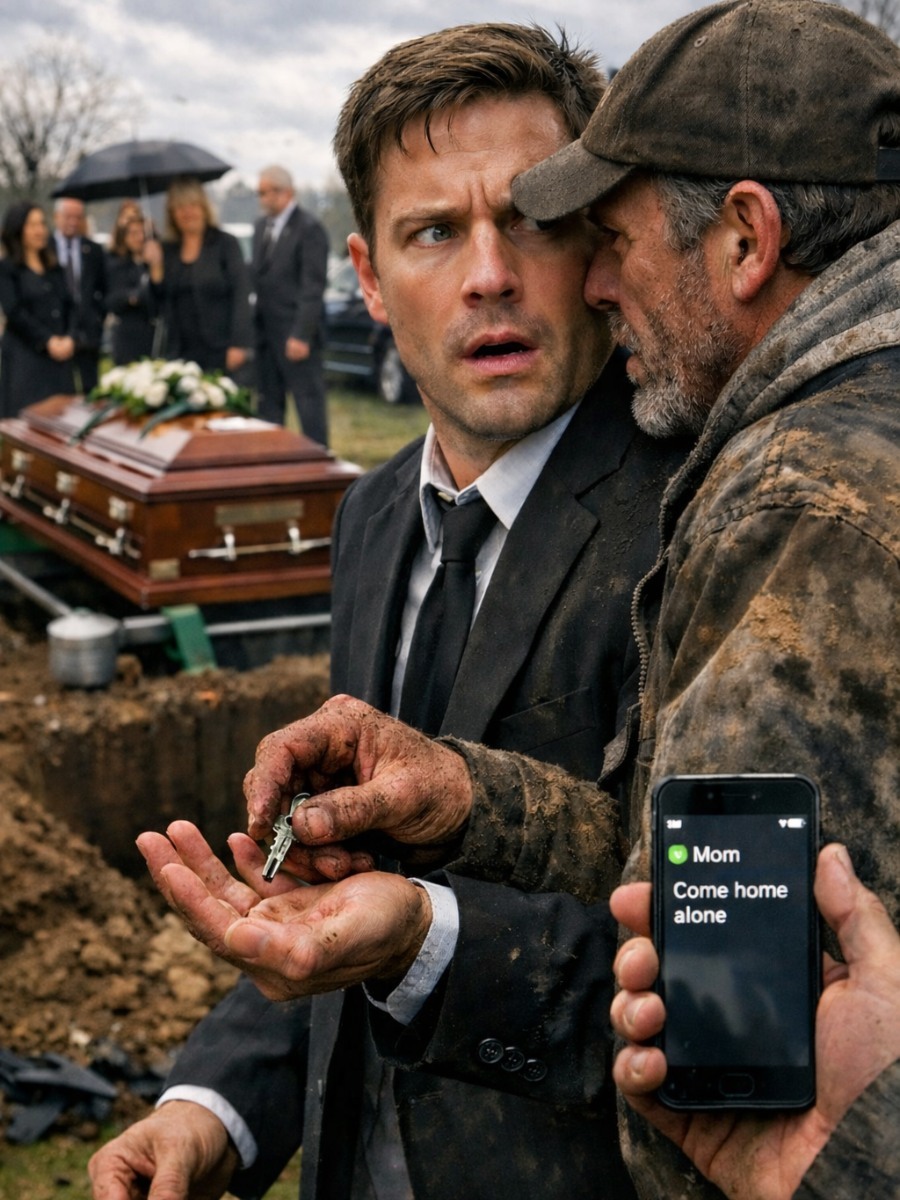
A woman stood there waiting.
She was in her late forties, maybe early fifties, dressed in dark slacks and a navy coat. She had the posture of someone who had spent years in institutions that demanded straight backs and fast decisions. Her eyes were sharp and measured, taking me in the moment I stepped from the car.
“Julian Mercer?” she asked.
I nodded.
“Patricia?”
Her expression didn’t change, but something in it hardened with recognition. “Come with me.”
“Who are you?”
She reached into her coat, flipped open a badge, and closed it again before I fully processed the lettering.
“Special Agent Patricia Holloway. FBI.”
I stopped walking.
“The FBI?”
She looked past me toward the road. “Everything will be explained, but not out here.”
“What does the FBI have to do with my father?”
Her mouth tightened. “More than you’re going to like.”
I followed her through a side gate and into the maze of storage units.
Unit numbers passed in sequence: 3, 5, 9, 11.
My heart beat harder with every step.
I wanted this to be a mistake.
I wanted to round the corner and find a harmless explanation—my father wrapped up in some absurd estate-planning game, some dramatic prank gone too far, a weird attempt at teaching me some final life lesson from beyond the grave.
Instead, Patricia led me deeper into the facility, farther from the office and the road, until we reached a unit at the very back.
17.
She turned to me. “Use the key.”
My fingers felt clumsy as I fitted the brass key into the padlock. It slid in perfectly.
I turned it.
The lock clicked open.
Patricia stepped back. “Lift the door.”
I grabbed the handle at the bottom of the metal roll-up door and pulled.
The unit opened with a hard rattle of metal tracks.
And my father stood up from a folding chair inside.
For one stunned instant I thought my mind had broken.
He looked exactly as he had three days ago when I last saw him alive—same gray at the temples, same square shoulders, same tired crease between his brows that appeared whenever he was worried about something he wouldn’t say aloud. He looked older somehow, more worn, but undeniably himself.
Not a body.
Not a memory.
Alive.
“Julian,” he said.
The sound of his voice hit me harder than the sight of his face.
I stumbled backward, caught the edge of the doorway, nearly lost my footing.
“What—”
“I know,” he said quickly, stepping forward with both hands out as if approaching a wounded animal. “I know how this looks. Come inside. Please. Before anyone sees.”
I couldn’t breathe.
“Dad?”
His expression broke a little at that word.
“Yes.”
I took one step into the unit.
Then another.
Patricia pulled the metal door down behind us, plunging the space into dim artificial light.
This was no ordinary storage unit.
At least not anymore.
The front half had been transformed into something between a bunker and a surveillance room. Folding tables held laptops, radio equipment, maps, burner phones, and stacks of files. A bank of monitors displayed live security feeds from the facility entrance, nearby roads, and what looked like residential cameras. On one wall hung photographs connected by red string in patterns so chaotic they made my eyes ache: faces, license plates, street maps, bank records, property deeds, newspaper clippings.
In the back stood a cot, a mini refrigerator, cases of bottled water, and enough supplies to live off-grid for weeks.
And in the middle of all of it stood the man I had buried.
“How?” I whispered.
My father exhaled slowly. “Sit down, son.”
I sank into the nearest folding chair because my legs no longer felt equal to the task of holding me.
Patricia remained standing by the door, arms crossed, watchful.
My father sat opposite me and leaned forward, forearms resting on his knees.
“There is no easy way to tell you this,” he said. “So I’m going to tell you straight.”
“Start with the body at the funeral.”
He closed his eyes briefly. “A cadaver from a medical program. Same height. Similar build. The funeral home was compensated to ask no questions.”
I stared at him.
“That is insane.”
“Yes.”
“I saw Mom kiss your forehead.”
Pain flashed across his face. “I know.”
“Do you have any idea what you put us through?”
“Yes.” His voice was low, steady, and full of a grief that looked almost as raw as mine felt. “I do. And if there had been any other way, I would have taken it.”
“You wrote that they have Mom.” I stood abruptly. “Where is she?”
Patricia answered. “We don’t know yet.”
I turned on her. “What do you mean you don’t know?”
“We know she was taken from the cemetery parking lot approximately twenty-four minutes after the burial.”
The words hit me like a punch.
“What?”
“We have footage. Two males. Black SUV. Fast extraction.”
My father rose too. “Julian, listen to me.”
“No, you listen to me. My mother has been kidnapped, you faked your death, the FBI is apparently involved, and I want an explanation right now.”
For a moment neither of them said anything.
Then my father nodded once.
“All right,” he said. “You’re owed that.”
He took a breath.
“Twenty-eight years ago, I was not just your father. I was an accountant with a growing practice and a client list I was proud of. Most of my clients were ordinary—small business owners, real estate developers, medical offices. But one of them was a man named Victor Crane.”
The name meant nothing to me.
It must have shown on my face.
“He ran an import-export company,” my father continued. “At least, that was what the paperwork said. To everyone outside his inner circle, he was legitimate. Rich, connected, a little ruthless, but legitimate.”
Patricia stepped to the wall and pulled down one of the photographs.
A man stared back at me.
Silver hair, pale eyes, smooth expensive features that had somehow remained handsome while becoming colder. Even in a still photo there was something reptilian about him. Patient. Controlled. Without warmth of any kind.
“Victor Crane,” Patricia said. “Convicted in 1998 on racketeering, money laundering, conspiracy, and multiple related charges.”
My father gave a grim nod. “For the first six months I handled his accounts, I thought he was like any other wealthy client—complicated, secretive, aggressively tax-averse. Then I started noticing patterns. Transfers that made no business sense. Shell corporations with no employees. Invoices for shipments that didn’t exist. Cash deposits broken into carefully structured amounts to avoid federal reporting.”
He looked at his hands.
“I realized he wasn’t just hiding money. He was cleaning it.”
“For who?” I asked.
“For everyone,” Patricia said. “Organized crime families up and down the East Coast. He was a financial hub. He made dirty money disappear.”
My father continued. “Once I understood what I was seeing, I had a choice. Walk away and pretend I’d never noticed. Or go to the authorities.”
“And you chose the FBI.”
He nodded.
“Why?”
He looked at me then, and I saw the man who had taught me to tell the truth when it cost something, the man who had returned extra change to cashiers, who had once driven forty minutes to give back a wallet he found at a gas station.
“Because it was wrong,” he said simply. “Because I thought if decent people always looked away, then men like Victor Crane would own the world.”
Patricia’s face softened a fraction.
“He came to us with files, account statements, internal ledgers, enough to suggest criminal activity but not enough to prosecute. We asked if he’d help build a case.”
My father smiled bitterly. “They told me it would take a few months.”
“It took two years,” Patricia said.
My father paced once across the narrow strip of clear floor. “For two years, I wore wires. I copied records. I sat in rooms with killers and smiled while they joked about things no one should joke about. I listened to Victor discuss shipments, collections, debt payments, bribes. I passed everything to the Bureau through Patricia.”