

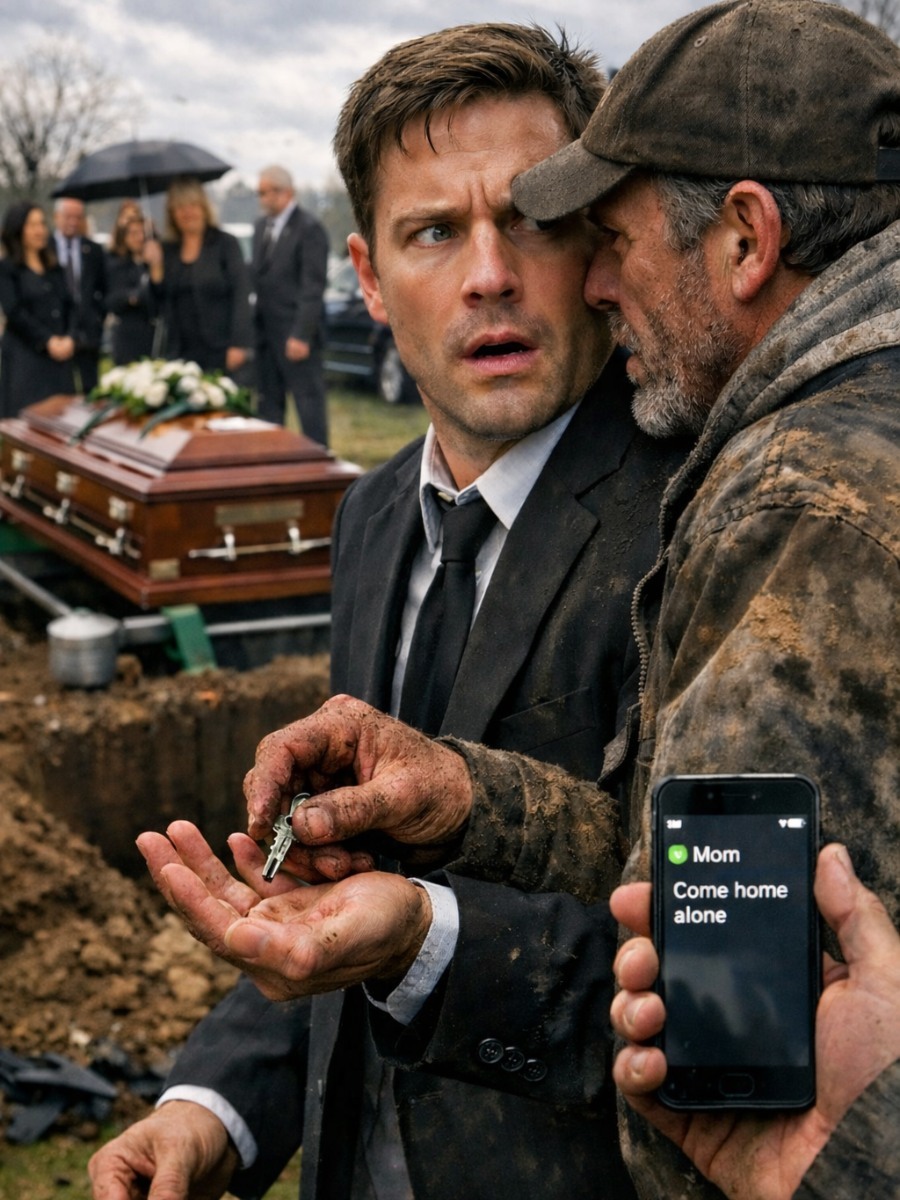
I looked between them.
“You were his handler?”
Patricia nodded. “Freshly assigned. Twenty-eight years old. Too junior for a case that no one expected to matter much.”
My father gave a humorless laugh. “It mattered.”
“It led to one of the largest money-laundering prosecutions in the region,” Patricia said. “Crane’s network handled hundreds of millions. Once the financial channels were exposed, half a dozen families lost access to clean capital. Businesses collapsed. Assets were seized. People flipped. It was a domino line.”
“And Crane went to prison.”
“In 1998,” my father said. “Thirty years.”
I sat again.
The chair felt colder now.
“You should have been in witness protection,” I said.
My father’s face tightened. “Yes.”
“Then why weren’t you?”
A long silence answered that.
Finally Patricia spoke. “The Bureau assessed the threat as temporary. Crane’s organization had been dismantled. Several key associates were dead or incarcerated. Others had fled. Your father wanted a normal life. He had just married your mother. He wanted children.”
“You let him stay?”
There was enough accusation in my voice to make her flinch.
“We advised caution,” she said. “New routines. Limited exposure. Security awareness. But yes. He stayed.”
My father stepped in before I could say anything worse.
“I agreed with them because I wanted to believe it was over,” he said. “I wanted your mother to have a real marriage. I wanted you to grow up in one house, one town, one life. Not moving every year under false names, never knowing who to trust.”
“And for a while,” Patricia said, “it looked like the right call.”
My father nodded. “Years passed. Then more years. Crane stayed in prison. We heard less and less. I let my guard down. Your mother and I built a life. You were born. Then your sister—”
I looked up. “I don’t have a sister.”
He stopped.
A strange shadow passed over his face.
For one second I thought he’d misspoken, confused by stress.
Then I realized what I had seen.
Grief.
Old grief.
He sat slowly. “No,” he said quietly. “You don’t.”
The room went still.
Patricia looked away.
“What does that mean?” I asked.
My father’s voice dropped. “It means there was a pregnancy before you. Your mother miscarried at four months.”
I stared at him.
They had never told me.
Not once. Not ever.
“Why are you telling me this now?”
“Because Crane knew,” my father said. “Because he used every vulnerable thing he ever learned about us, every pain, every fear. There are no secrets left now, Julian. Not if I can help it.”
The wall of photographs suddenly seemed to pulse at the edge of my vision.
He stood and motioned for me to come closer.
I did.
He pointed to a cluster of recent surveillance photos.
My blood went cold.
There was my house.
My wife, Celeste, taking groceries from the car.
My daughter Emma outside school, pink backpack over one shoulder.
My son Oliver in a soccer uniform.
My mother leaving church.
Me walking into my office.
Every picture taken from a distance.
Every picture framed like a hunter choosing where to place the shot.
“He’s been watching us,” I said.
“For three months,” Patricia said.
My father pointed to another photo.
Victor Crane, leaving a prison gate.
“That was ninety-two days ago,” he said. “Good behavior. Medical reductions. Administrative nonsense. The sentence meant thirty years on paper. In reality, he served twenty-eight.”
“And the moment he got out,” Patricia said, “he started reaching out to the pieces of what remained of his old network.”
“He wants revenge,” I said.
My father’s laugh was empty. “No, son. He wants art.”
I turned to him.
He held my gaze.
“Victor Crane isn’t satisfied by simple murder. He wants balance, as he sees it. I took away his empire. He wants to take away my family. He wants me to watch.”
A deep, ugly nausea rose in my throat.
I thought of Celeste.
Emma.
Oliver.
My mother.
I pulled out my phone.
“I need to call my wife.”
“Do it,” Patricia said.
Celeste answered on the second ring.
“Julian? How was the funeral?”
Her voice sounded normal. Domestic. Untouched by any of this.
It almost broke me.
“Where are you?”
“At your parents’ house. Why?”
I stood so fast the chair scraped behind me.
“What?”
“Your mom invited us for dinner after the service,” Celeste said. “She texted me earlier and told us to come by before you got there. We let ourselves in. She said she had to run an errand after the cemetery.”
My father shut his eyes.
“Celeste,” I said, every word coming out too fast, “listen to me very carefully. Take Emma and Oliver and leave the house right now.”
There was a pause.
“What? Why?”
“I can’t explain yet.”
“Julian, what’s going on?”
“Please. Just trust me. Take the kids and go somewhere public. A restaurant. A crowded store. Anywhere with people. Do not go to our house. Do not go back to my parents’ house. Do not tell anyone where you’re going until I call you.”
She went silent long enough that I thought the line had dropped.
Then, in a smaller voice, “Are we in danger?”
I looked at my father.
He looked suddenly older than I had ever seen him.
“Yes,” I said.
Her breath caught.
“Okay,” she whispered. “Okay. I’m getting the kids now.”
“Call me the moment you’re somewhere safe.”
“I will.”
“And Celeste?”
“Yes?”
“I’m sorry.”
The line stayed quiet for a beat.
Then she said, “Just come back to us.”
She hung up.
My hand shook as I lowered the phone.
Patricia was already looking at one of the monitors. “Mercer residence has movement,” she said. “Two males inside. Both armed.”
“How do you know they’re armed?” I asked.
“We have thermal and zoom. One shoulder holster, one waistband carry.”
I turned to my father. “So they were waiting for me.”
“Or your mother,” he said.
“Where is she?”
Patricia checked another screen, then another.
“We’re pulling traffic cams now. We’ll find the vehicle.”
Three hours passed inside that metal box, and I lived each minute inside a tension so fierce it made my muscles ache.
Agents came and went in plain clothes. Radios cracked. Monitors flickered. Coffee appeared and went untouched. Names I didn’t know were spoken with clipped urgency. License plates were cross-referenced. Cell towers mapped. Security footage scrubbed frame by frame.
Somewhere in those hours I learned the black SUV had left the cemetery and headed toward the industrial waterfront.
Somewhere in those hours I learned my father had been planning his own death for months.
Somewhere in those hours I stopped being merely shocked and began to be angry.
The anger arrived quietly, almost neatly, folding itself into place beneath the fear.
At first it was anger at Victor Crane, at the invisible shape of him pressing itself into every corner of our lives.
Then it turned.
My father was reviewing a schematic of a waterfront warehouse with Patricia when I interrupted.
“You let us mourn you.”
Both of them looked up.
I hadn’t meant to say it just then. But once the words came, they wouldn’t stop.
“You let Mom collapse over a coffin with no body in it. You let me stand there and bury you.”
My father didn’t answer immediately.
“You let me think you were dead.”
“Yes,” he said.
I laughed once, bitterly. “That’s all you have?”
“What do you want me to say?”
“I want you to say you knew what that would do to me.”
His face changed then. The calm, controlled mask he had held all afternoon slipped.
“I knew exactly what it would do to you,” he said quietly. “That is why it nearly killed me to do it.”
I shook my head.