

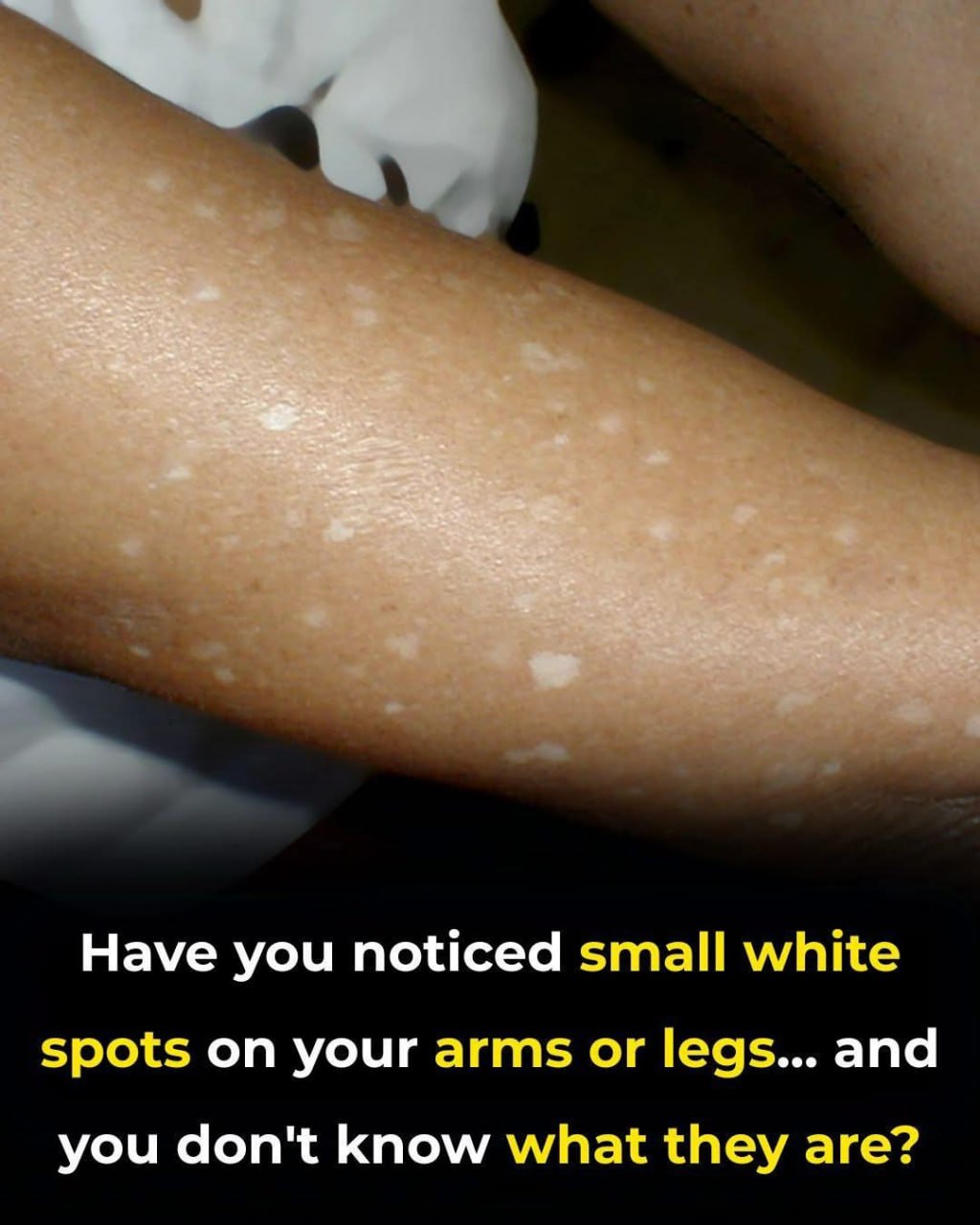
You’re going about your day, maybe getting dressed or glancing at your arms in the sunlight, and you notice them: small, white spots scattered across your skin. They’re not raised. They don’t itch. They’re just… there. Pale little patches that stand out against your normal skin tone.
If you’ve noticed these spots, you’re not alone. They’re surprisingly common, especially as we age. But what are they? Are they harmless? And is there anything you can do about them?
Let’s explore the most likely causes—and when you might want to mention them to a doctor.
The Most Common Cause: Idiopathic Guttate Hypomelanosis
The medical name is a mouthful, but the condition itself is simple: idiopathic guttate hypomelanosis (often called IGH).
Let’s break it down:
-
Idiopathic – The cause isn’t fully understood
-
Guttate – Latin for “teardrop-shaped”
-
Hypomelanosis – Loss of skin pigment
What it looks like:
-
Small, flat white spots, usually 1-5mm in size
-
Most commonly on sun-exposed areas: shins, forearms, shoulders
-
Smooth texture (not scaly or raised)
-
More common as we age (often starting after 40)
What causes it?
While the exact cause isn’t known, IGH is strongly associated with:
-
Sun exposure over many years (it’s most common on sun-exposed skin)
-
Natural aging – the spots become more common as we get older
-
Genetics – some people are simply more prone to them
Is it harmful?
No. IGH is completely harmless. It doesn’t turn into skin cancer, doesn’t spread to other people, and doesn’t affect your overall health. It’s purely a cosmetic concern.
Other Possible Causes of White Spots
While IGH is the most common explanation, white spots can sometimes indicate other conditions:
1. Tinea Versicolor
This is a fungal infection caused by yeast that naturally lives on your skin. When it overgrows, it can cause:
-
White, pink, or tan patches
-
Often on the chest, back, and shoulders
-
May be slightly scaly
-
More noticeable in summer (the yeast prevents tanning)
Treatment: Over-the-counter antifungal creams or shampoos often clear it up.
2. Vitiligo
An autoimmune condition where the immune system attacks pigment-producing cells (melanocytes):
-
Larger, irregular patches of complete pigment loss
-
Can appear anywhere on the body
-
Often symmetrical (appears on both sides)
-
May run in families
Treatment: Options include topical steroids, light therapy, and camouflage makeup. A dermatologist can help.
3. Post-Inflammatory Hypopigmentation
After an injury, rash, or inflammation, some people lose pigment in the affected area:
-
Follows a pattern of previous skin trauma
-
May gradually repigment over time
-
Common after eczema flares or minor injuries
4. Sunspots (Not the Kind You Think)
Ironically, sun damage can cause both dark spots and white spots. Some people develop white spots where sun exposure has destroyed pigment cells over time—essentially, tiny areas of sun damage.
How to Tell Them Apart

She signed the divorce papers in silence—no one in the room realized her billionaire father was sitting quietly in the back, watching everything unfold. The ink hadn’t even dried when Ethan Carter let out a soft laugh and slid a black Amex card across the polished mahogany table “Take it, Emily. That should cover a small, cheap place for a month. Consider it compensation for the two years you wasted as my wife.” From the side, his girlfriend Vanessa let out a quiet laugh, already imagining how she’d transform Ethan’s luxury penthouse into her own. They saw Emily as nothing—just a woman with no status, no support, no one to fall back on. They assumed she was afraid. What they failed to notice was the man in the charcoal suit seated silently at the back of the room. They didn’t know he was Alexander Reed—the owner of the entire building… and Emily’s father. And they certainly didn’t realize that the moment she signed those papers, Ethan had already lost everything. The conference room at Harrison & Cole carried the scent of leather, old coffee, and the quiet collapse of a marriage. It overlooked the city skyline, where rain traced slow lines down the windows, leaving Phoenix gray and distant. Emily sat calmly on one side of the long table. Her hands rested lightly in her lap. She wore a simple cream cardigan, slightly worn, with no jewelry—not even her wedding ring, which she had removed days earlier. Across from her sat Ethan. He looked exactly like the successful entrepreneur he claimed to be—tailored navy suit, expensive watch, and a confident smile that bordered on arrogance. “Let’s not make this complicated, Emily,” he said, pushing the papers toward her. The pages brushed softly against the table. “We’re both exhausted. This marriage was a mistake from the beginning.” “A mistake…” she echoed quietly. Her voice was steady, her eyes fixed on the bold title at the top: Dissolution of Marriage. “Don’t play the victim,” Ethan said with a sigh, leaning back. “When I met you, you were just a waitress. I thought I was helping you—giving you a better life. But you never fit into my world.” He gestured dismissively. “You don’t know how to behave at events. You can’t hold a conversation with investors. You’re just… forgettable.” Vanessa added without looking up from her phone, “She really is, Ethan. And her cooking? Honestly embarrassing.” Ethan chuckled. “My company is going public next month. My team says it’s better if I’m single. It’s a cleaner image.” Emily looked at him. “So after two years of marriage… I’ve become a liability?” “It’s business,” he replied coolly. “Don’t take it personally.” He tapped the papers. “The prenup says you get nothing. But I’m being generous.” He nudged the card closer to her. “There’s money on it. Enough to start over somewhere modest. And you can keep the old car.” Emily’s voice remained calm. “I don’t want your money, Ethan.” She paused slightly. “And I don’t want the car either…”

Psychological test: Which of these four babies is a little girl?

My 15-year-old granddaughter Olivia lost her mother when she was eight.
DID YOU KNOW? If hair grows on your ears, it’s because your body is…

She Was Deemed Unmarriageable—So Her Father Gave Her to the Strongest Slave, Virginia 1856